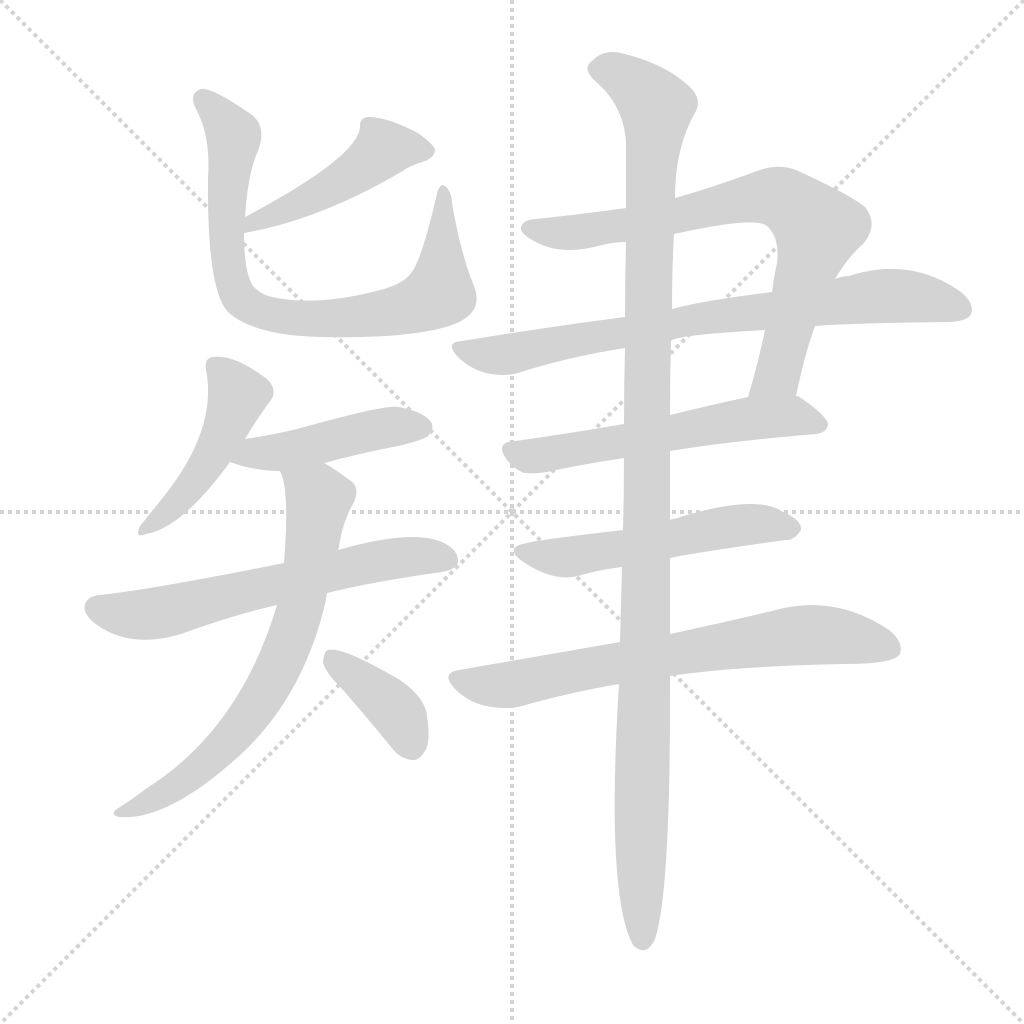
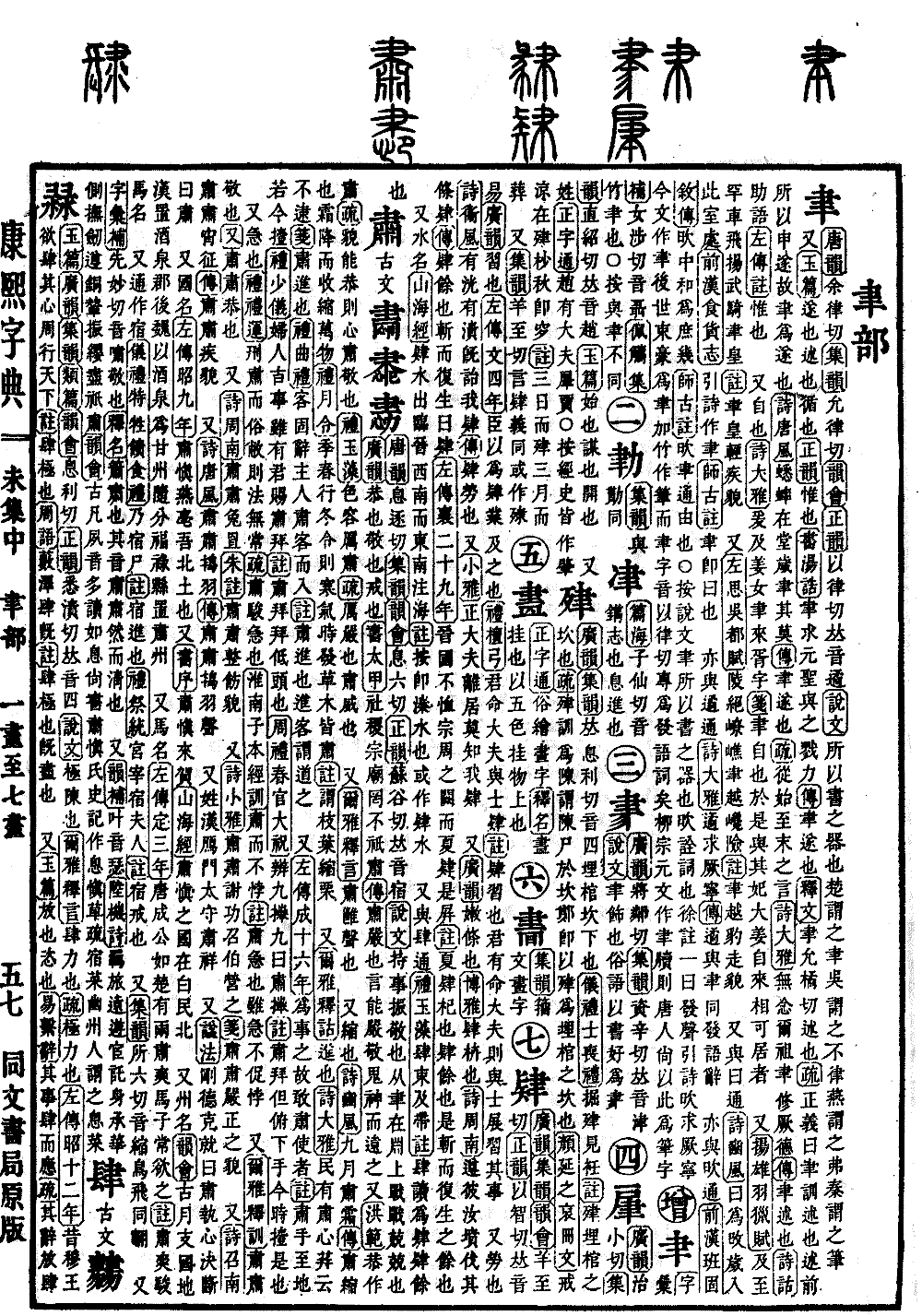
Wei Collection, Middle Volume. Radical: Writing Brush (yù). Kangxi strokes: 13. Page 971, Entry 10.
Pronounced yi (falling tone).
Broad Rimes (Guangyun), Collected Rimes (Jiyun), and Rime Compendium (Yunhui) state it is pronounced yi (falling tone); Correct Rimes (Zhengyun) states it is pronounced yi (falling tone).
Broad Rimes (Guangyun): To study or practice.
Zuo Tradition (Zuozhuan), Year 4 of Duke Wen: I, your subject, believe that practicing one's craft leads to this.
Book of Rites (Liji), Tan Gong: When the ruler gives a command, the grand officers and the scholars practice it. Commentary: The term signifies to practice. It means that when the ruler gives a command, the grand officers and scholars repeatedly practice that matter.
Also signifies labor or hardship.
Book of Odes (Shijing), Weifeng: With imposing presence and overflowing power, you have brought me hardship. Commentary: The term signifies labor or hardship.
Also in the Lesser Odes (Xiaoya): The senior officers are scattered and living apart; none know of my toil.
Broad Rimes (Guangyun): Refers to tender branches.
Expanded Glossary (Boya): The term signifies new shoots that grow after a tree is felled.
Book of Odes (Shijing), Zhounan: Along those banks of the Ru, they cut down the branches and shoots. Commentary: The term signifies the remaining parts. That which grows again after being cut is called yi.
Zuo Tradition (Zuozhuan), Year 29 of Duke Xiang: The State of Jin does not worry about the decline of the Zhou royal house, but instead protects the remnants of the Xia dynasty, the State of Qi. Commentary: The term Xia-yi refers to the State of Qi. It means the remainder, signifying that which grows again after being severed.
Also refers to the name of a river.
Classic of Mountains and Seas (Shanhaijing): The Yi River originates southwest of Linjin and flows southeast into the sea. Commentary: This is the Qin River. Sometimes written as Yi River.
Also interchangeable with the character si.
Book of Rites (Liji), Jade Pattern: In the passage regarding the binding of the sash, the character si is read as yi. It means the remainder.