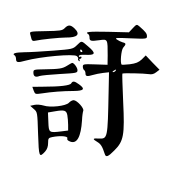
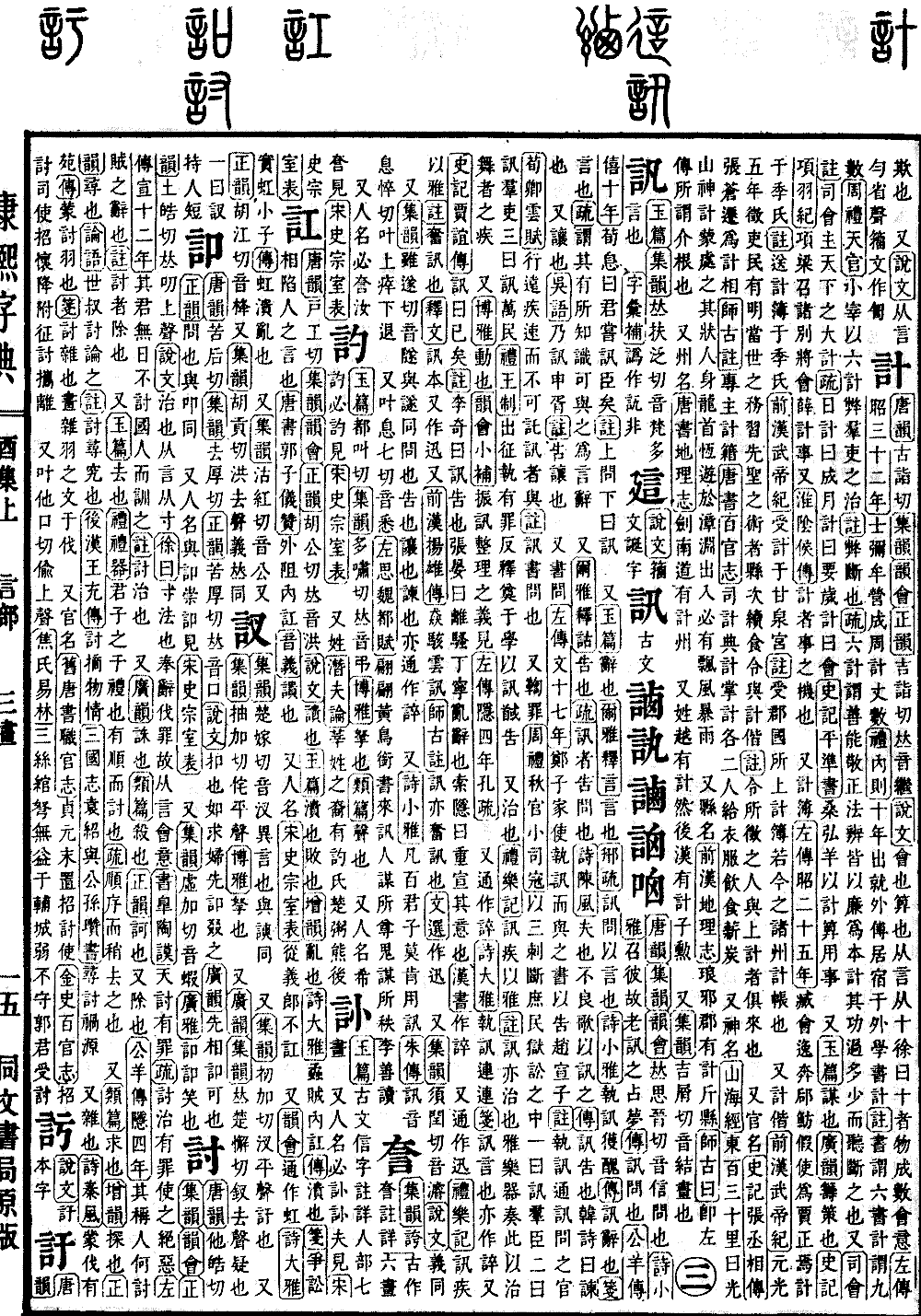
You Collection, Upper Volume
Radical: Speech (yán)
Kangxi Strokes: 10
Page 1147, Entry 18
Pronounced xu.
According to the Explaining Graphs and Analyzing Characters (Shuowen Jiezi), it means to deceive or use false speech. Another source states it is a term in the states of Qi and Chu for trust. Zheng comments that it means to boast.
According to the Erya (Erya: Explanation of Ancient Terms), it means great.
Book of Odes (Shijing): Great plans determine fate.
Yang Xiong’s Regional Dialects (Fangyan): Between the middle of Qi and the west of Chu, the word for great is xu.
Commentary: Xu is also written as yu.
Book of Odes (Shijing): The noble man travels along.
Commentary: It means great.
It is also interchangeably written as xu. See the note under the Eye (mù) radical for the character xu.
Pronounced hu.
According to the Guangya (Guangya), it means great.
According to the Yupian (Yupian), it means to open the mouth and cry out.
Book of Odes (Shijing): It is extended, it is great, its sound fills the road.
Commentary: It refers to opening the mouth to call out.
The Zheng commentary cites the Book of Etiquette and Ceremonial (Yili), stating that xu is pronounced hu, meaning to open the mouth and call out, with the sound being great.
Pronounced xu (rising tone).
According to the Leipian (Leipian), xu xu means great.
Book of Odes (Shijing): The rivers and marshes are vast and great.
Commentary: It means great.
Zhu Xi’s commentary notes the rhyme as xu.
The Explaining Graphs and Analyzing Characters (Shuowen Jiezi) notes that the original form of the character was xu, which was written with the component for yū.