Wei Collection, Upper Volume
Radical: Bamboo (zhú)
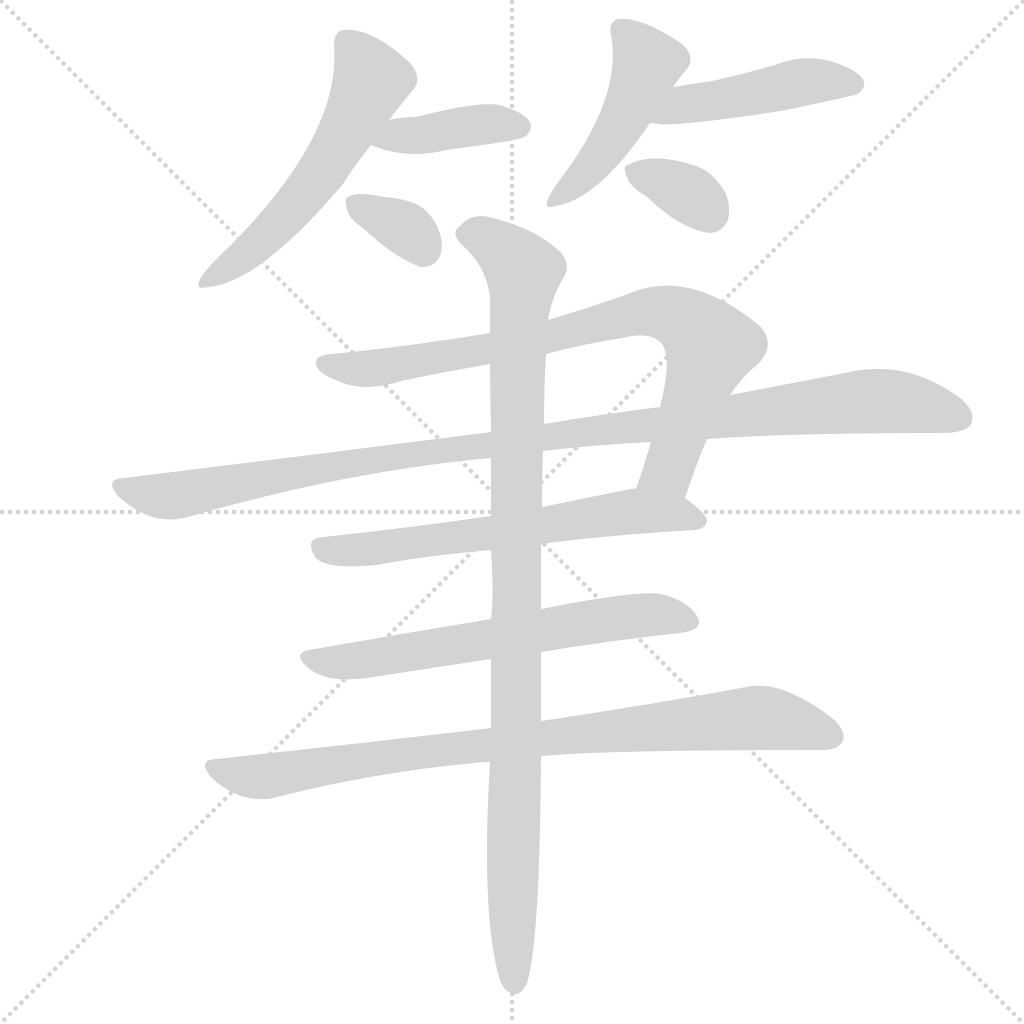
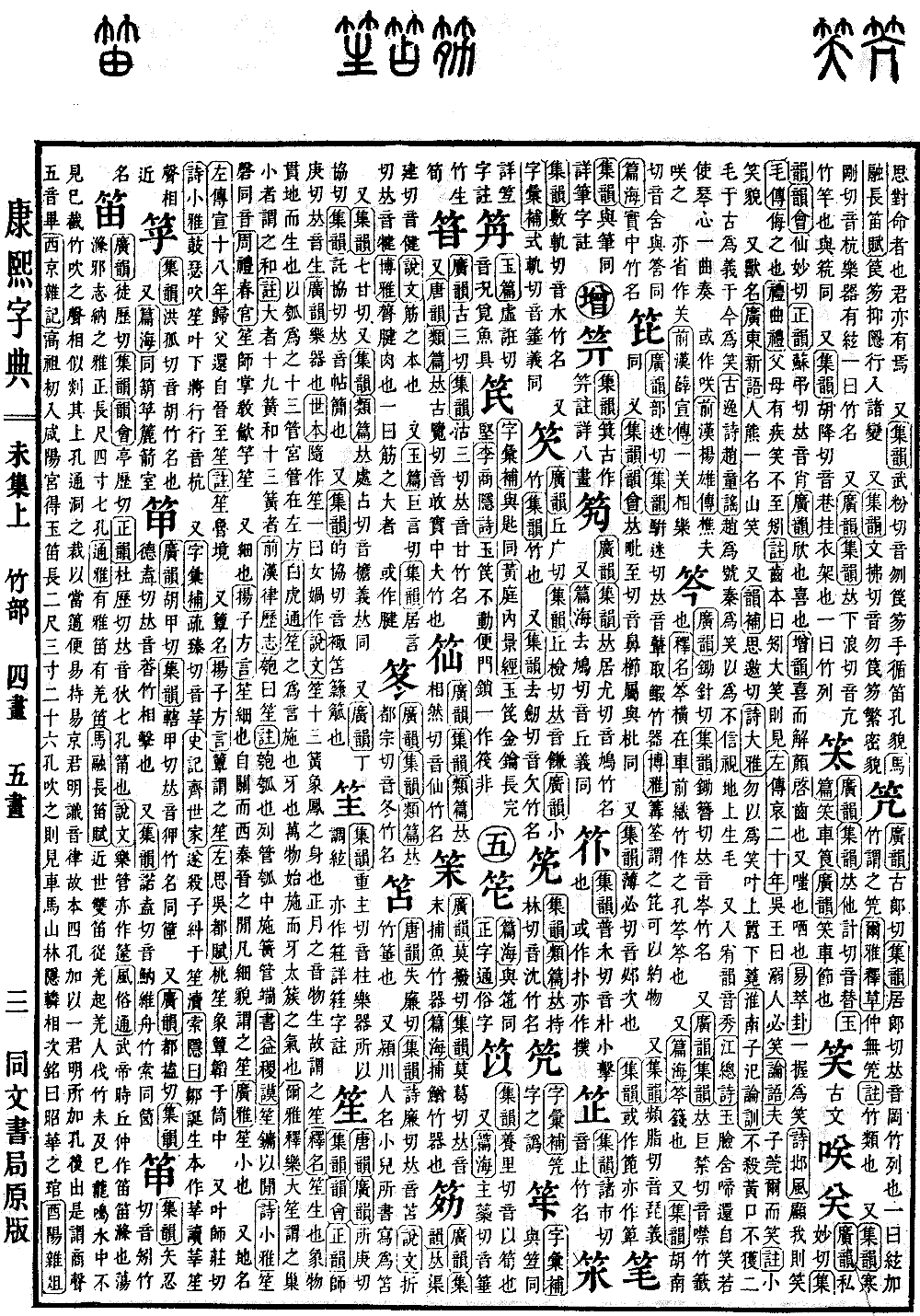
Brush; Kangxi stroke count: 12; Page 879
Pronounced bì.
Explanation of Names (Shiming): A brush is for recording. It is used to record events and write them down.
Classic of Rites (Erya), Interpretation of Vessels (Shiqi): That which is called bù lǜ is a brush.
Commentary: People in the Shu region call a brush bù lǜ.
Analytical Dictionary of Characters (Shuowen): In the Chu region, it is called yù; among the people of Wu, it is called bù lǜ; in the Yan region, it is called fú; and in the Qin state, it is called bǐ.
Records of Ancient and Modern Times (Gujin Zhu): In ancient times, a brush, whether made of bamboo or wood, was called a brush as long as it could be dipped in ink to write characters. When the Qin state annexed the six kingdoms, it eliminated the advantages of previous generations, which is why Meng Tian became famous during that era. Meng Tian made brushes, which are the Qin brushes. Using withered wood for the shaft, deer hair for the core, and sheep hair for the outer covering is what is known as cāng háo. A tóng guǎn is a brush painted with red lacquer, used by court historians for recording events.
Examination of Calligraphy (Fashu Kao): Yu Shinan said: A brush should not exceed six inches in length. Use one part of force for regular script, two parts for running script, and three parts for cursive script; the fingers should grasp it firmly while the palm remains hollow.
Book of Rites (Liji), Summary of Rites (Qu Li): The court historian carries a brush, and the scholar carries a record of his words.
Commentary: A brush refers to a category of writing implements.
Also refers to the Brush Star.
Explanation of Names (Shiming): The Brush Star is a nebula that forms a bundle with a sharp end resembling a brush.
Also a flower name.
Commentary on Songs of the South (Chu Ci): When the magnolia flower first opens, it resembles a brush; people in the north call it the wooden brush.
Also in the Collected Rhymes (Jiyun), pronounced bié. In the Shandong region, this is the term for a brush.
Also written in a variant form (yǐn). Found in the Han dynasty inscription for Qi Bo Fan Yi.
Also written as (bā yǐn), found in the Summary of Essentials (Juyao).
Collected Rhymes (Jiyun): Sometimes also written in a variant form.