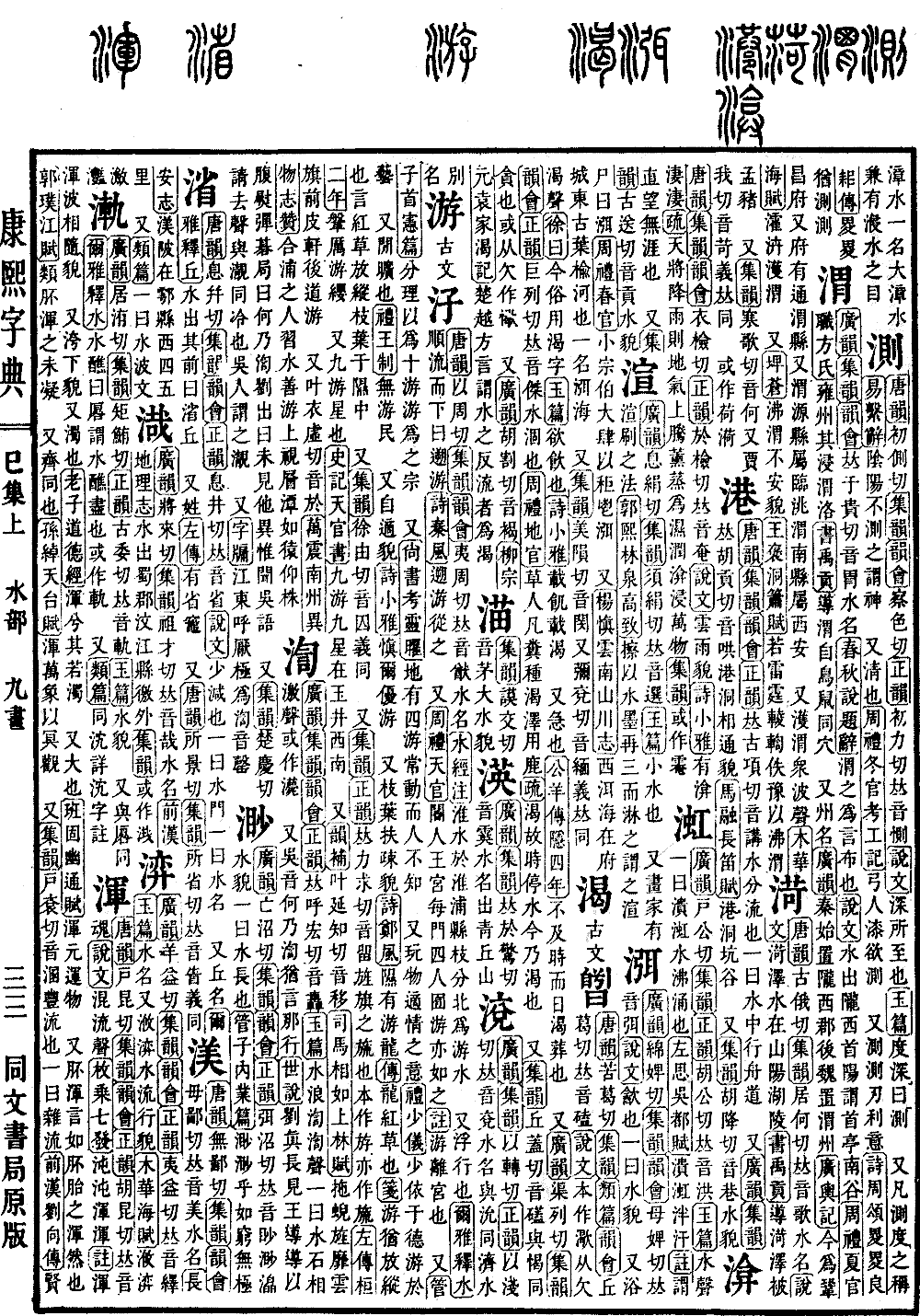
Si Collection, Upper Volume
Radical: Water (shuǐ)
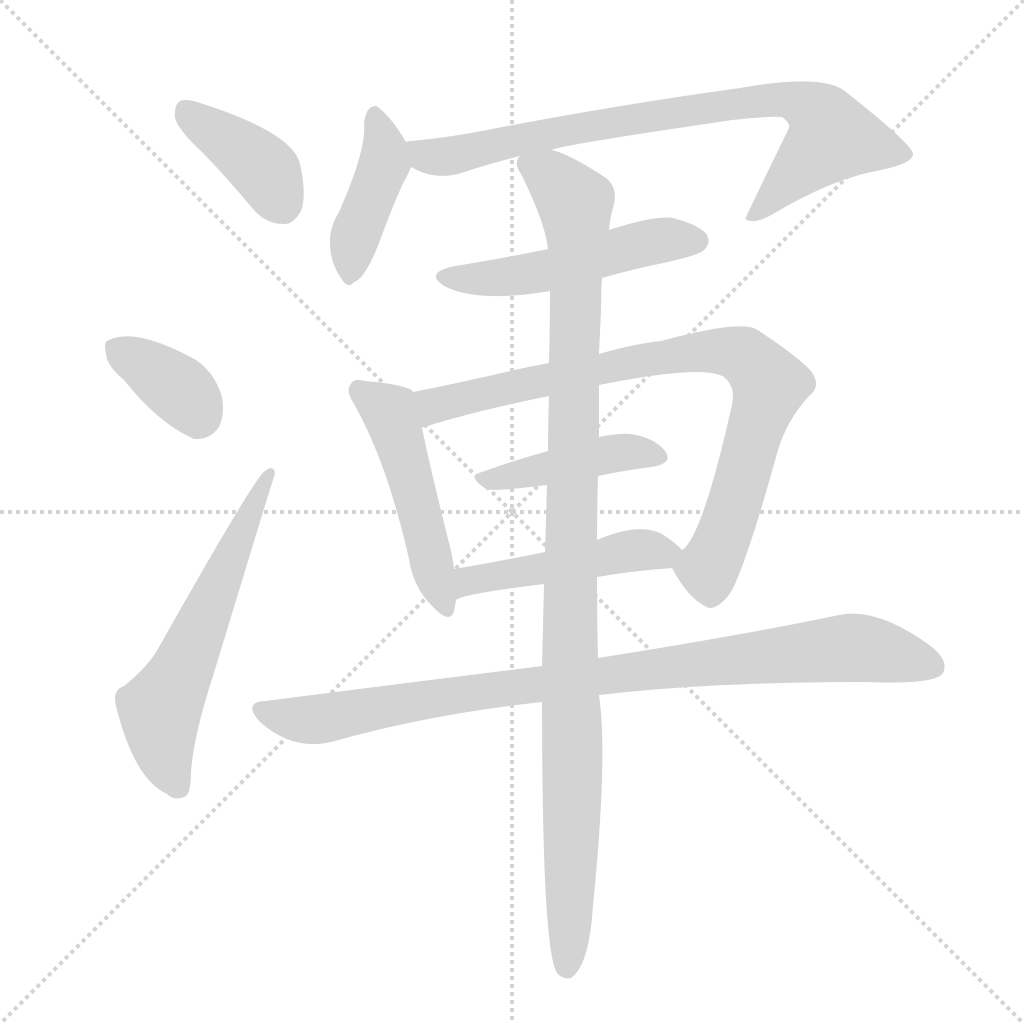
渾
Kangxi strokes: 13
Page 635, Entry 23
Pronounced hún
According to the Explaining Graphs and Analyzing Characters (Shuowen Jiezi), it refers to the sound of flowing water.
From Seven Stimuli (Qi Fa) by Mei Cheng: The surging, chaotic waters. Commentary: The appearance of waves following one another. It also refers to a low, stagnant appearance. It also means muddy.
From Classic of the Way and Virtue (Daodejing) by Laozi: Murky like the muddied water.
It also means great.
From Rhapsody on Obscure Communication (Youtong Fu) by Ban Gu: The great primal force moves all things.
It also refers to the embryonic state, meaning the wholeness of an embryo.
From Rhapsody on the Yangtze River (Jiang Fu) by Guo Pu: Like an embryo not yet congealed.
It also means to be uniform or identical.
From Rhapsody on Mount Tiantai (Tiantai Fu) by Sun Chuo: Blending the myriad phenomena into a single profound vision.
Pronounced hùn
It means flowing in abundance. Another meaning is mixed or chaotic flow.
From History of the Former Han (Qianhan Shu), Biography of Liu Xiang: The worthy and the unworthy are mixed and confused.
Pronounced hún
According to the Regional Speech (Fangyan) by Yang Xiong, it means flourishing or abundant. Commentary: Plump and full.
According to the Erya (Erya), it means to fall. Commentary: The appearance of water dropping.
It is a surname.
From Zuo Tradition (Zuo Zhuan): The Zheng state official Hun Han.
Pronounced gǔn
Equivalent to the character for surging or rolling. The appearance of a great river flowing.
From Xunzi, Chapter on Enriching the State (Fuguo Pian): Wealth and goods flow in abundance like a fountainhead.