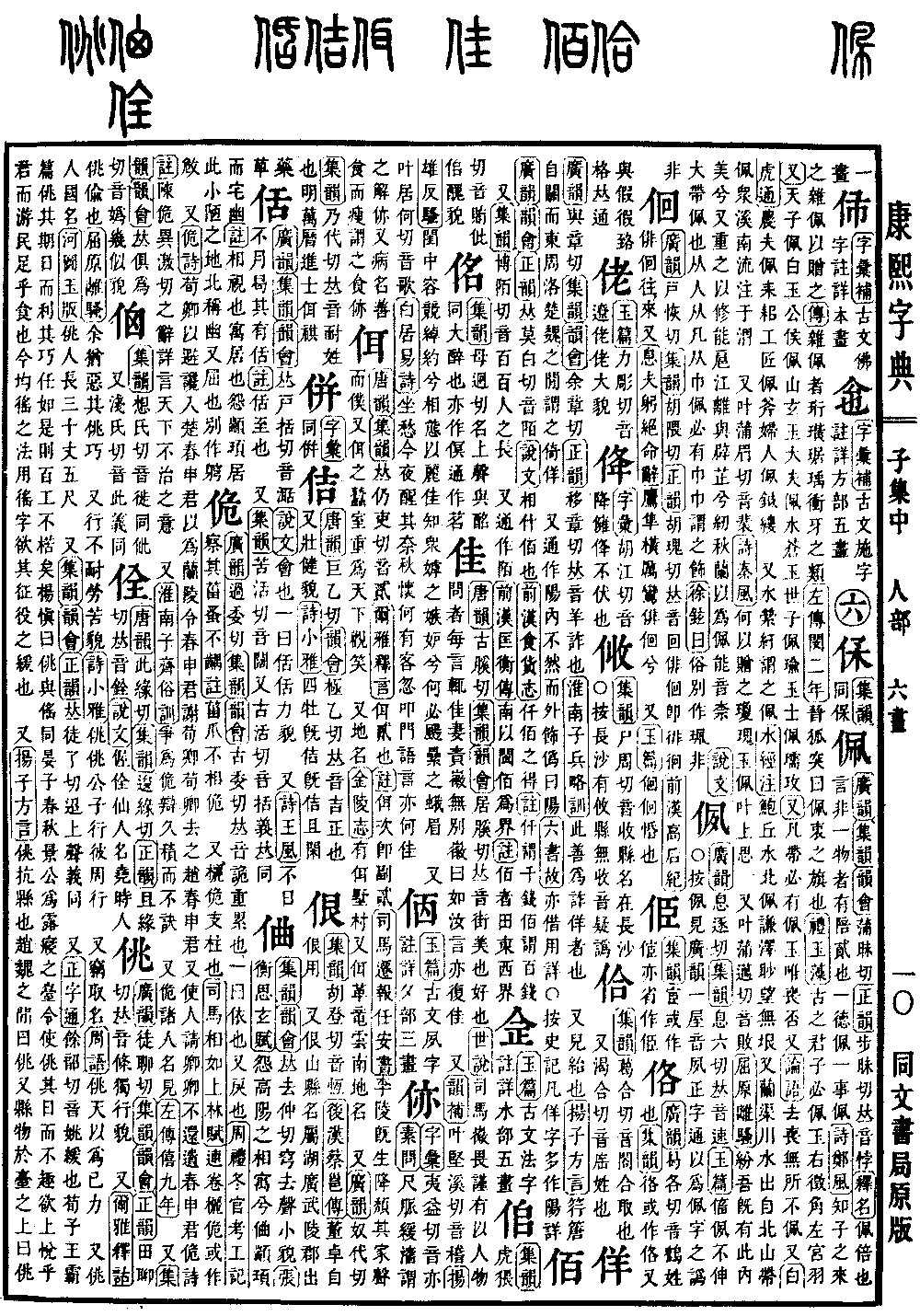
Zi Collection, Middle Volume. Radical: Person (rén). 8 Kangxi strokes. Page 100, Position 13. According to the Extensive Rhymes (Guangyun), the Collected Rhymes (Jiyun), the Rhyme Assemblage (Yunhui), and the Correct Rhymes (Zhengyun), the pronunciation uses various fanqie spellings all resulting in a sound identical to yang. The meaning is to deceive or to feign. This refers to one who is skilled in the methods of deceit and feigning — Master of Huainan (Huainanzi). It also refers to children deceiving. According to the Dialects (Fangyan) by Yangzi, for the term hangtang, the regions east of Hangu Pass, including the old Zhou capital of Luoyang and the states of Chu and Wei, use the term yiyang. It is also used interchangeably with the character yang. When the internal heart is not in agreement, but the external appearance is a false pretense, it is called yang. According to the Explanations of the Six Scripts (Liushugu), it also borrows the character xiang. Note that in the Records of the Grand Historian (Shiji), instances of the character yang are mostly written as yang or xiang.