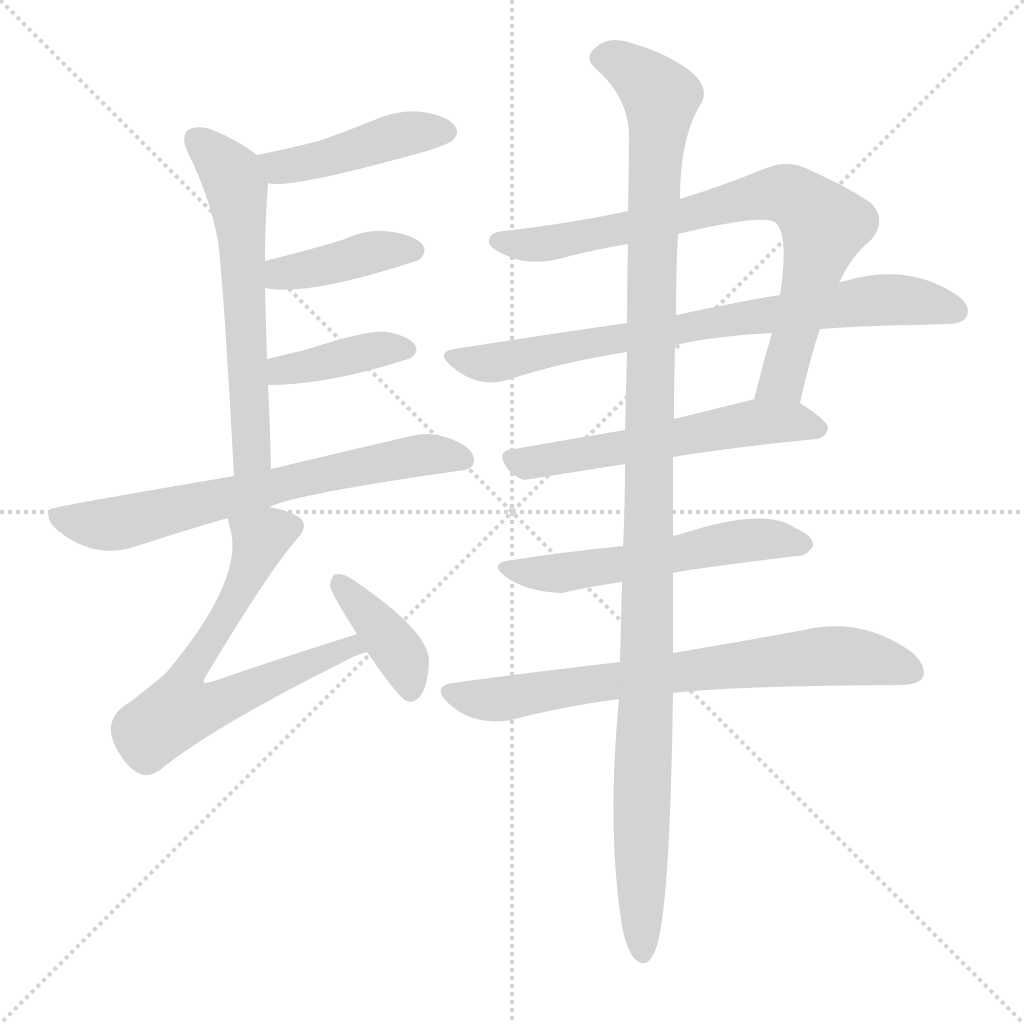
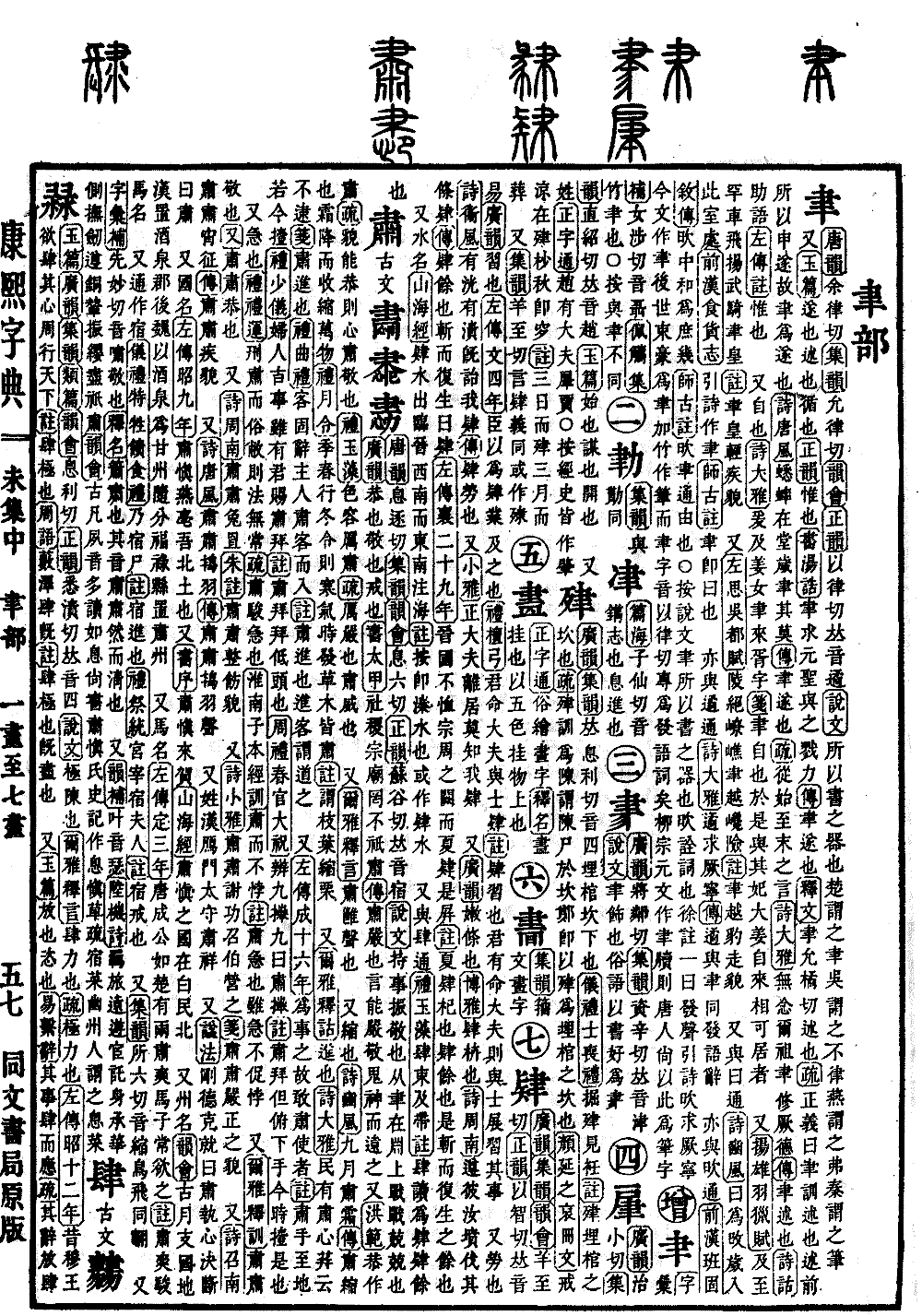
Wei Collection, Lower Volume. Radical: Brush (yù). Page 971, Entry 15.
According to Jade Record (Yupian), Extensive Rhymes (Guangyun), Collected Rhymes (Jiyun), Classified Dictionary (Leipian), and Rhyme Assembly (Yunhui), the pronunciation is si (falling tone); according to Correct Rhymes (Zhengyun), the pronunciation is si (falling tone).
According to Explanation of Writing (Shuowen), it means to display fully. According to Record of Progressive Words (Erya, Shiyan), it means strength. The commentary explains it as utilizing full strength. In Zuo Tradition (Zuozhuan), Year 12 of Duke Zhao: Formerly, King Mu wished to exert his heart and travel the world. The commentary explains it as to reach the limit. In Discourses of Zhou (Zhouyu): The marshes and lakes are fully utilized. The commentary explains it as to reach the limit; fully means to exhaust.
Also according to Jade Record (Yupian), it means to release or to be unrestrained. In Book of Changes (Yijing), Appendix: Its matters are unrestrained yet hidden. The commentary explains that the wording is unrestrained and overt, while the discussed principles are deep and hidden. In Zuo Tradition (Zuozhuan), Year 32 of Duke Zhao: If my uncle were to release great kindness, restore the industry of the two previous kings, and relax the worries of the Zhou house. The commentary explains that to release means to unfold. In Record of Rites (Liji), Table Records: The noble man is solemn and respectful, growing stronger day by day, while being lazy and unrestrained leads to decay day by day. The commentary explains that being unrestrained is like being self-indulgent.
It also means to follow or to proceed. In Book of Documents (Shujing), Canon of Shun: Then perform sacrifices to the Almighty God. The commentary explains it as to proceed.
It also means order or sequence. In Book of Odes (Shijing), Minor Odes: Like the Weaver Maid, who drives her carriage all day long. The sub-commentary explains that to drive means to change one's position. There are twelve positions in the heavens where the sun and moon reside. These places are called stations. On Earth, they are called earthly branches; each branch is a station. Thus, they pass through seven stations.
It also means to arrange or display. In Book of Documents (Shujing), Pledge of Mu: They recklessly abandon their arranged sacrifices and do not respond. The commentary explains that to be reckless is to be chaotic, and that to arrange means to display. In Book of Odes (Shijing), Greater Odes: Spread the mats and set the seats. The commentary explains that to arrange signifies the intent to display.
Also according to Record of Past and Present (Gujin Zhu), it is a place for displaying goods for sale. In Rites of Zhou (Zhouli), Earth Officers, Market Master: Manage the arrangement of market stalls to distinguish goods and equalize market prices. The commentary explains that these are places where items are displayed. In History of the Former Han (Qian Hanshu), Treatises on Law: Open market stalls to facilitate trade. The commentary of Yan Shigu says it means a row or array.
Also, according to Rhyme Assembly (Yunhui), to expose a corpse is called si. In Record of Rites (Liji), Monthly Ordinances: In the month of mid-spring, order the officials to inspect the prisons, remove shackles, and do not expose or abuse the bodies. The commentary explains this as leaving a corpse exposed. In Rites of Zhou (Zhouli), Autumn Officers, Warden of Prisoners: Whoever kills a person shall have the body exposed in the market for three days.
Also, according to Record of Progressive Words (Erya), it means formerly. The sub-commentary explains that this serves as an introductory or transitional word. It also means now. The commentary notes that since it means both formerly and now, these contradictory meanings are simultaneously understood. In Book of Documents (Shujing), Counsels of Great Yu: Therefore I, with you many officers, receive the mandate to punish the crimes. The commentary explains it as formerly. In Book of Odes (Shijing), Greater Odes: Therefore one does not put an end to this anger, nor does one discard these questions. The commentary explains it as formerly and now.
Also, according to Extensive Dictionary of Progressive Words (Boya), it means to extend. In Zuo Tradition (Zuozhuan), Year 30 of Duke Xi: Having already established the eastern borders of Zheng, he again wished to extend his western borders. The commentary explains it as to stretch.
Also, according to Small Record of Progressive Words (Xiao Erya), it means surplus.
Also, it means to be lenient. In Book of Documents (Shujing), Canon of Shun: In cases of inadvertent disaster, pardon with leniency. The commentary explains it as to be lenient; when a fault occurs, one should be slow to punish. In Zuo Tradition (Zuozhuan), Year 22 of Duke Zhuang: Leniency in great calamities. The sub-commentary explains it as to be lenient. According to the commentary of Gongyang Tradition, it means to stumble or to exceed. According to Guliang Tradition, it means to lose. The three commentaries differ in their interpretations.
Also, according to Jade Record (Yupian), it means to measure.
Also, it means great. In Book of Documents (Shujing), Timber of the Catalpa: Extending its boundaries to the path of the former kings, it becomes great. The commentary explains that if one can expand boundaries, one succeeds in the path of the former kings.
Also, it means long. In Book of Odes (Shijing), Greater Odes: Its poems are very substantial, and its customs are long and good. The commentary explains it as long.
Also, it means to abandon. In Yang Xiong, Rhapsody on the Long Yang: Therefore, one does not abandon safety for danger. The commentary by Fu Qian says it means to abandon.
Also, according to Small Record of Progressive Words (Xiao Erya), it means to collide. In Book of Odes (Shijing), Greater Odes: They attack and they collide. The commentary explains it as to be swift. The sub-commentary notes it means to invade and collide, suggesting a sudden attack. In Zuo Tradition (Zuozhuan), Year 12 of Duke Wen: If light troops are sent to collide, it is acceptable. The commentary explains it as attacking briefly and then retreating.
Also, in Rites of Zhou (Zhouli), Spring Officers, Minor Arranger: For hanging bells and stone chimes, a half set is a duo, a full set is a si. The commentary explains that a set consists of twenty-six pieces on one stand, called a duo. One duo of bells and one duo of chimes together is called a si. In Zuo Tradition (Zuozhuan), Year 11 of Duke Xiang: Two sets of singing bells. The commentary explains it as an arrangement. Sixteen hanging bells make one set; two sets make thirty-six pieces.
Also, an official title. In Rites of Zhou (Zhouli), Earth Officers: The Chief of the Market manages the regulations of the market.
Also, a surname. According to Records of Names by He (He Shi Xing Yuan), there was a Grand Administrator of Yuyang named Si Min.
Also, the name of a sacrifice. In Records of the Grand Historian (Shiji), Annals of Zhou: The sacrifices are not responded to.
Also, according to Collected Rhymes (Jiyun), pronounced si (rising tone). It means to release.
Also, according to Rhyme Assembly (Yunhui), pronounced yi (falling tone). It is identical to the character meaning to practice. According to Five Sounds Collected Rhymes (Wuyin Jiyun), it means practice or a tender shoot. In Record of Rites (Liji), Jade Pattern: If a busy person has a matter, they bundle it; if they are running, they carry it. The commentary suggests reading it as practice, meaning surplus. The Explication of Text says the sound is yi.
Also, pronounced gai (falling tone). In Record of Rites (Liji), Vessels of Propriety: When it comes out, it is accompanied by the Gai Xia music, which is a significant ritual. The commentary states that Gai Xia should be written as Gai Xia. The Explication of Text says it is written as Gai, pronounced gai.
Also, according to Collected Rhymes (Jiyun), pronounced ti (entering tone). It means to carve. In Record of Rites (Liji), Suburban Sacrifice: The raw, the carved, and the cooked are used for sacrifices. The commentary explains that dressing meat is called si. The sub-commentary says it means to slice. The Explication of Text says the sound is ti. In Rites of Zhou (Zhouli), Earth Officers, Grand Marshall: When sacrificing to the five emperors, present the ox as a sacrifice, and offer its sliced meat. The commentary by Zheng Xuan says si means to arrange the bones and body. The Record of Scholar Funerals states that si means to dismember and remove the hooves. The sub-commentary by Jia states that to offer means to present, and si means to dismember, referring to the presentation of dismembered animal parts on a sacrificial tray before the spirit seat.