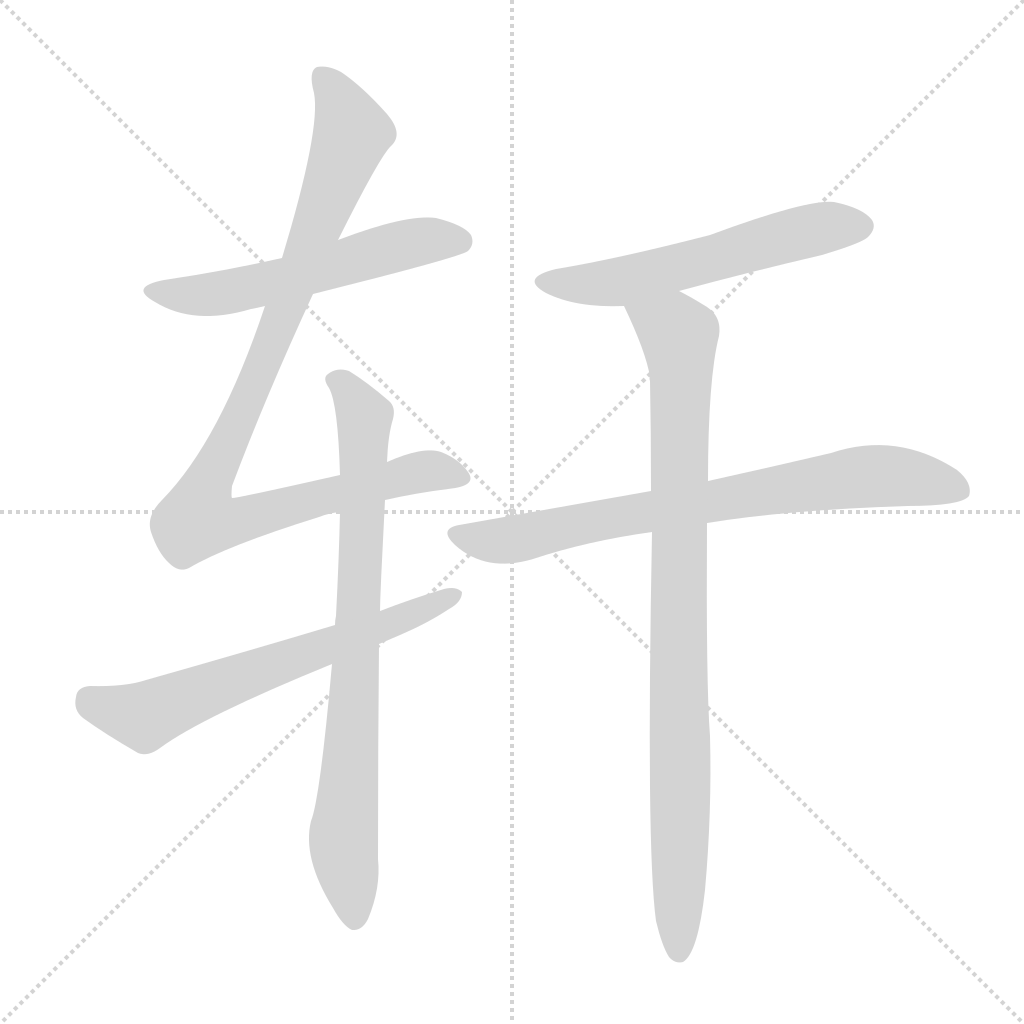
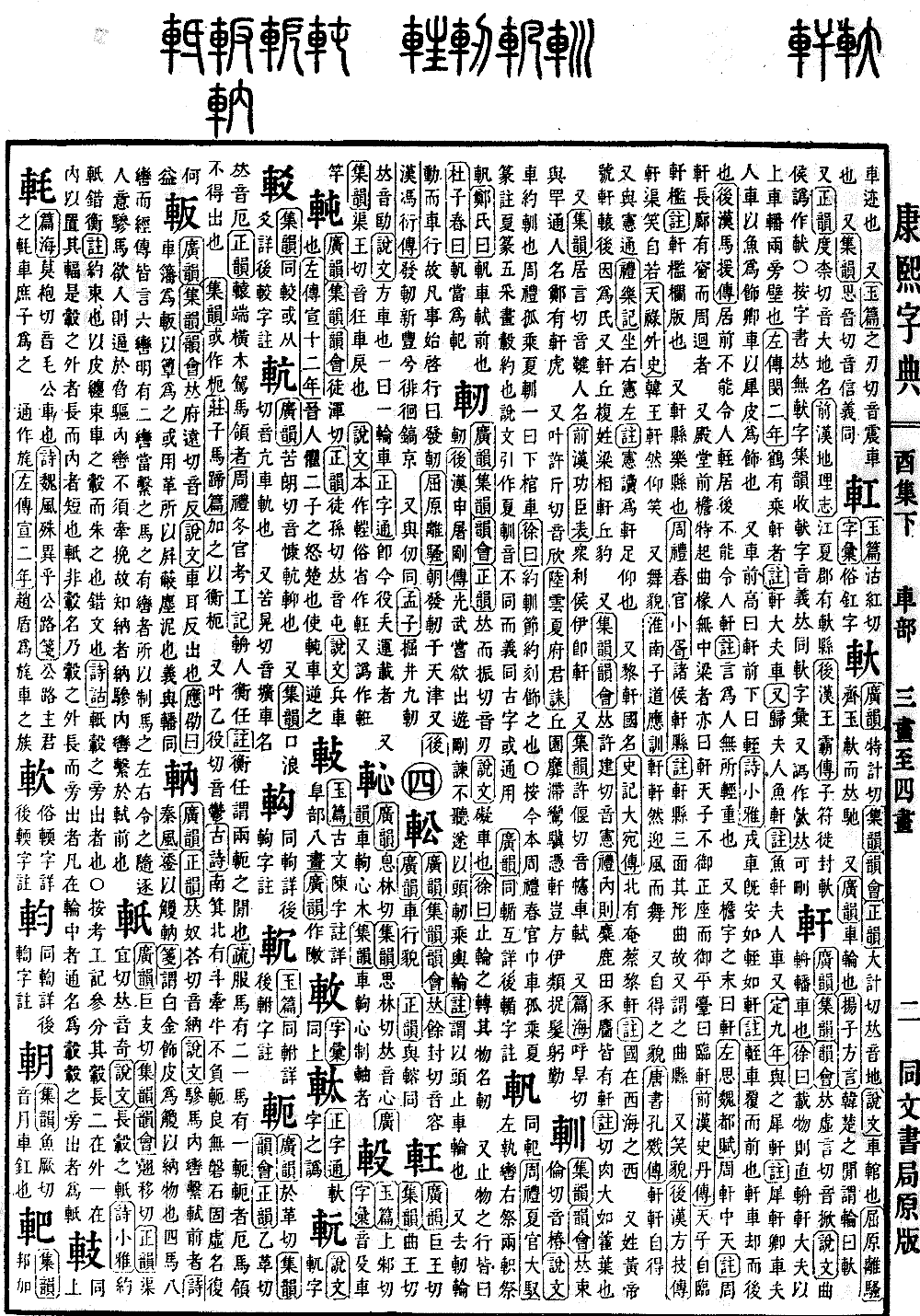
You Collection, Lower Volume
Radical: Carriage (chē)
Kangxi Strokes: 10
Page 1240, Entry 01
Pronounced xian.
Shuowen Jiezi (Shuowen): A carriage with a curved pole and side curtains. Xu states: When carrying goods, the pole is straight. A xuan is a carriage for a grand master or higher rank. The fan is the screen on the side.
Zuo Zhuan (Zuo Zhuan), Second Year of Duke Min: Cranes were given carriage rides. Commentary: Xuan is a carriage for a grand master. Also: Returned the lady's fish-adorned xuan. Commentary: A fish-adorned xuan is a carriage for a lady of rank. Also: In the ninth year of Duke Ding: Gave him a rhinoceros-adorned xuan. Commentary: A rhinoceros-adorned xuan is a carriage for a minister. A lady's carriage is decorated with fish, while a minister's carriage is decorated with rhinoceros hide.
Also, the front of a carriage being high is called xuan, and being low is called zhi. Book of Odes (Shijing), Xiao Ya: The war carriages are secure, sometimes low, sometimes high. Commentary: Zhi means the carriage tilts forward; xuan means the carriage tilts backward. Book of the Later Han (Hou Hanshu), Biography of Ma Yuan: Occupying a forward position does not make others feel low, and occupying a rear position does not make others feel high. Commentary: This means one has no influence or weight in the eyes of others.
Also, the edge of an eave is called xuan. Zuo Si, Rhapsody on the Capital of Wei (Wei Du Fu): The long galleries reach the middle of the sky. Commentary: A zhou xuan is a long gallery with windows that circles around. Also, the curved rafters on the front eaves of a palace or hall that do not have a central beam are also called xuan. When the Emperor does not sit on the main throne but attends at the terrace, it is called lin xuan. Book of the Former Han (Qian Hanshu), Biography of Shi Dan: The Emperor personally approached the xuan railing. Commentary: Xuan-jian refers to the railing boards.
Also, xuan-xian refers to musical instrument arrangements. Rites of Zhou (Zhouli), Spring Officials: The feudal lords use the xuan-xian arrangement. Commentary: The xuan-xian arrangement is on three sides; its shape is curved, so it is also called the qu-xian (curved arrangement).
Also, the appearance of laughing. Book of the Later Han (Hou Hanshu), Biographies of Masters of Esoteric Arts: Laughed heartily and remained composed. Tianlu Waishi: King Han threw his head back and laughed.
Also, the appearance of dancing. Huainanzi, Dao Ying Xun: Dancing and swaying in the wind.
Also, the appearance of self-satisfaction. Book of Tang (Tangshu), Biography of Kong Kui: Pleased and self-satisfied.
Also, interchangeable with xian. Record of Music (Yueji): Reach out the right, lift the left. Commentary: Xian is read as xuan, meaning to lift the foot.
Also, Lixuan, a country name. Records of the Grand Historian (Shiji), Account of Dayuan: To the north are Yancai and Lixuan. Commentary: The country is located west of the Western Sea.
Also, a surname. The Yellow Emperor was named Xuanyuan, which later became a clan name.
Also, Xuanqiu, a compound surname. Xuanqiu Bao was a minister in the state of Liang.
Pronounced xian.
Rites (Liji), Inner Chapters: For elk, deer, wild pig, and muntjac, all have xuan. Commentary: The meat is sliced as large as bean leaves.
Pronounced jian. A personal name. Book of the Former Han (Qian Hanshu), Table of Meritorious Officials: The Marquis of Zhongli, Yiji Xuan.
Pronounced xian. The crossbar on the front of a carriage.
Pronounced han. A personal name. There was a Xuan Hu in the state of Zheng.
Pronounced xin. From Lu Yun, Eulogy for Summer Prefect Jun: The garden remains still, while the luan and ji birds lean on the xuan. How could they compare to his kind, who grasped his hair and worked diligently?