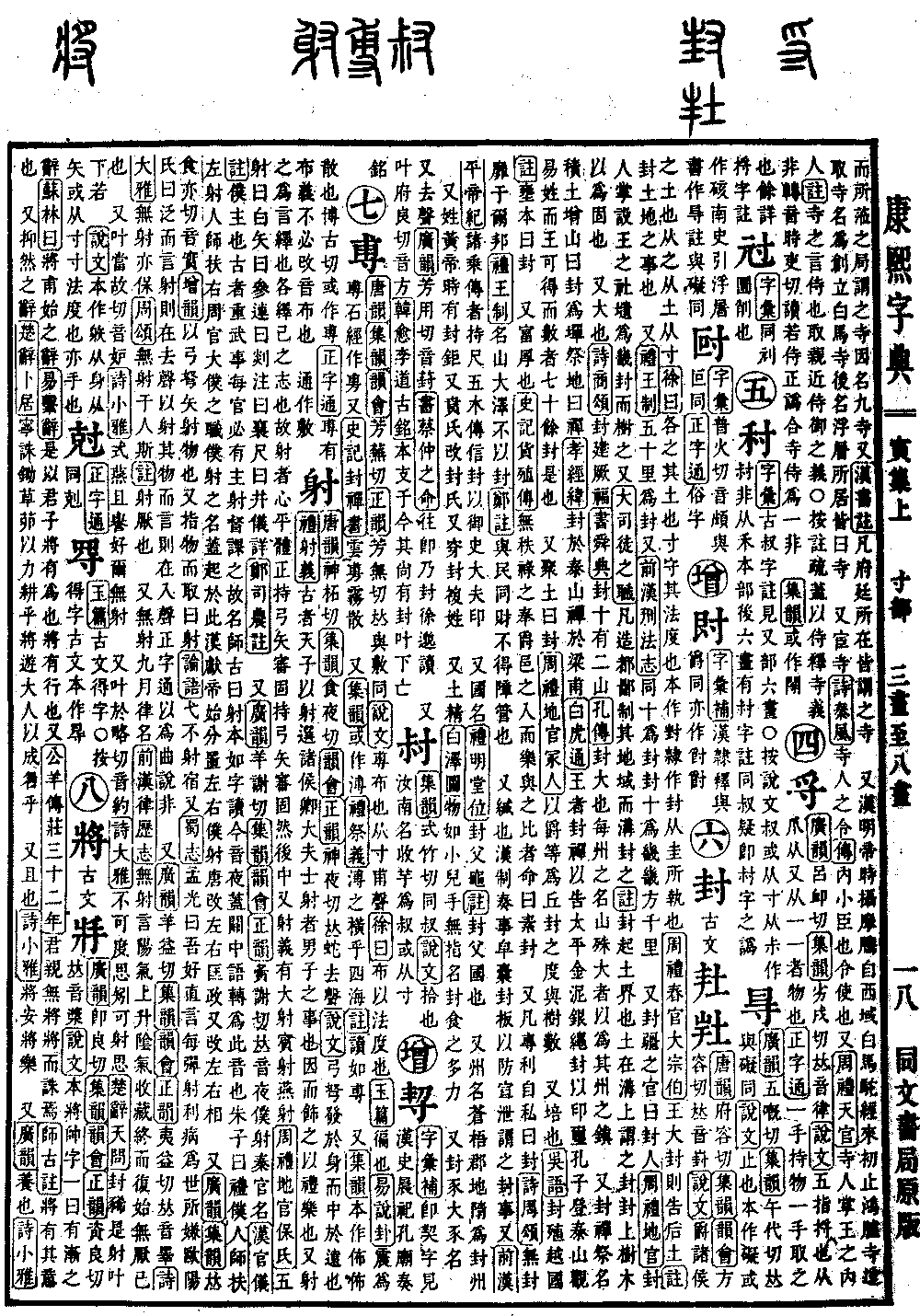
Yin Collection, Upper Volume
Radical: Inch (cùn)
Page 294, Entry 07
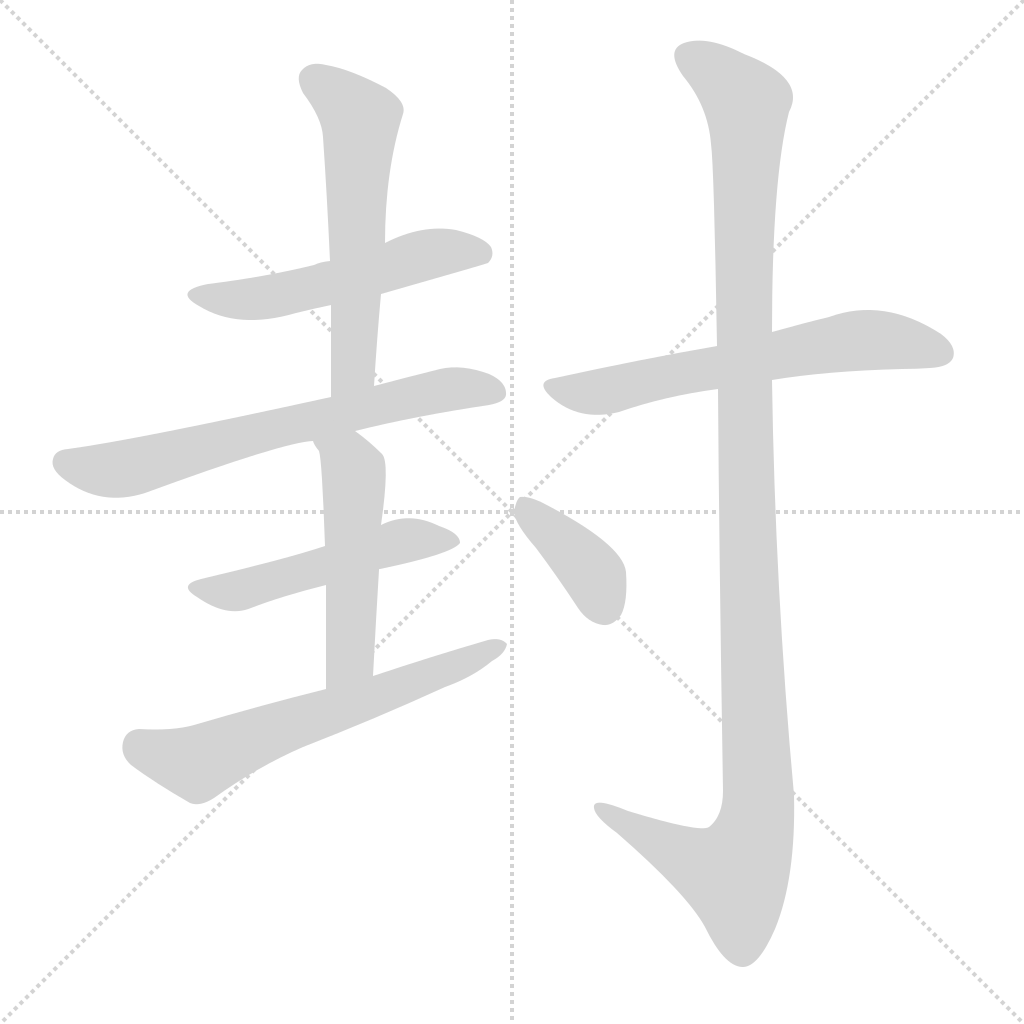
Ancient character. According to Tangyun, pronounced feng. According to Jiyun and Yunhui, pronounced feng. Pronounced feng. According to Shuo Wen, it means to grant titles and land to feudal lords. The character structure consists of "go," "earth," and "inch." Xu says it means each possesses their own land, and "inch" represents the observance of laws. Originally written in a certain form, later written in clerical script as feng, with the character shape derived from the jade tablets held by feudal lords.
Book of Rites (Zhouli), Spring Office, Great Grand Master: When the Son of Heaven performs a great ennoblement, he offers sacrifices to the deity of the earth. Commentary: Feng refers to the matter of enfeoffing land.
Also, Da Dai Liji: Fifty li constitutes a feng territory.
Also, History of the Former Han (Qian Han Shu), Treatise on Law: Ten tong (areas) constitute one feng, ten feng constitute one ji, and one ji is a thousand li square.
Also, officials who manage boundaries are called feng people. Book of Rites (Zhouli), Earth Office: The feng person is in charge of establishing the altars for the Son of Heaven, digging ditches and piling earth at the borders of the ji, and planting trees as markers.
Also, Duties of the Great Minister of Instruction: Whenever constructing cities or border towns and delineating their territories, one must dig ditches and pile earth to serve as boundaries. Commentary: Feng means piling earth to serve as a boundary line. The pile of earth on the ditch is called feng, and trees are planted on the heaped earth to reinforce it.
Also denotes greatness. Book of Odes (Shijing), Eulogies of Shang: Making their blessings vast and great. Book of Documents (Shujing), Canon of Shun: Performed the feng sacrifice for the twelve mountains. Kong's Commentary: Feng means to revere and enlarge. Every famous mountain that is especially tall within a province serves as the guardian mountain of that province.
Also fengshan, the name of a sacrifice. Piling earth to increase the height of a mountain is called feng; leveling the earth to sacrifice to the earth deity is called shan. Xiaojing Wei: Build an altar on Mount Tai to sacrifice to Heaven, and clear a site on Mount Liangfu to sacrifice to Earth. Baihu Tong: Emperors perform the fengshan ceremony to report peace to Heaven. They use gold mud and silver cords to tie up jade tablets, which are then sealed with an imperial seal. Confucius climbed Mount Tai and examined the records of dynasties that had changed; there were over seventy kings who had performed the fengshan sacrifice.
Also, gathering earth into a mound is called feng. Book of Rites (Zhouli), Earth Office, Tomb Master: According to rank, regulations specify the height of burial mounds and the amount of earth to be piled, as well as the number of trees to be planted.
Also refers to mounding soil. Wu Yue Chunqiu (Wuyu): Supporting the State of Yue. Commentary: Adding soil to the roots of a plant is called feng.
Also refers to being wealthy and abundant. Records of the Grand Historian (Shiji), Biographies of Money-makers: Those who have no government salary or income from enfeoffed fiefs, yet whose enjoyment of life can be compared to such, are called sufeng (unennobled wealthy individuals).
Also, any act of monopolizing profits or taking for one's own is called feng. Book of Odes (Shijing), Eulogies of Zhou: Do not be greedy and monopolize profits in your state. Book of Rites (Liji), Royal Regulations: Famous mountains and great marshes are not to be granted as private property. Zheng's Commentary: These resources are shared with the people and must not be obstructed or monopolized.
Also refers to sealing or closing. In the Han dynasty system, memorials were encased in black bags to prevent leaks; these were called fengshi (sealed matters).
Also, History of the Former Han (Qian Han Shu), Annals of Emperor Ping: Whoever travels by postal relay must carry a one-foot-five-inch wooden travel permit, sealed with the seal of the Censor-in-Chief.
Also, the name of a state. Book of Rites (Liji), Mingtang Wei: The turtle produced by the State of Fengfu. Commentary: Fengfu is a state name.
Also, the name of a prefecture. In the Sui dynasty, the area of Cangwu Commandery was established as Feng Prefecture.
Also, a surname. There was Feng Ju in the time of the Yellow Emperor. There is also the Ben family changing to the Feng surname. There is also the Chuanfeng family, which is a double-surname.
Also refers to an earth sprite. Baize Tu: A monster that looks like a child's hand, without fingers, named feng. Eating it increases one's strength.
Also, fengshu, the name of a large pig.
Also read in the departing tone (falling tone). According to Guangyun, pronounced feng. Book of Documents (Shujing), Charge to Cai Zhong: Go to your enfeoffed state to assume office. Xu Miao read it this way.
Also, as a rhyming word, read fang. Han Yu, Inscription for Li Daogu: The branches of the ancestral line continue to this day, and there will likely be more who receive enfeoffment. It rhymes with the word wang in the following sentence.
The character feng is written with the component for "inch."
Textual research: Book of Rites (Liji), Royal Regulations: Fifty li is one feng. Note: The text in the Royal Regulations does not contain this passage; investigation confirms it is from the Da Dai Liji, Wang Yan chapter. Based on this, it is corrected to Da Dai Liji: fifty li is one feng.