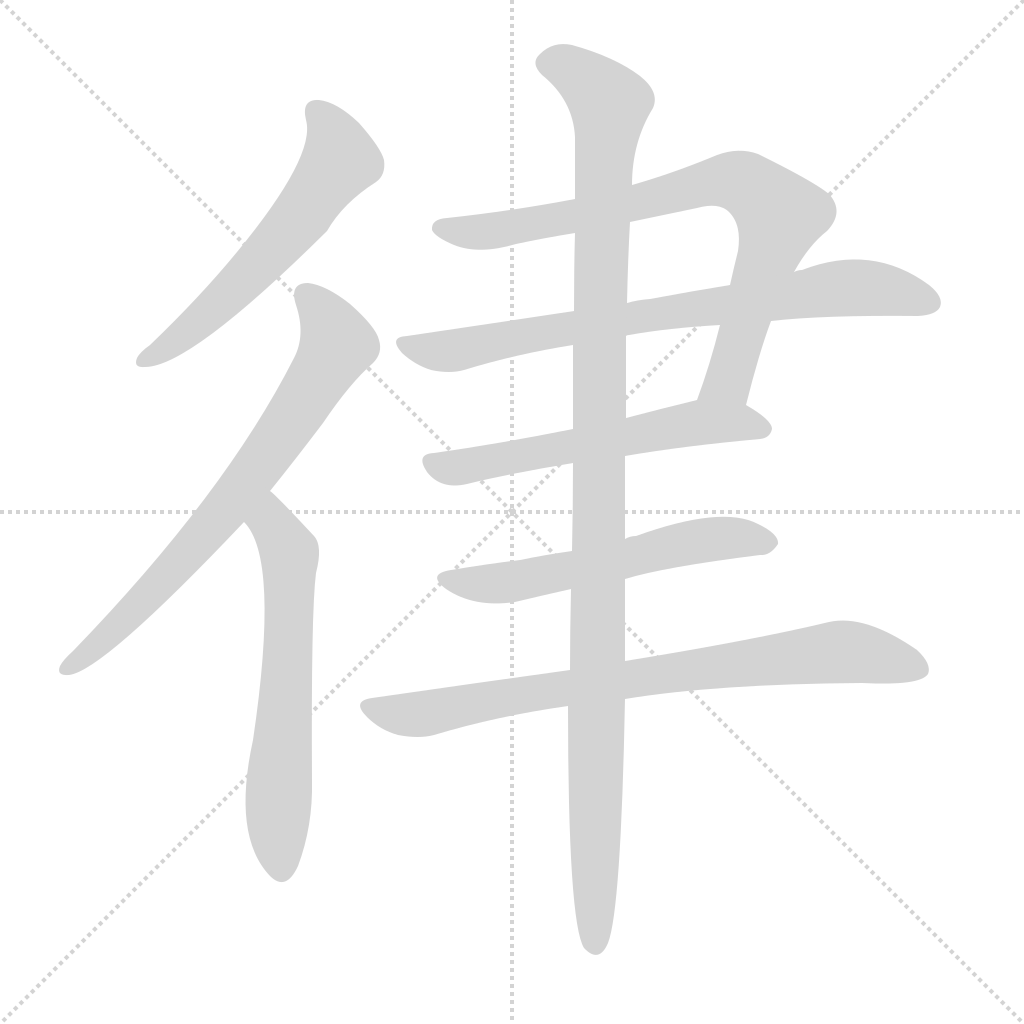
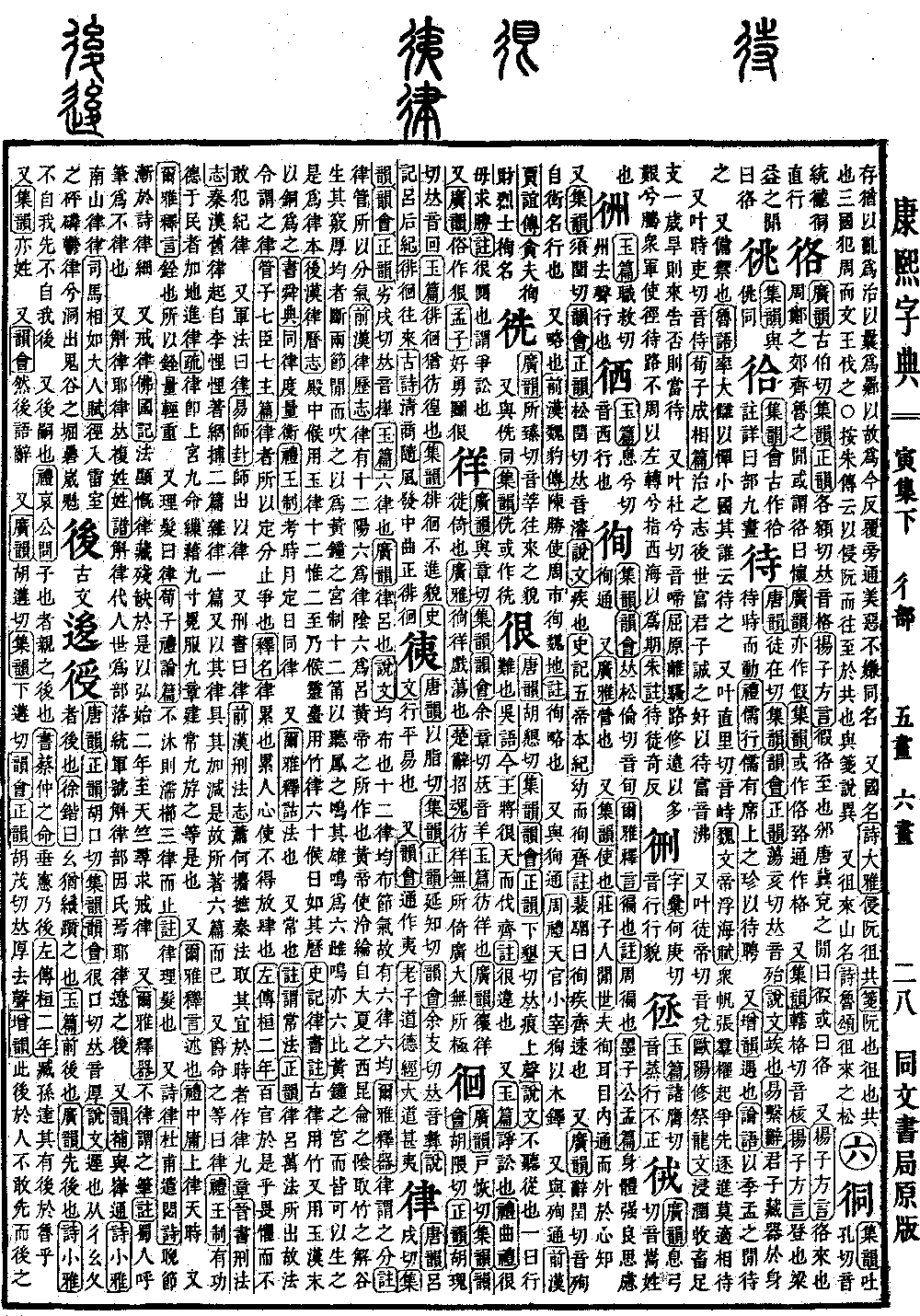
Yin Collection, Lower Volume
Radical: Step (chì)
Page 366, Entry 17
Pronounced lü (falling tone)
Jade Chapters (Yupian): The six pitch pipes.
Broad Rhymes (Guangyun): Pitch pipes and resonance tubes (lü lü).
Analytical Dictionary of Characters (Shuowen): Even distribution. The twelve pitch pipes are evenly distributed according to the solar terms; hence, there are six pitch pipes and six standard measures.
Approaching Elegance (Erya), Explanation of Vessels: A pitch pipe is called a fen. Commentary: The pitch pipe tube is used to determine the solar terms.
History of the Former Han (Qianhan), Treatise on Pitch Pipes and Calendrics: There are twelve types of pitch pipes; the six yang tones are the lü, and the six yin tones are the lü, which were created by the Yellow Emperor. The Yellow Emperor sent Ling Lun to the west of Daxia and the north of Mount Kunlun to select bamboo growing in Xie Valley that had uniform node thickness and internal spacing. He cut a section between two nodes to blow into, using it as the foundational pitch for the Huangzhong (Yellow Bell) note, and crafted twelve bamboo tubes to listen to the cries of the phoenix. The male bird has six calls and the female bird has six calls, which, when compared to the Huangzhong, all produce corresponding tones; this is the root of the pitch pipes.
History of the Later Han (Houhan), Treatise on Pitch Pipes and Calendrics: Twelve jade pitch pipe tubes were used in the palace, employed only at the winter and summer solstices. The Lingtai (Spirit Terrace) used bamboo pitch pipe tubes, which were changed every sixty days to align with the calendar.
Records of the Grand Historian (Shiji), Commentary on the Treatise on Pitch Pipes: Ancient pitch pipe tubes were made of bamboo and also of jade. In the late Han dynasty, they were changed to bronze.
Book of Documents (Shu), Canon of Shun: Standardize pitch pipes, measures, weights, and balances.
Book of Rites (Liji), Royal Regulations: Examine the seasons and months, determine the dates, and standardize the pitch pipes.
Approaching Elegance (Erya), Explanation of Words: Law. It also means constant. Commentary: Refers to the constant law.
Standard Rhymes (Zhengyun): The pitch pipes and resonance tubes are the origin from which all laws arise, hence legislation is called lü.
Master Guan (Guanzi), Chapter on Seven Ministers and Seven Lords: The lü is used to define status and halt disputes.
Explanation of Names (Shiming): The lü is the accumulation of restraints. It binds the human heart so one cannot be unrestrained or impulsive.
Zuo Commentary (Zuozhuan), Second Year of Duke Huan: All officials were therefore filled with awe and dared not change the discipline.
Military law is called lü.
Book of Changes (Yijing), Shi Hexagram: Military movements must be based on law.
Penal statutes are called lü.
History of the Former Han (Qianhan), Treatise on Law: Xiao He collected and organized the laws of the Qin dynasty, selected those suitable for the time, and formulated the Nine Chapter Code.
History of the Jin (Jinshu), Treatise on Law: The old laws of the Qin and Han originated with Li Kui. Li Kui wrote six chapters: Law on Theft, Law on Robbery, Law on Imprisonment, Law on Arrest, Miscellaneous Laws, and General Laws. He further detailed provisions for aggravating or mitigating punishments based on these articles, so he only wrote six chapters.
Ranks of enfeoffment and appointments are called lü.
Book of Rites (Liji), Royal Regulations: For those with merit and virtue toward the people, increase their territory and promote their rank. Commentary: The lü refers to the nine ranks of the upper nobility; the colorful mat for jade ritual objects is nine inches long, the crown and ceremonial robes have nine patterns, and the banners set up have nine streamers, among other such ranks.
Approaching Elegance (Erya), Explanation of Words: To narrate.
Doctrine of the Mean (Zhongyong): To follow the heavenly timing upward.
Approaching Elegance (Erya), Explanation of Words: To weigh. Used to measure weight.
Combing the hair is called lü.
Xunzi, Chapter on the Theory of Rites: If you do not wash your hair, use a damp comb, and comb it three times before stopping. Commentary: Lü means to comb the hair.
Refers to the rules of poetry.
Du Fu, Sentiments poem: In my later years, I gradually became refined regarding the rules of poetry.
Refers to religious precepts.
Records of Buddhist Kingdoms (Foguo Ji): Faxian felt that the collection of monastic precepts was incomplete, so in the second year of the Hongshi era, he arrived in India to seek them.
Approaching Elegance (Erya), Explanation of Vessels: A brush is called a bulü. Commentary: People in the Shu region call a brush a bulü.
Hulu and Yelu are double-character surnames.
Genealogy of Surnames (Xingpu): The Hulu were people of Dai Commandery who served for generations as tribal commanders, known as the Hulu tribe, and thus took it as a surname. The Yelu are descendants of the Liao Kingdom.
Rhyme Supplement (Yunbu): Interchangeable with lü (meaning high or steep).
Book of Odes (Shijing), Xiaoya: The southern mountains are high and precipitous.
Sima Xiangru, Rhapsody on the Great Master: Entering straight into the thunderous, deep, and rugged Thunder Chamber; emerging through the craggy and uneven Ghost Valley.