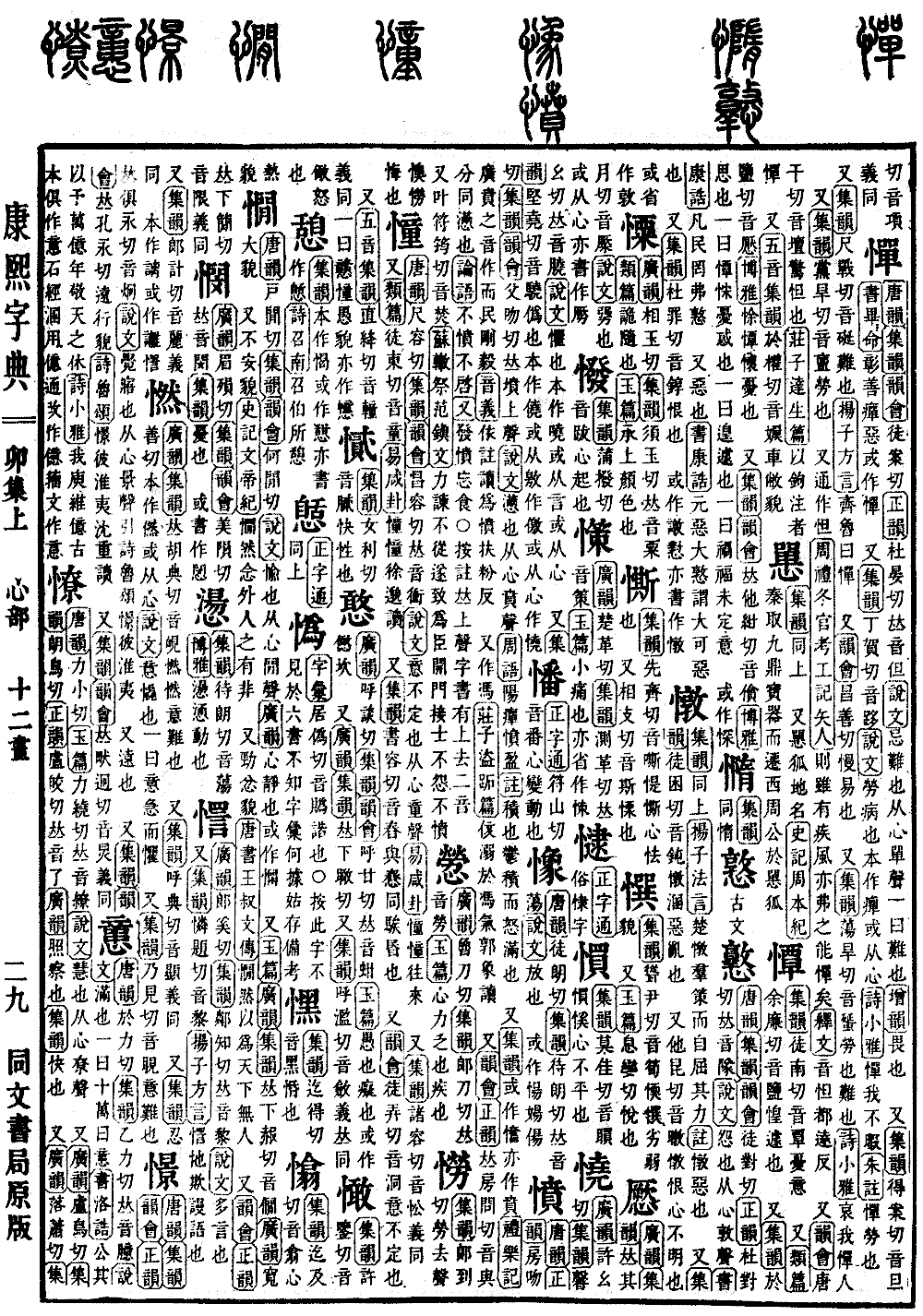
Mao Collection, Upper Volume
Radical: Heart (xīn)
Kangxi stroke count: 16
Page 403, Entry 01
Pronounced dan (falling tone).
Shuowen Jiezi (Explanation of Simple and Compound Characters): To dread or find difficult. Formed from the heart radical with the sound component dan. Another definition is to find difficult.
Zengyun (Augmented Rhymes): To fear.
Also pronounced dan (falling tone).
Book of Documents (Shujing), Bi Ming: To manifest the good and punish the evil. Sometimes written as dan.
Also pronounced duo (falling tone).
Shuowen Jiezi: Fatigue or illness. Originally written as dan, sometimes written with the heart radical.
Book of Odes (Shijing), Xiao Ya: Fatigue prevents me from having leisure.
Zhu Xi Commentary: Dan means fatigue.
Also pronounced chan (falling tone).
To find difficult.
Yang Xiong, Fangyan (Regional Speech): In the regions of Qi and Lu, it is called dan.
Also pronounced chan (falling tone).
Negligence or ease.
Also pronounced dan (falling tone).
Fatigue; to find difficult.
Book of Odes (Shijing), Xiao Ya: Pity us, the fatigued people.
Also pronounced dan (falling tone).
Fatigue.
Also used interchangeably with da.
Rites of Zhou (Zhouli), Dongguan Kaogongji, Shiren: Even if there is a strong wind, it cannot cause instability.
Shuowen Commentary: Pronounced da.
Also pronounced tan (level tone).
Shock or fear.
Zhuangzi, Dasheng Chapter: Those who use hooks and weights are startled.
Also pronounced quan (level tone).
The appearance of a worn-out carriage.