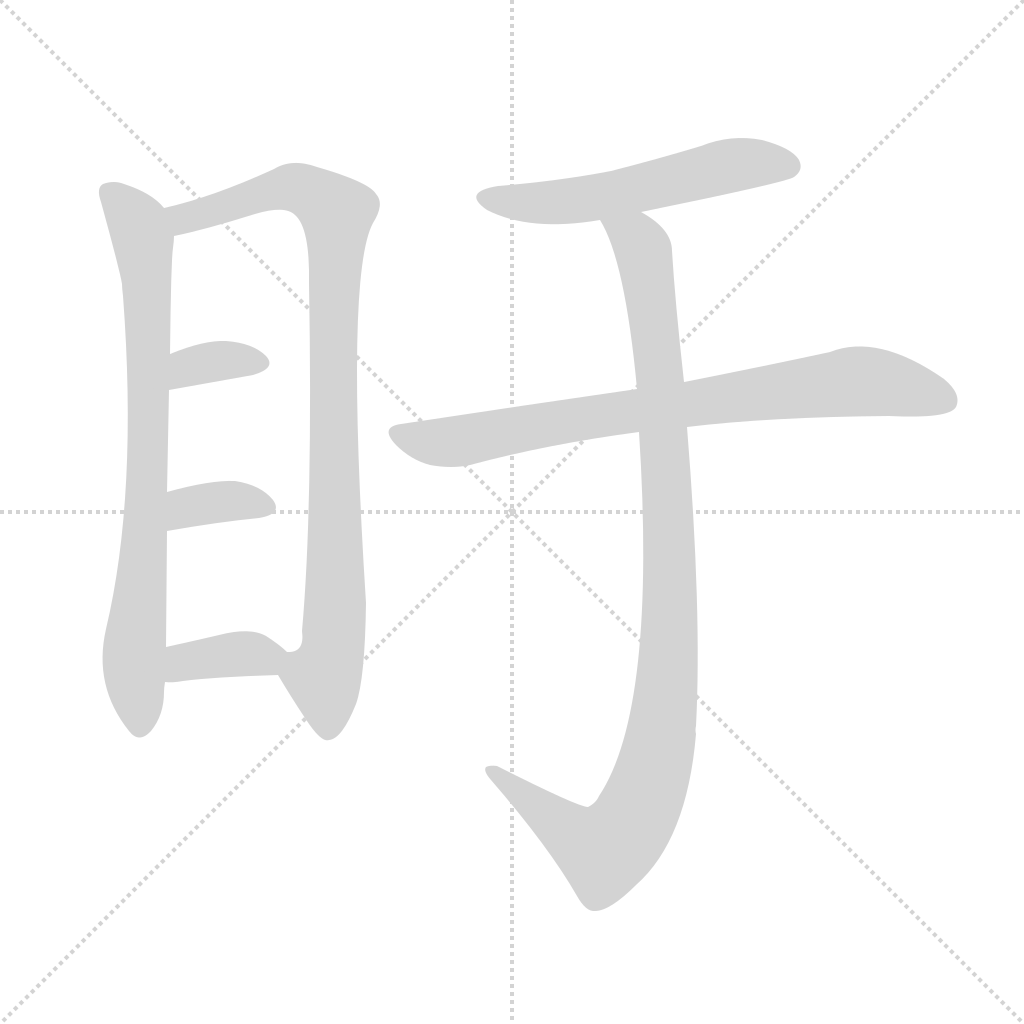
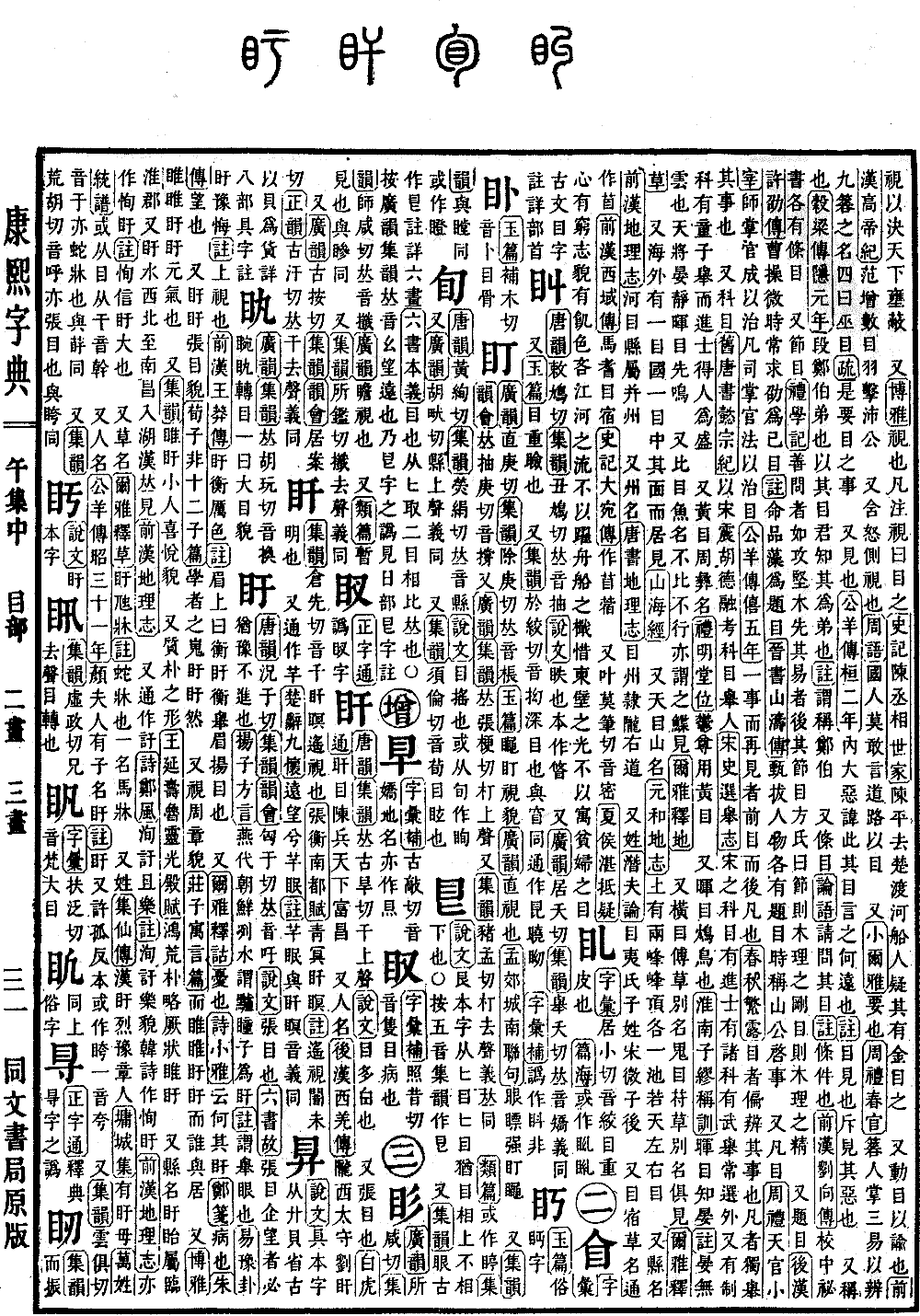
Wu Collection, Middle Volume. Radical: Eye (mù). 8 strokes. Page 799, Entry 17.
Pronounced xu.
According to the Explaining Graphs and Analyzing Characters (Shuowen Jiezi), to open the eyes wide.
According to the Record of the Six Writings (Liushugu), one who opens the eyes wide and gazes while standing must be hesitating and not advancing.
According to Master Yang's Dialect (Fangyan), in the regions of Yan, Dai, and Chaoxian, the pupils of the eyes are called xu. Commentary: This refers to raising the eyes.
Book of Changes (Yijing), Yu Hexagram: Gazing in anticipation, regret. Commentary: To look upward.
History of the Former Han (Qianhan Shu), Biography of Wang Mang: Raising the eyebrows and showing a stern expression. Commentary: The area above the eyebrows is called the heng. To raise the eyebrows and open the eyes wide.
Also, according to the Approach to Elegance (Erya), to be anxious.
Book of Odes (Shijing), Lesser Odes: Why is there this anxiety? Commentary by Zheng: It means suffering. Commentary by Zhu: It means to gaze.
Also, xu xu, the appearance of opening the eyes wide.
Xunzi, Against the Twelve Masters: The scholars are formidable and wide-eyed.
Also, the appearance of looking around in confusion. Zhuangzi, Metaphorical Words: With eyes wide and staring, with whom can you dwell?
Also, according to the Broad Approach to Elegance (Boya), wide-eyed represents the primordial energy.
Also, according to the Collection of Rhymes (Jiyun), wide-eyed represents the joyful appearance of a petty person.
Also, the form of being simple and unadorned. Rhapsody on the Lingguang Hall of Lu by Wang Yanshou: The vastness is plain and simple, its form is wide and staring.
Also, the name of a county. Xuyi, belonging to Linhuai Prefecture.
Also, the Xu River, flowing northwest to Nanchang and entering Lake Han; see the Treatise on Geography in the History of the Former Han.
Also, interchangeably written as xu.
Book of Odes (Shijing), Zheng Odes: Truly grand and happy. Commentary: Truly, grand and happy appearance. The Han version of the Odes uses this character. The Treatise on Geography in the History of the Former Han also writes it this way. Commentary: Truly means sincere; grand means large.
Also, the name of a plant. According to the Approach to Elegance (Erya), it is the snake bed herb. Commentary: The snake bed plant. Another name is horse bed.
Also, a surname. Biographies of the Immortals (Jixian Zhuan): Xu Lie of the Han dynasty, a man from Yuzhang. The Collection of the Fortified City (Yongcheng Ji) mentions a Mother Xu. The General Genealogy of Ten Thousand Surnames (Wanxing Tongpu) notes that some write it with the radical for eye and the component for gan, pronounced gan.
Also, a personal name. Gongyang Commentary, 31st Year of Duke Zhao: Lady Yan had a son named Xu. Commentary: Also pronounced xu. Some original texts use a variant. One pronunciation is kua.
Also, according to the Collection of Rhymes (Jiyun), pronounced yu. It is also the snake bed herb, identical to the previous entry.
Also, according to the Collection of Rhymes (Jiyun), pronounced hu. It also means to open the eyes wide, identical to the previous entry.