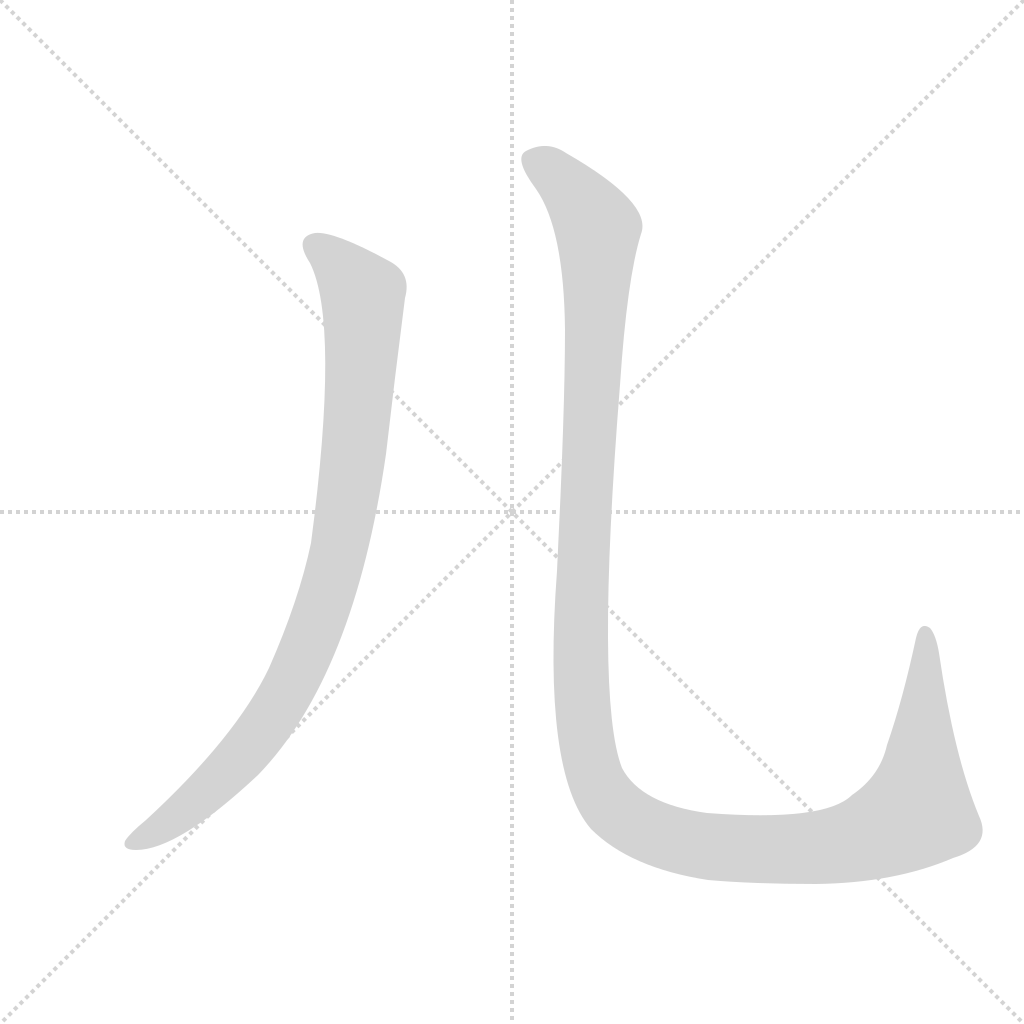
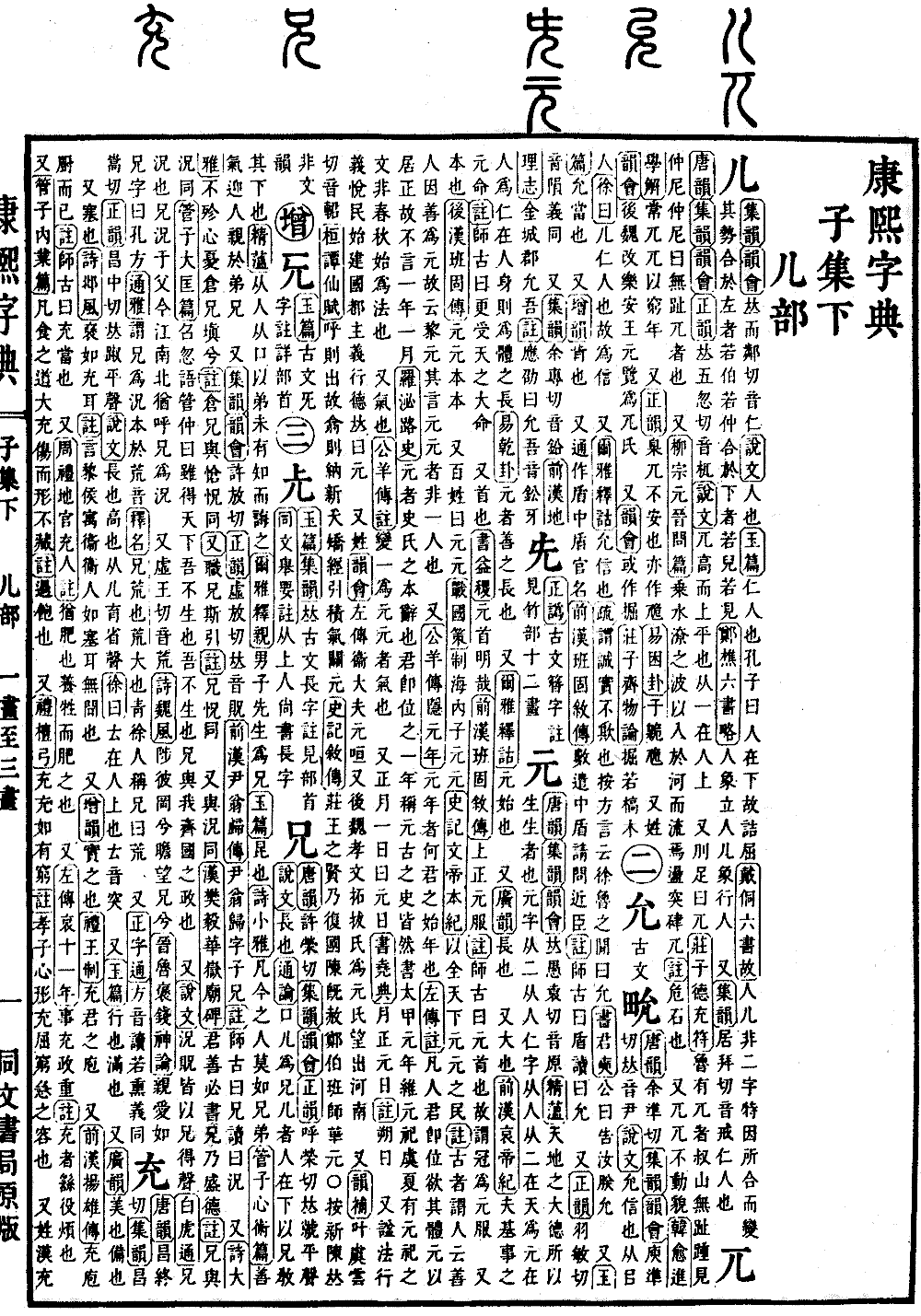
Zi Collection, Page Position: Lower
Radical: Legs (ér)
Kangxi Dictionary Strokes: 8
Page 123, Entry 01
Pronounced rǎn (falling tone), same pronunciation as rén (level tone) — Jiyun (Jiyun), Yunhui (Yunhui)
Explained as "person" — Shuowen Jiezi (Shuowen Jiezi)
Explained as "a virtuous person" — Yupian (Yupian)
Confucius said: Because the person is below, the character's shape is bent — Dai Tong, Liushu Gu (Liushu Gu)
Considers "rén" and "ér" not to be two separate characters, but rather forms that change based on their position in a combination. When on the left, as in "bó" (伯) or "zhòng" (仲); when below, as in "ér" (兒) or "jiàn" (見) — Dai Tong, Liushu Gu (Liushu Gu)
States that "rén" resembles a standing person, while "ér" resembles a walking person — Zheng Qiao, Liushue Lue (Liushue Lue)
Also, pronounced jī (level tone), same pronunciation as jiè (falling tone), meaning a virtuous person — Jiyun (Jiyun)
The ancient script for "ér" (兒) is pronounced rǔ (rising tone) — Tangyun (Tangyun)
Pronounced rú (rising tone), same pronunciation as ěr (level tone) — Jiyun (Jiyun), Yunhui (Yunhui), Zhengyun (Zhengyun)
Explained as "young child" — Shuowen Jiezi (Shuowen Jiezi)
Pictographic character resembling a child with the fontanelle not yet closed — Shuowen Jiezi (Shuowen Jiezi)
Boys are called "ér" (兒), and girls are called "yīng" (嬰) — Yunhui (Yunhui)
Also explained as "ní" (倪), referring to the beginning of a person's life, like the initial sprouts of a tree — Yunhui (Yunhui)
Also stated to be "rú" (嬬), meaning the softness of an infant — Cangshang Pian (Cangshang Pian)
Also a surname; there was a person named Er Kuan (兒寬) during the Han Dynasty — Yunhui (Yunhui)
Also pronounced wǔ (falling tone), same pronunciation as ní (rising tone) — Tangyun (Tangyun), Jiyun (Jiyun), Yunhui (Yunhui)
Also a surname — Jiyun (Jiyun), Yunhui (Yunhui)
Records an article titled "Er Liang" (兒良) — Qian Han, Yiwen Zhi (Qian Han, Yiwen Zhi)
Note: Shigu said Er Liang (兒良) was a person from the Warring States period — Shigu
Er Kuan (兒寬) was from Qiancheng (千乘) — Er Kuan Zhuan (Er Kuan Zhuan)
Also explained as "weak and small," a phonetic loan for "ní" (倪) — Yunhui (Yunhui)
There is "fǎn qí máo ní" (反其旄倪) in Mencius — Mencius (Mengzi)
Verification:
"Child" changed to "young child" — Shuowen Jiezi (Shuowen Jiezi)
"Fontanelle" changed to "top of the head, fontanelle" — Shuowen Jiezi (Shuowen Jiezi)
"Mao ni" changed to "mao ni" — Mencius (Mengzi)