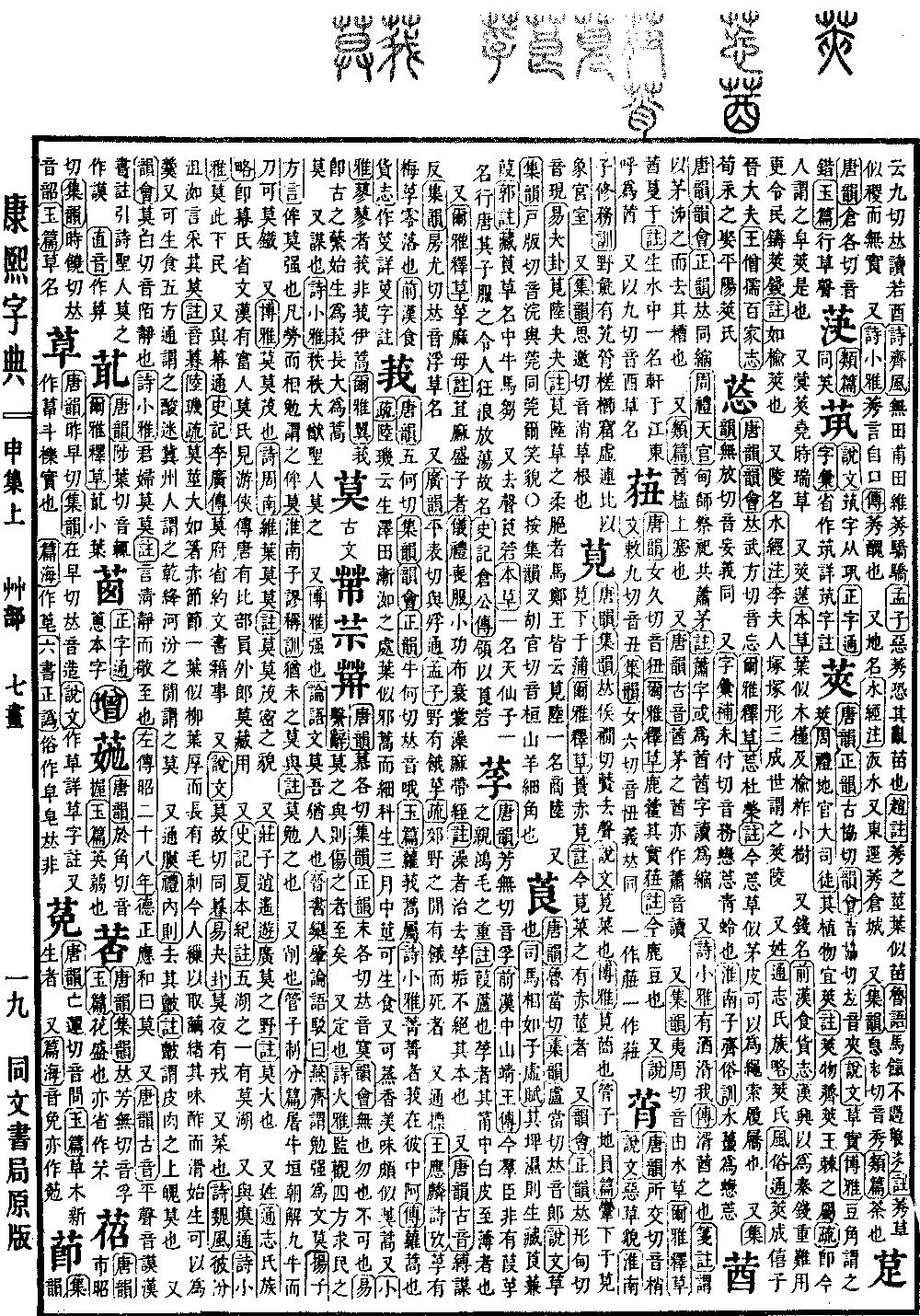
Shen Collection, Upper Volume
Radical: Grass (cǎo)
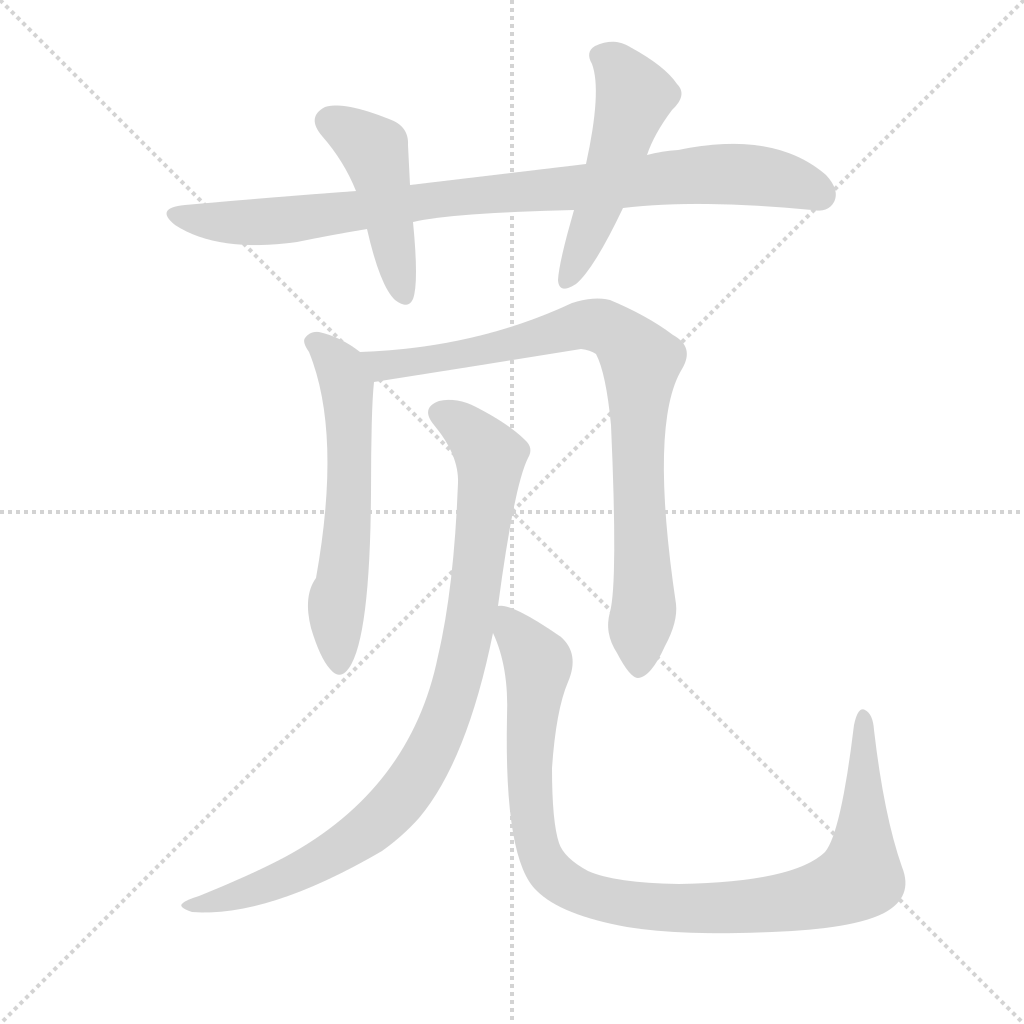
莧
Kangxi strokes: 13
Page 1035, Entry 01
Tang Rhyme (Tangyun) and Collection of Rhymes (Jiyun) state the pronunciation is xian (falling-rising tone), similar to the pronunciation of the character xian (falling tone).
Shuowen Jiezi states that the amaranth is a type of vegetable.
Boya states that the amaranth is the same as the plant known as meng.
Guanzi, Earth Resources chapter (Diyuan Pian), states that the quality is lower than that of amaranth, and amaranth is lower than that of the cattail.
Erya, Interpretation of Plants (Shicao), states that the kui is the amaranth with red stems. The commentary notes that this refers to the amaranth with red stems as known today.
According to Rhyme Compilation (Yunhui) and Correct Rhymes (Zhengyun), the pronunciation is xian (falling tone), which is the same as the sound of the character xian.
Book of Changes (Yijing), Break-through hexagram (Guagua), mentions the plant known as xianlu. The commentary notes that xianlu is a soft and fragile herb. Ma Rong, Zheng Xuan, and Wang Bi all state that xianlu is also called shanglu.
According to Collection of Rhymes (Jiyun), the pronunciation is huan (falling-rising tone), which is the same as the sound of the character huan. This is equivalent to the character guan, referring to a smiling expression.
The Collection of Rhymes (Jiyun) also records the pronunciation as huan (rising tone), which is the same as the sound of the character huan. This refers to the small, thin horns of a mountain goat.