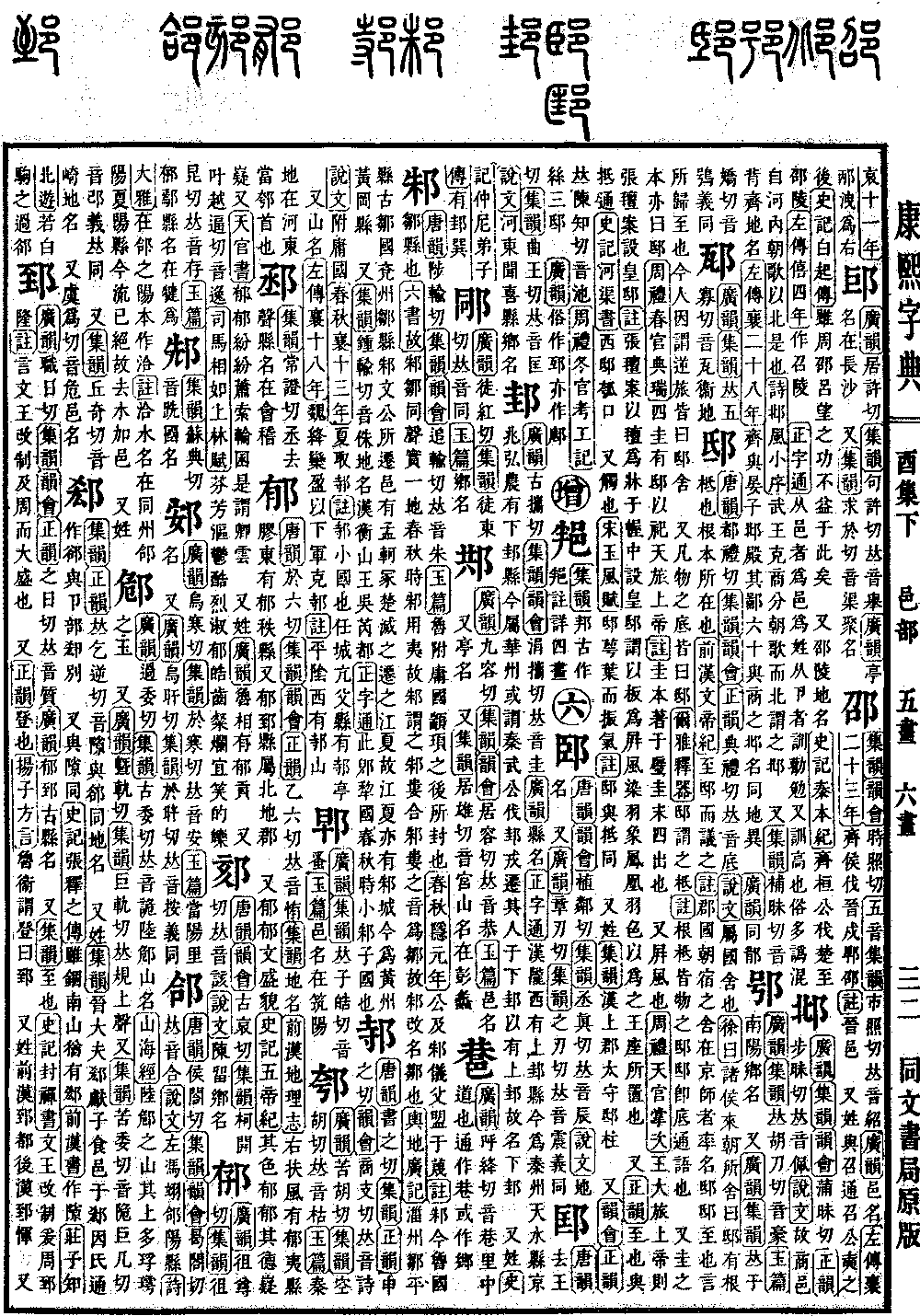
You Collection, Lower Volume
Radical: City (yì)
dǐ
Kangxi Stroke Count: 12
Page 1270, Entry 06
Pronunciation: dǐ (falling tone)
Pronunciation: dǐ (falling tone)
Pronunciation: dǐ (falling tone)
Definition: A subordinate state's lodging.
Explanation: Lodging for feudal lords when they came to pay homage. It signifies having roots, the place where the foundation lies.
Citation: "Arrived at the lodging and discussed it" — Annals of Emperor Wen of Han (Qian Han Shu)
Note: Lodgings for officials from prefectures and kingdoms to stay overnight in the capital were generally called dǐ. Dǐ means to arrive, indicating the place of arrival. Nowadays, inns are all called dǐ shè.
Also, the bottom of all things is called dǐ.
Citation: "Dǐ is called dǐ" — Explanations of Objects (Erya)
Note: Roots and bases are all the dǐ of things. Dǐ is the same as dǐ, a common term.
Also, the base of a jade tablet is also called dǐ.
Citation: "Four jade tablets with dǐ, used to sacrifice to Heaven and the traveling emperor" — Rites of Zhou (Zhou Li), Official of Spring, Official of Auspiciousness
Note: The base of the jade tablet is placed on the jade disc, and the tip of the jade tablet extends outwards in four directions.
Also, a screen.
Citation: "When the King makes a great pilgrimage to sacrifice to Heaven, felt mats are spread, and the imperial dǐ is set up" — Rites of Zhou (Zhou Li), Official of Heaven, Official of Ranks
Note: Felt mats are spread, and a bed is made of felt. Within the tent, the imperial dǐ is set up, which is a screen made of boards, dyed with feathers to resemble phoenix feather colors, and placed where the King sits.
Also, pronunciation: zhì (falling tone). Same as dǐ.
Citation: "West dǐ HuKou" — Historical Records (Shiji), Treatise on Rivers and Canals
Also, to touch.
Citation: "Dǐ the calyx and shook its energy" — Odes of Song (Song Yu), Rhapsody on Wind
Note: Dǐ is the same as dǐ.
Also, a surname.
Citation: "Dǐ Zhu, Prefect of Shang Commandery in Han Dynasty" — Collected Rhymes (Jiyun)
Also, pronunciation: zhì (falling tone).
Citation: "Three dǐ of silk" — Rites of Zhou (Zhou Li), Winter Official, Craftsman Record
Commonly written as. Also written as.