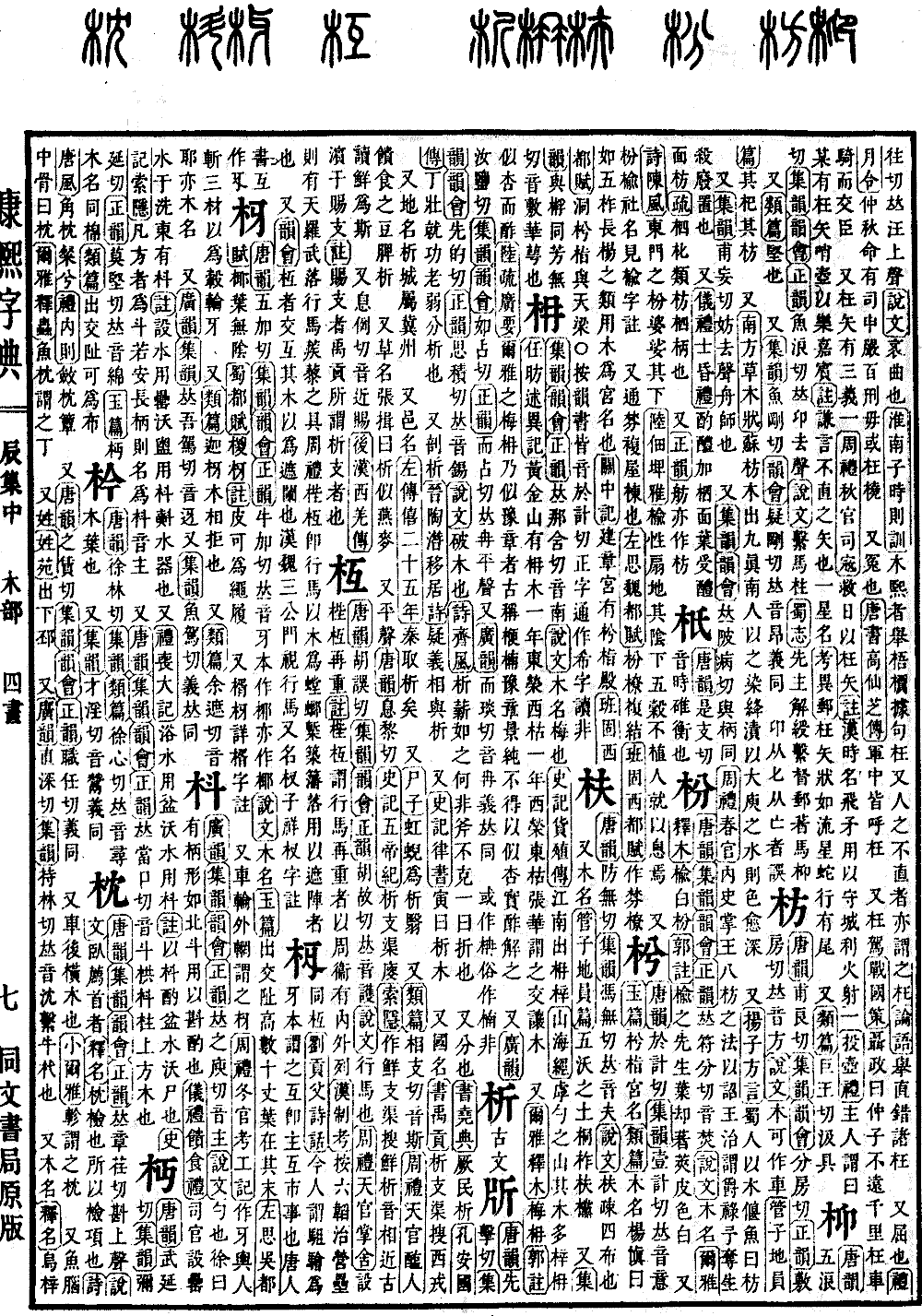
Chen Collection, Middle Volume
Radical: Tree (mù)
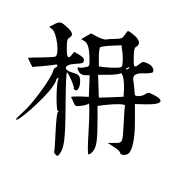
Entry: Nan
Kangxi stroke count: 8
Page 515, Entry 07
Collected Rhymes (Jiyun), Rhyme Meetings (Yunhui), and Orthodox Rhymes (Zhengyun) state the pronunciation is nan.
Explaining Graphs and Analyzing Characters (Shuowen) states it is the name of a tree, identified as the plum.
Records of the Grand Historian (Shiji), Biography of Merchants (Huozhi Zhuan) states: The south of the Yangtze River produces nan and zi wood.
Classic of Mountains and Seas (Shanhaijing) states: On Mount Hujue, there are many zi and nan trees.
Ren Fang, Record of Strange Things (Shuyi Ji) states: On Golden Mountain there is the nan tree; one year it flourishes on the east side and withers on the west, and the next year it flourishes on the west side and withers on the east. Zhang Hua referred to this as the mutual-yielding tree.
Also, Literary Expositor (Erya), Explanation of Trees states: Mei is nan. Guo Pu’s commentary states: It resembles an apricot and is sour.
Lu’s Extensive Essentials (Lu Shu Guang Yao) states: The mei-nan mentioned in the Literary Expositor (Erya) is a type that resembles the camphor tree. In ancient times, people spoke of pian-nan and camphor wood, so Jingchun was incorrect to explain it as resembling a sour apricot.
Also, Wide Rhymes (Guangyun) states the pronunciation is ran, Collected Rhymes (Jiyun) and Rhyme Meetings (Yunhui) state the pronunciation is ran, and Orthodox Rhymes (Zhengyun) states the pronunciation is ran (level tone).
Also, Wide Rhymes (Guangyun) states the pronunciation is ran. The meaning is the same.
Sometimes written as a variant form (nan). The common form (nan) is incorrect.