Wu Collection, Middle Volume
Radical: Eye (mù)
Character: Dan
Kangxi Strokes: 9
Page 802, Entry 18
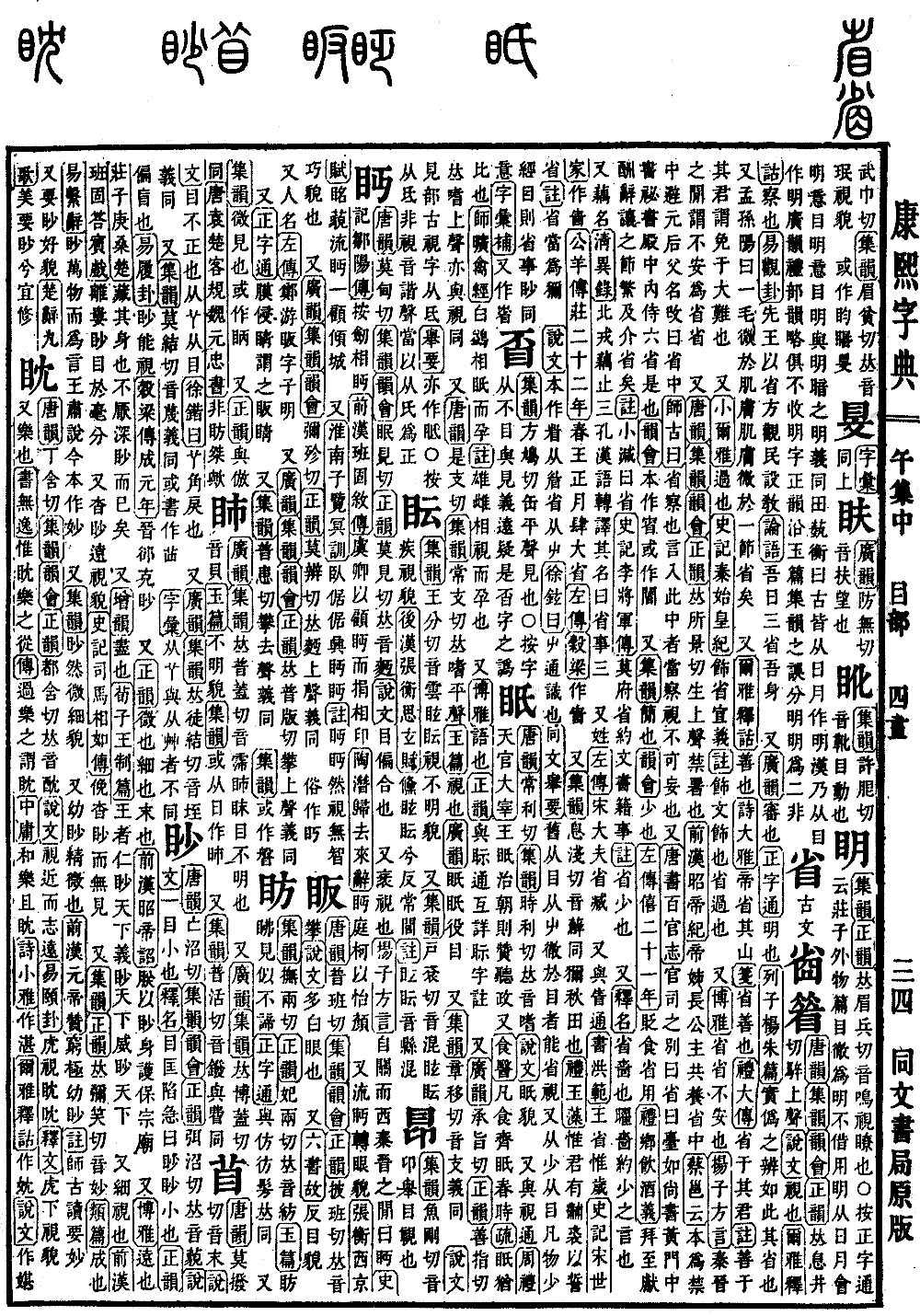
Pronounced dan. According to the Analytical Dictionary of Characters (Shuowen), to look at something nearby while focusing on something distant. In the Book of Changes (Yijing), regarding the Nourishment hexagram: The tiger glares intently. In the Explanations (Shiwen): The appearance of a tiger looking down. Also means to enjoy. In the Book of Documents (Shujing), regarding the chapter On Not Being Idle: To follow excessive pleasures. The commentary states: Excessive pleasure is called dan. In the Doctrine of the Mean (Zhongyong): Harmonious, happy, and indulgent. In the Book of Odes (Shijing), it is written as zhan. In the Erya Dictionary (Erya), in the section Explaining Ancient Terms, it is written as dan. In the Analytical Dictionary of Characters (Shuowen), it is written as dan, with the same sound and meaning. Also, pronounced dan (rising tone). It also means the gaze of a tiger. Also, pronounced tan. The meaning is the same. Also, pronounced tan (rising tone). To look slowly. It is the same as the character for looking. Also, pronounced chen. To stick one's head out to look. Commonly written as chuang. Also, rhymes with shen. In the Book of Odes (Shijing), in the Odes of Wei: Alas, young lady, do not indulge with a man. Rhymes with shen. Shen is in the level tone. In the Miscellaneous Poems by Zhang Han: The green branches are like tufts of kingfisher feathers, the yellow leaves like scattered gold. Beautiful plants are truly worth viewing, yet it is difficult to indulge in this for long. According to the Zhengzitong Dictionary: Dan and dan are different. The character for indulgent with the ear radical refers to indulgence, while the character for indulgent with the eye radical refers to looking or pleasure. In the Book of Changes, the Book of Documents, and the Book of Odes, the original character was dan, but it was mistakenly written as dan. The Zheng Yun dictionary states: Dan is sometimes written as dan, which is incorrect. The common variant form, also written as dan, is even more incorrect.