Wu Collection, Middle Volume
Radical: Eye (mù)
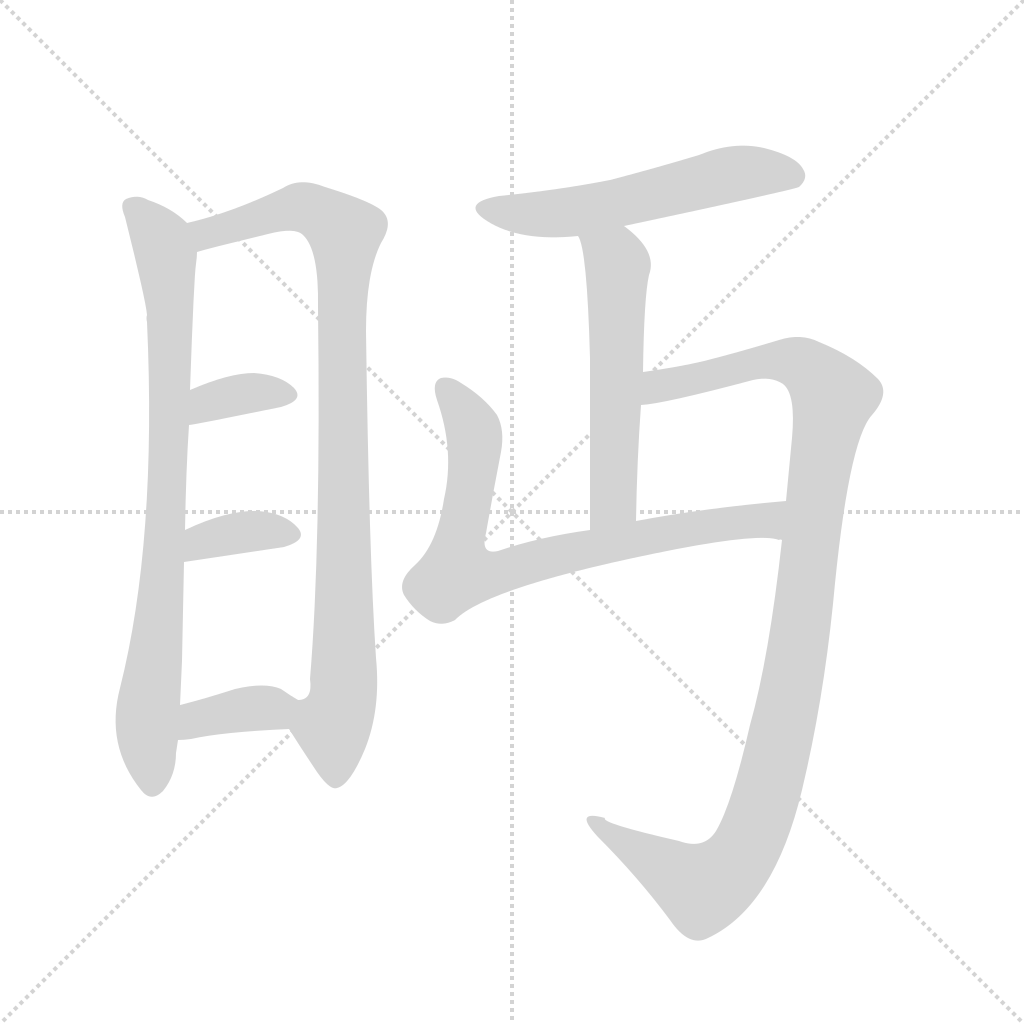
Entry: Mian
Kangxi Stroke Count: 9
Page 802, Entry 12
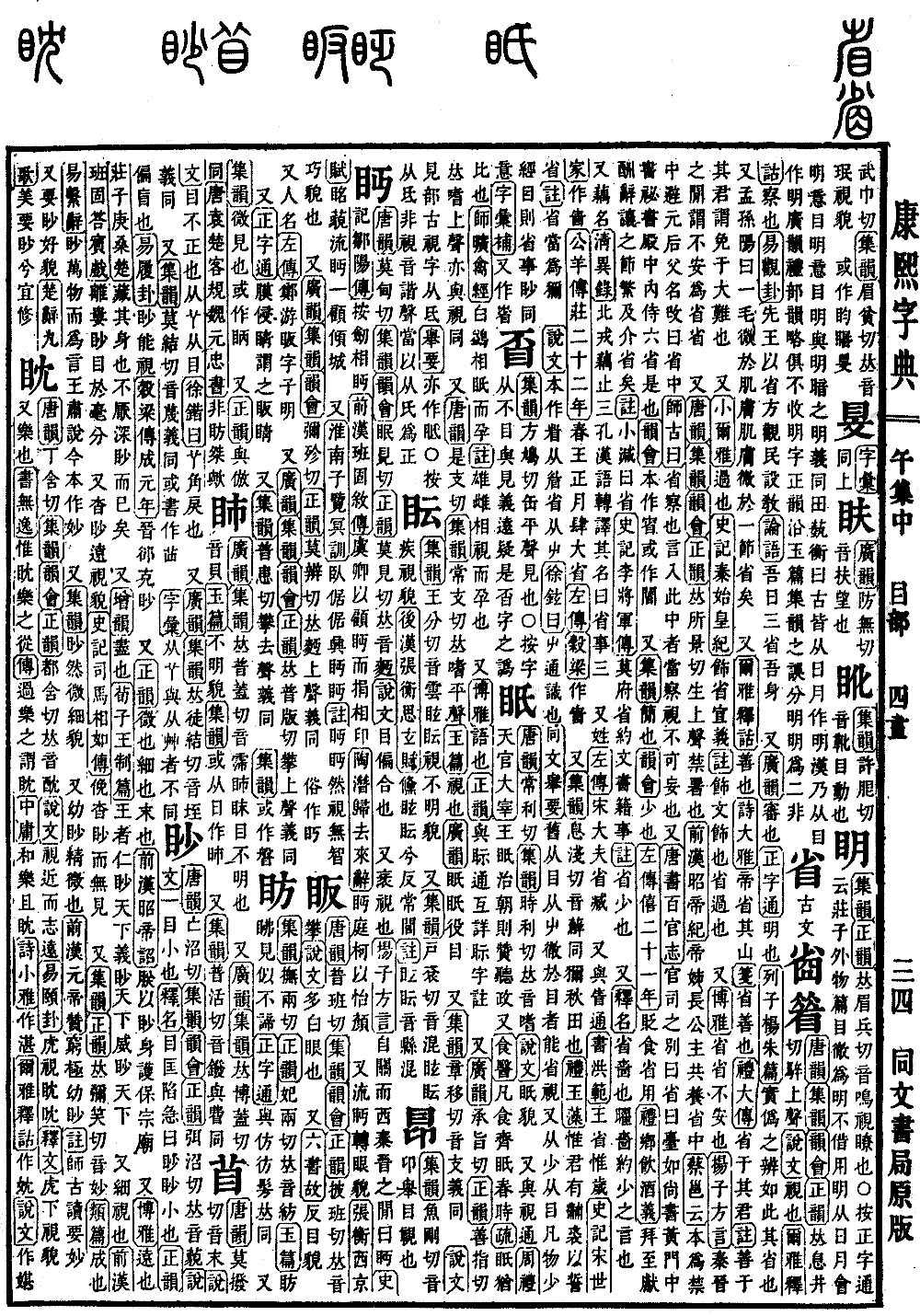
Pronounced mian. According to the Shuowen Jiezi (Shuowen), it describes eyes being half-open and half-closed. It also means to look askance. According to the Regional Dialects (Fangyan), in the regions west of the pass, within the territories of Qin and Jin, this is called mian. In the Records of the Grand Historian (Shiji), Biography of Zou Yang, it describes pressing one's sword and looking askance at one another. In the History of the Former Han (Qianhan), Narrative Biography by Ban Gu, it notes that Yu Qing once turned his head for a single glance and subsequently abandoned the prime minister's seal. In the Return to My Home (Guiqulai Ci) by Tao Qian, it describes glancing sideways at the trees in the courtyard and feeling joy. It also refers to the flowing gaze, the appearance of shifting one's eyes. In the Western Capital Rhapsody (Xijing Fu) by Zhang Heng, it describes a gaze shifting and flowing, where a single look could topple a city. Furthermore, in the Huainanzi, Discussion on Observing the Dark (Lanming Xun), it refers to lying stiffly while sleeping and having a dull, sluggish gaze upon waking. The commentary states that this indicates a simple appearance, lacking cunning or craft. Also pronounced mian (rising tone), with the same meaning. Commonly written in a variant form.