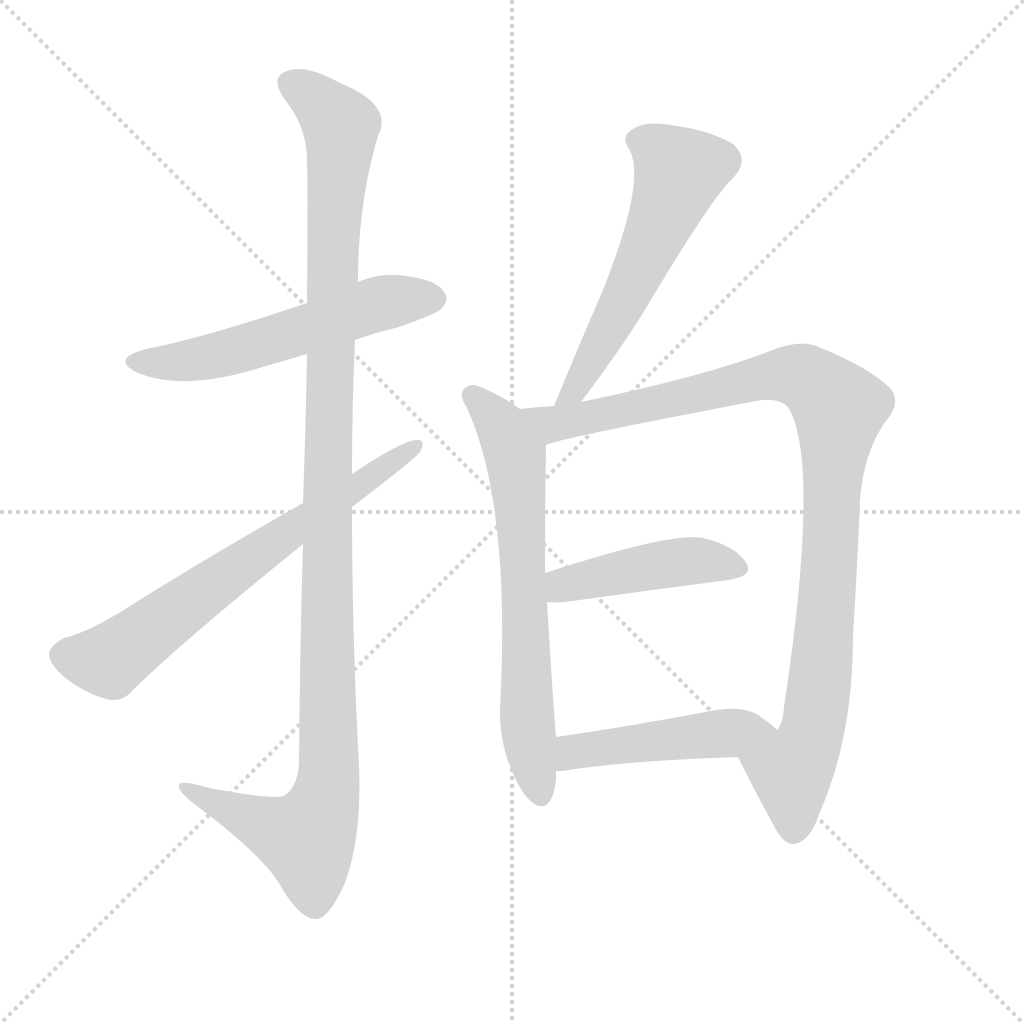
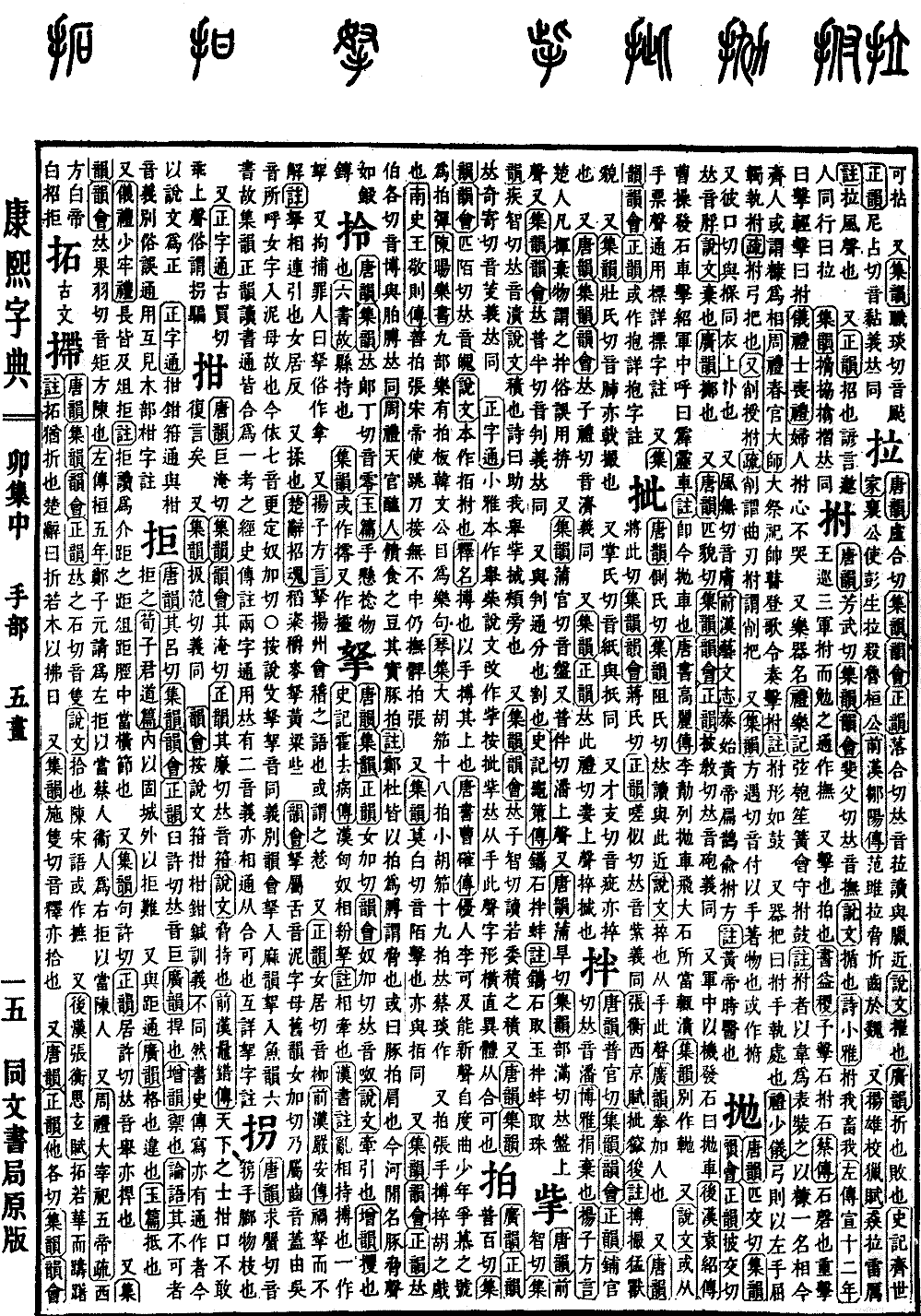
Mao Collection, Middle Volume
Radical: Hand (shǒu)
Kangxi stroke count: 9
Page 425, Entry 07
Pronounced po.
Shuowen Jiezi states it was originally written as a variant form. It means to beat or strike.
Shiming states it is to fight or attack. It refers to striking the upper part of an object with the hand.
History of the Tang (Tangshu), Biography of Cao Que: The artist Li Keji was able to compose new musical pieces; young people vied to admire him, referring to this as paitan.
Yang Music Treatise (Yangyueshu): Among the nine categories of music, there is the paiban, which Han Yu refers to as a musical phrase.
Qin Collection (Qinji): The Large Hujia has eighteen pai, and the Small Hujia has nineteen pai; these were composed by Cai Yan. There is also paizhang, which refers to unarmed combat and wrestling, a game of the northern tribes.
History of the Southern Dynasties (Nanshi), Biography of Wang Jingze: He was skilled at paizhang; the Emperor of Song had him perform a knife-juggling act. He caught every knife without fail, then slapped his thighs to perform paizhang.
Pronounced mo.
It means to strike or beat. It is also the same as the variant character.
Pronounced bo.
It is the same as the characters bo and bo.
Rites of Zhou (Zhouli), Offices of Heaven, Preserver of Preserved Meats: During sacrificial rites, the dou vessel used to present food contains pork pai.
Commentary: Zheng Xuan and Du Yu both believe that pai is the same as bo, referring to rib meat. Others suggest that pork pai refers to pork shoulder meat; today, in the Hejian region, pork ribs are called tunxie, with a pronunciation similar to duanbo.