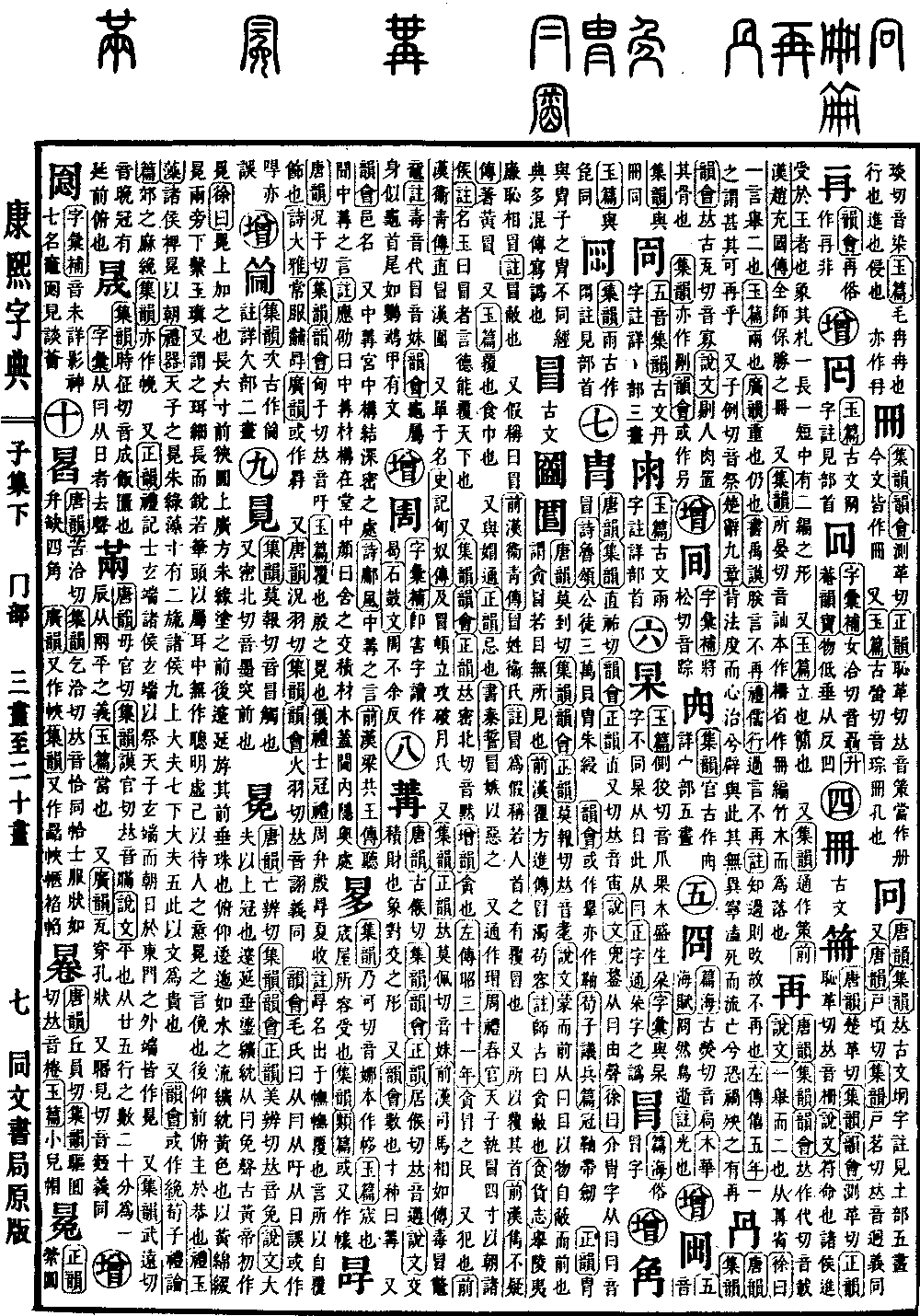
Zi Collection, Page Position: Lower; Radical: Upside-down Box (jiōng)
冑; Kangxi strokes: 9; Page 129, Entry 20
The Tangyun and Jiyun rhyme dictionaries give the pronunciation as "zhí yòu qiè". The Yunhui and Zhengyun rhyme dictionaries give it as "zhí yòu qiè", sounding as zhòu.
The Shuowen Jiezi (Shuowen) defines it as a helmet. It is formed from the radical mào, with yóu as the sound component. Xu Kai states that the character for jiè zhòu (armor) uses the mào radical, which is pronounced mào.
In the Book of Odes (Shijing), Lu Hymns: "thirty thousand soldiers, with shell-adorned helmets and crimson cords."
The Yunhui states it is sometimes also written as a variant form, and also as another variant form.
In Xunzi (Xunzi), On Military Affairs: "wearing caps and carrying swords."
The Zhengyun states that the character zhòu (helmet) is different from the zhòu in zhòuzǐ (heir apparent). Classics often confuse them due to transmission errors.