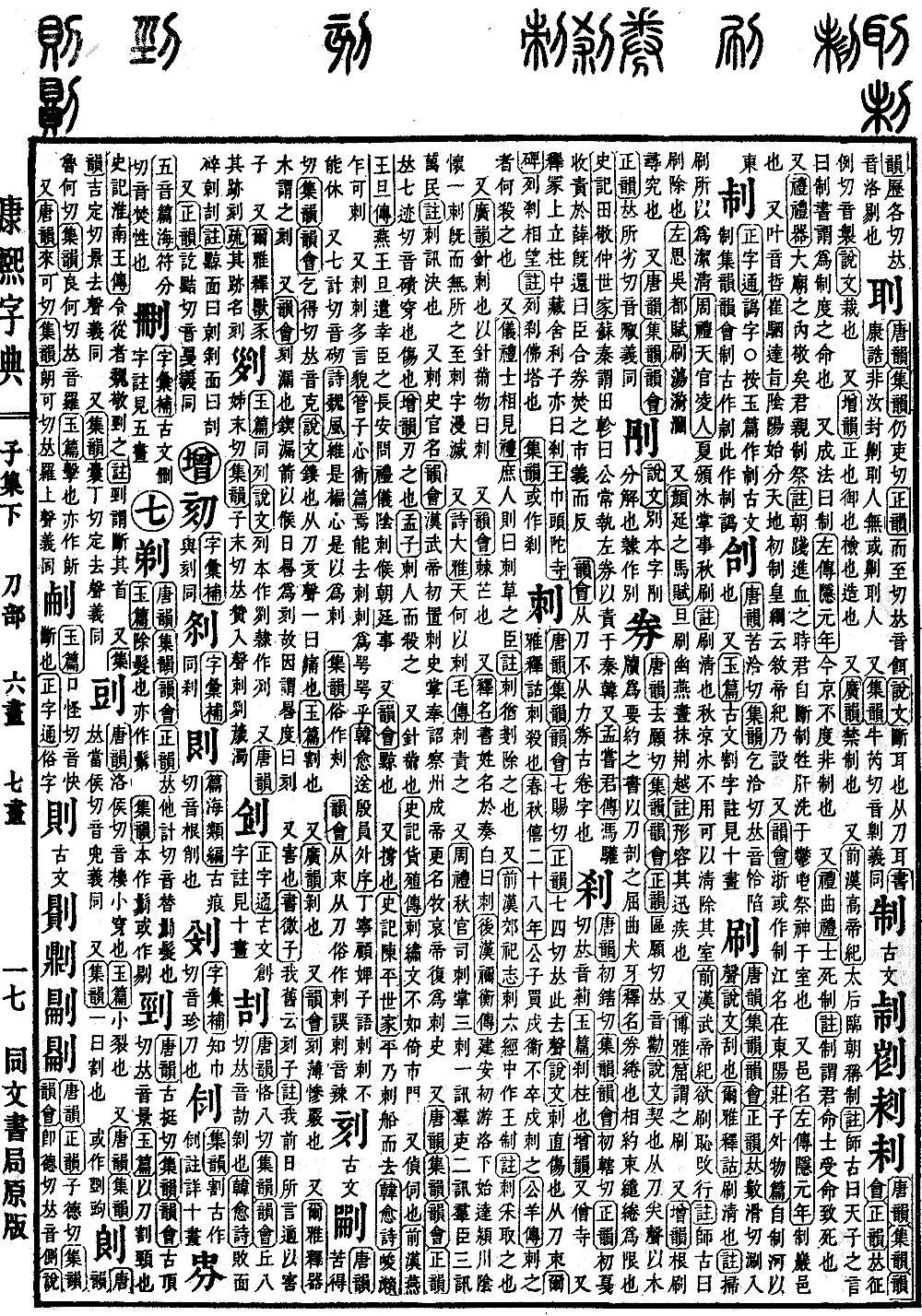
Zi Collection, Page Position: Lower
Radical: Knife (dāo)
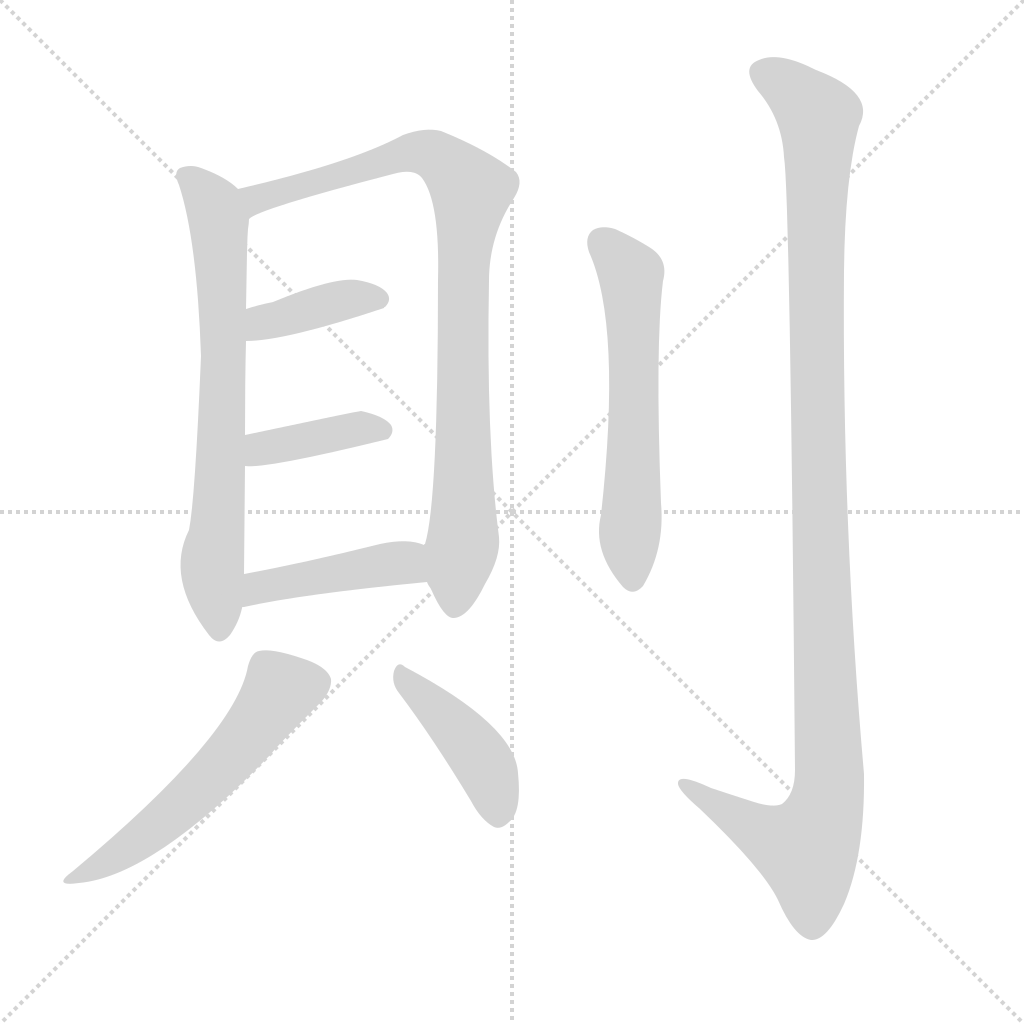
Character: Ze
Kangxi Stroke Count: 9
Page Number: Page 139, Position 31
Ancient script forms are noted. According to the Tang Dynasty Rhymes (Tangyun) and the Correct Rhymes (Zhengyun), the pronunciation is the fanqie of zi and de. In the Collected Rhymes (Jiyun) and the Collected Rhymes (Yunhui), it is the fanqie of ji and de, pronounced similarly to ce. The Analytical Dictionary of Characters (Shuowen Jiezi) states that ze means to grade and demarcate objects. It is composed of the radicals for knife and cowrie shell. Cowries were the currency and goods of antiquity. Xu says that ze means regulation. There is regulation in usage, and the knife is what is used to cut and regulate. Also, the Jade Chapters (Yupian) states that it means law. The Erya, Explaining Words (Shigu) states that ze means constant. The sub-commentary notes this refers to constant rites and laws. The Rites of Zhou (Zhouli), Offices of Heaven, Grand Administrator states: Use the eight rules to govern the capital and the outskirts. Zheng's commentary states that ze means law. Also, the Augmented Rhymes (Zengyun) states that all systems, regulations, and formats are called ze. The Book of Documents (Shangshu), The Charge to Yue (Shuoming) states: The wise and discerning truly establish the standards. Also, when heavenly principles are without error, it is called ze. The Book of Changes (Yijing), Qian Hexagram states: One then perceives the heavenly laws. The Book of Odes (Shijing), Greater Odes (Daya) states: Following the laws of the Supreme Emperor. Also, to model oneself after what is worthy of modeling is called ze. The Book of Documents, Against Luxurious Ease (Wuyi) states: From now on, let the succeeding kings model themselves on this: do not indulge in excessive observation, ease, wandering, or hunting. The commentary notes this is a warning to King Cheng to follow the model of King Wen. The Book of Odes, Lesser Odes (Xiaoya) states: The gentleman takes this as a model and an imitation. Also, in the Rites of Zhou, under the commentary for Five Commands and the Bestowal of Ze, it is the name for land that has not yet become a state. Also, Yize is the name of the musical pitch for the seventh month. The History of the Former Han (Qianhan Shu), Treatise on Rhythms and the Calendar (Lulizhi) states that ze means law. It refers to the regulations of the yang energy, causing the yin energy to flatten and strike down things that should be harmed. Also, the Collected Rhymes (Yunhui) states it is an auxiliary particle, and also a particle meaning and then. The Analects (Lunyu) states: If after acting upon these things one has energy to spare, then use it to study literature. Textual Research: Regarding the note in the Rites of Zhou under Five Commands and the Bestowal, ze is the name for land that has not yet become a state. The text has been corrected to ze according to the original source.