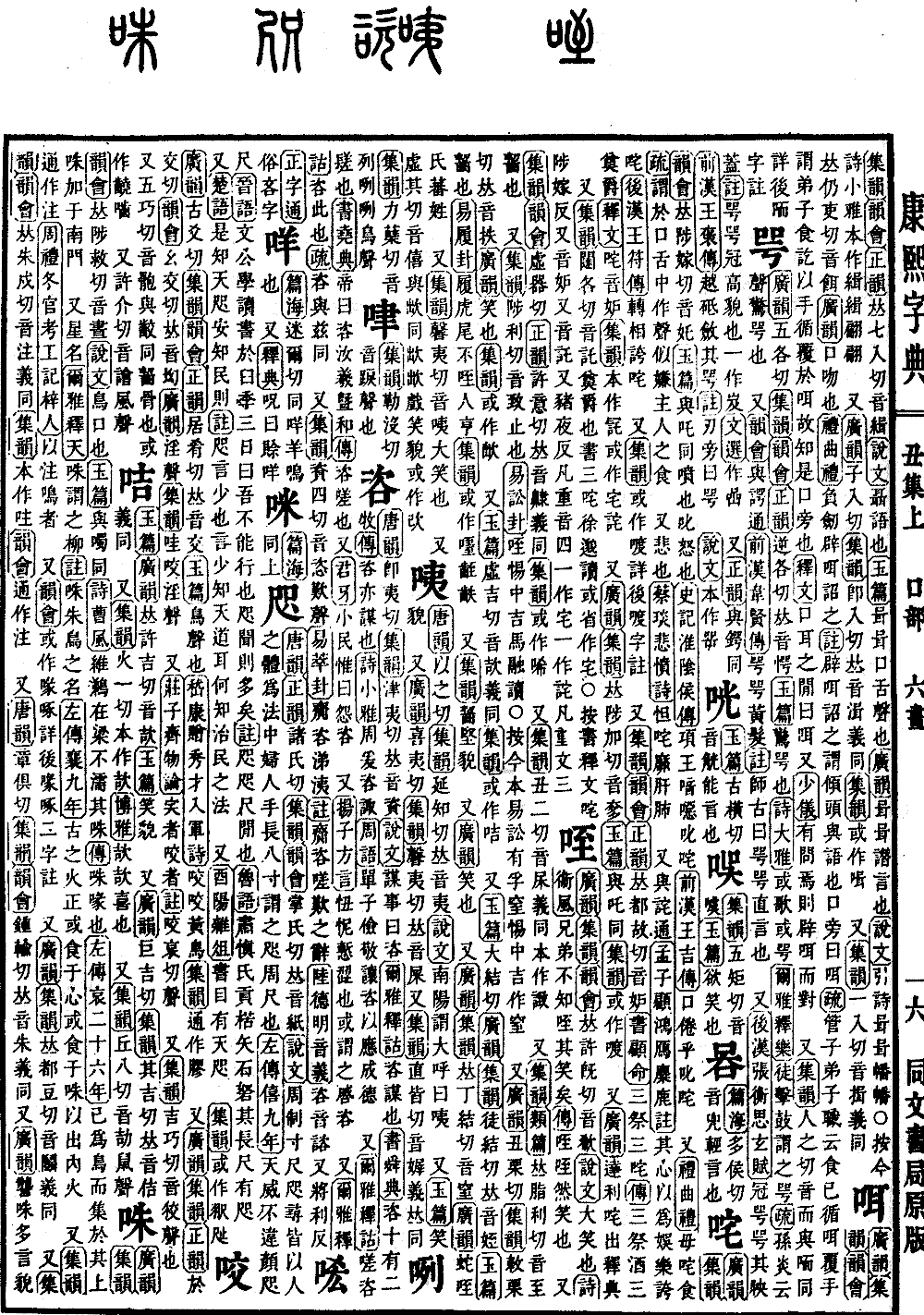
Chou Collection, Upper Volume
Radical: Mouth (kǒu)
Entry: 咡
Kangxi Strokes: 9
Page 186, Entry 01
Broad Rhymes (Guangyun), Collected Rhymes (Jiyun), Rhyme Collection (Yunhui): Pronounced er (falling tone).
Broad Rhymes (Guangyun): The corners of the mouth.
Book of Rites (Liji), Section on Manners (Quli): When carrying a sword on the back, turn the head and speak to them. Commentary states: Turning the head and speaking to them refers to tilting the head to converse. The area beside the mouth is called er. Commentary (Shu): The Student Duties section of the Master Guan (Guanzi) states: After eating, wipe the mouth and cover the hands. It means the student, after finishing a meal, uses their hands to wipe and cover the area beside the mouth, hence it is known to be the area beside the mouth. Explanation of Text (Shiwen): The area between the mouth and the ear is called er.
Additionally, in the Section on Minor Rituals (Shaoyi): When asked a question, one should turn the head and respond.
Additionally, Collected Rhymes (Jiyun): Pronounced er. Identical to a variant form. Refer to the note on the subsequent character for details.