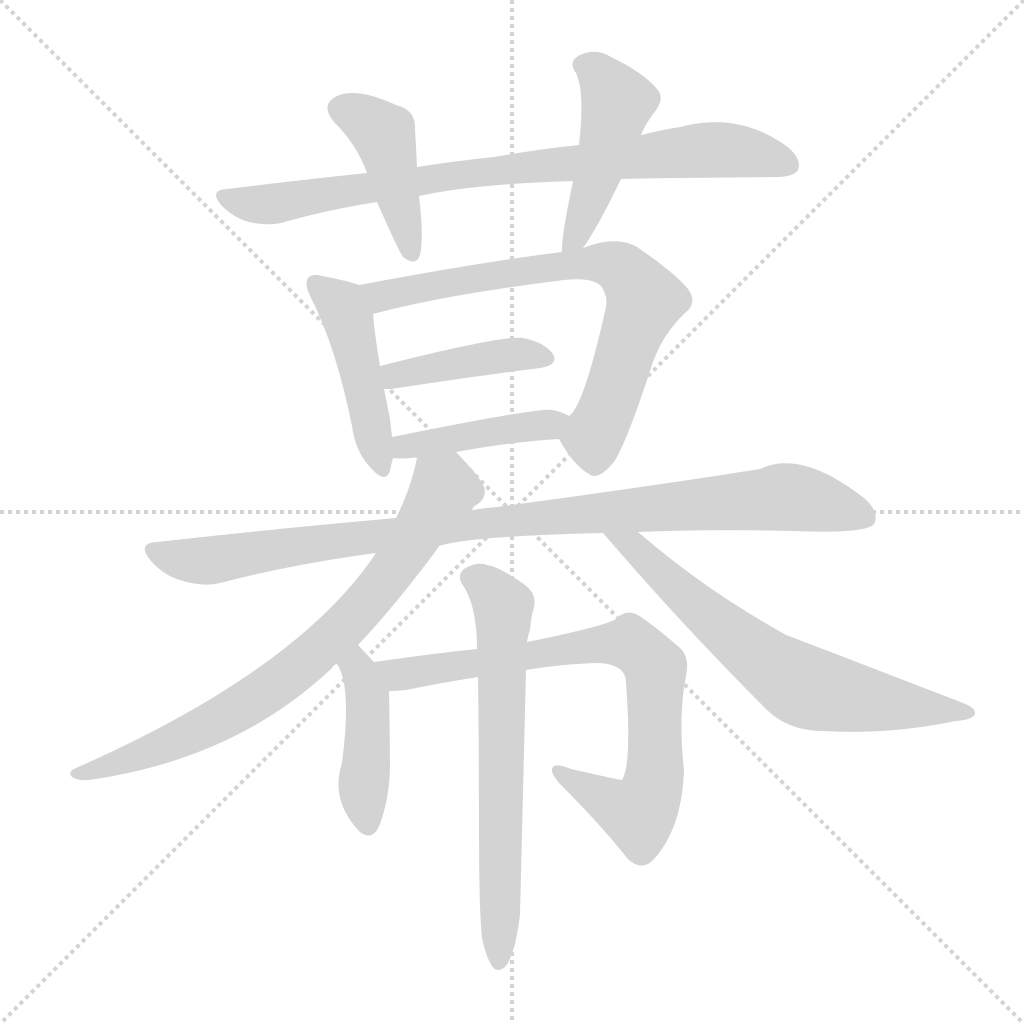
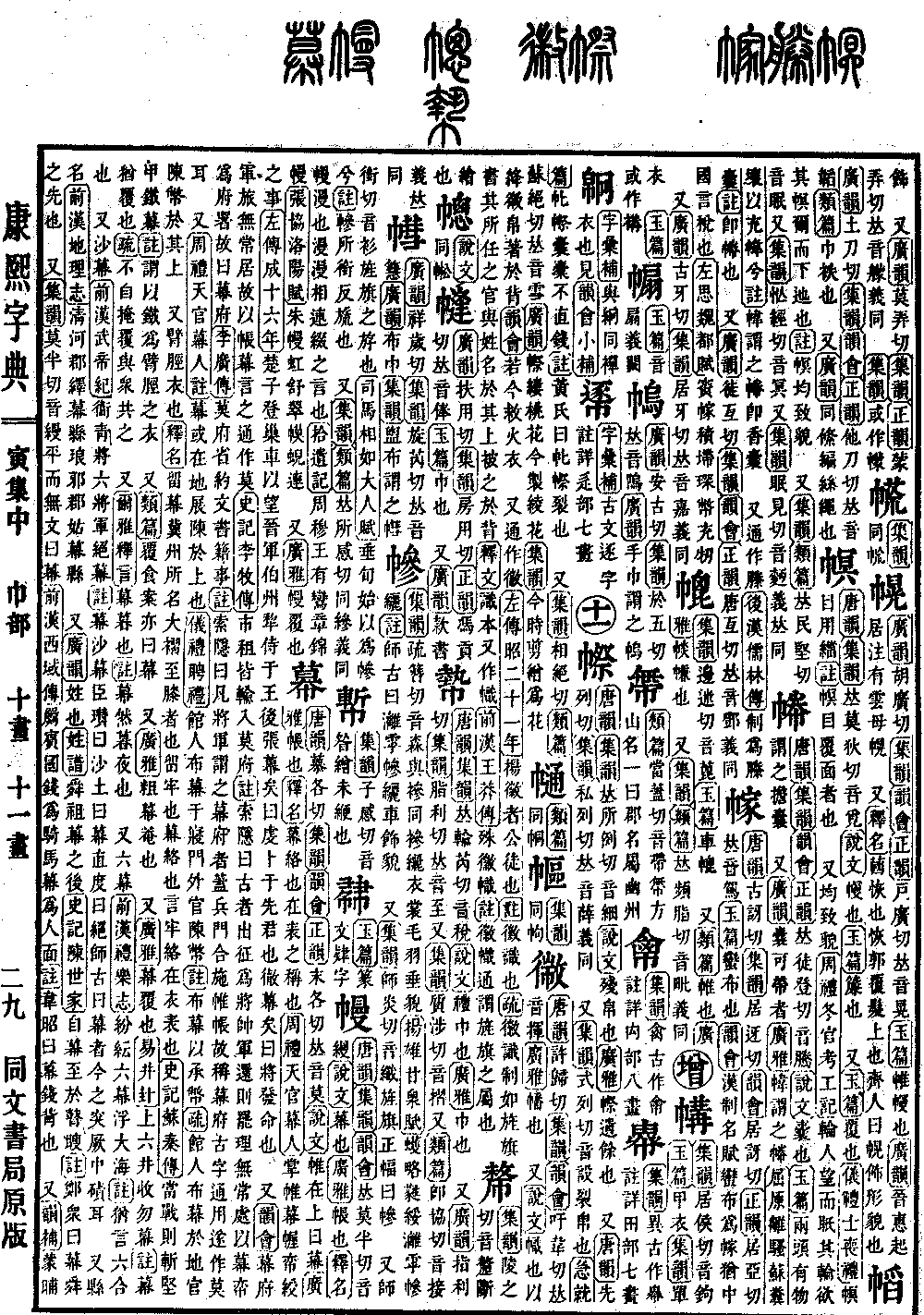
Yin Collection, Middle Volume. Radical: Towel (jīn). Kangxi stroke count: 14. Page 335, Entry 29.
Pronounced mo.
In the Shuowen Jiezi (Dictionary of Explaining Graphs), it is stated: A screen above is called mu.
In the Guangya (Broad Refinements), it is stated: A tent.
In the Shiming (Explanation of Names), it is stated: Mu means to wrap; it is a term for something on the exterior.
In the Rites of Zhou (Zhouli), Office of Heaven, Mu Ren, it is stated: Manage the affairs of curtains, tents, canopy, and silk ribbons.
In the Zuo Tradition (Zuozhuan), 16th Year of Duke Cheng, it is stated: The Viscount of Chu climbed the nest-carriage to observe the Jin army. Bo Zhouli attended the King from behind. The King said: The tents are raised. He replied: This is to offer divination to the former kings. The tents are taken down. He replied: It is to issue commands.
Also, according to the Yunhui (Collection of Rhymes), a military headquarters is called a mufu. Because military campaigns have no permanent residence, the term is derived from the tents used. It is also commonly written as mo.
In the Records of the Grand Historian (Shiji), Biography of Li Mu, it is stated: Market taxes are all paid into the mufu. The commentary says: In ancient times, when going on a campaign as a general, the office would be disbanded upon returning. Since there was no permanent location, tents were used as an office, hence the term mufu.
In the Biography of Li Guang, it is stated: The mufu reduced and simplified administrative documents and affairs. The commentary says: A general is called mufu because, at the military gate, tents are erected, thus it is called mufu. In ancient times, the characters were interchangeable, so it was written as mo.
Also, in the Rites of Zhou, Office of Heaven, Mu Ren commentary, it is stated: Mu may also refer to something on the ground, spread out on top.
In the Book of Etiquette and Ceremonial (Yili), Pinyan, it is stated: The innkeeper spreads a curtain outside the sleeping quarters for the official gifts. The commentary says: Spread the curtain to receive the gifts. The sub-commentary says: The innkeeper spreads the curtain on the ground and places the gifts upon it.
It also refers to clothing for the arms and shins. In the Shiming, it is stated: Liumu, known in Jizhou as a large robe reaching the knees. Liu means secure; mu means to wrap. This implies a secure wrapping on the outer layer of clothing.
In the Records of the Grand Historian, Biography of Su Qin, it is stated: When fighting, they cut through strong armor and iron leg coverings. The commentary says: This refers to arm and shin guards made of iron.
Also, in the Leipian (Classified Dictionary), it is stated: A cover for a dining table is also called mu.
Also, in the Guangya, it is stated: A crude thatched hut is called mu.
Also, in the Guangya, it is stated: Mu means to cover.
In the Book of Changes (Yijing), Jing hexagram, it is stated: In the top line, the well is full; do not cover it. The commentary says: Mu means to cover. The sub-commentary says: Do not cover it yourself, but share it with others.
Also, in the Erya (Approaching Elegance), Explaining Words, it is stated: Mu means evening. The commentary says: Muran means the darkness of night.
Also, the Six Mu. In the History of the Former Han (Hanshu), Treatise on Rites and Music, it is stated: The chaotic six mu float on the great sea. The commentary says: This is synonymous with the six directions of the universe.
Also, the Sandy Mu. In the History of the Former Han, Annals of Emperor Wu, it is stated: Wei Qing led six generals to cross the desert (mu). The commentary says: Mu refers to a sandy desert. Chen Zan says: Sandy earth is called mu; crossing it directly is called jue. Shigao says: The mu is what is now the desert region within the territory of the Tujue (Turks).
Also, a district name. In the History of the Former Han, Treatise on Geography, it is stated: Yimu District in Qinghe Commandery, and Gumu District in Langya Commandery.
Also, pronounced as a surname. In the Xingpu (Genealogy of Surnames), it is stated: A descendant of the ancestor Mu of Shun. In the Records of the Grand Historian, Genealogy, it is stated: From Mu to Gusou. The commentary says: Zheng Zhong says: Mu is an ancestor of Shun.
Also, pronounced man. Level and without pattern is called mu.
In the History of the Former Han, Records of the Western Regions, it is stated: The currency of the Jibin kingdom has a horse on one side and a human face on the mu. The commentary says: Wei Zhao says: Mu is the reverse side of a coin.
Also, pronounced mo. In Li Ling's Song of Parting with Su Wu: Traveling ten thousand miles to cross the sandy desert, leading troops for you to strike the Xiongnu.
Also, pronounced mi. In Lu Tong's Song of Thinking of the King: My heart is like the wind, soughing and soughing; your body is like clouds, layer upon layer.