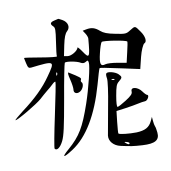
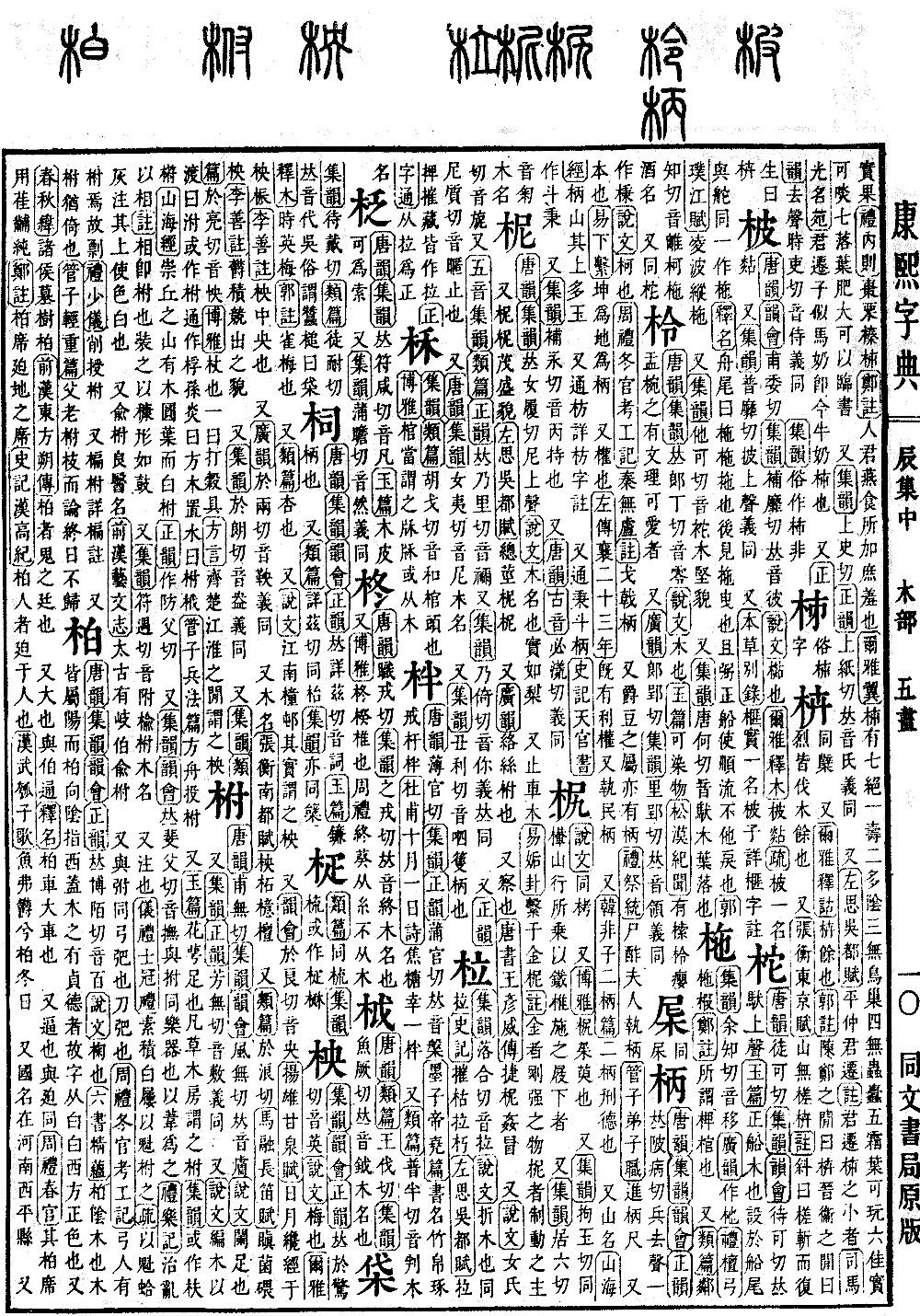
Chen Collection, Page 518, Entry 10
Radical: Tree (mù)
Pronounced ni (rising tone).
Explanations from Explaining Graphs and Analyzing Characters (Shuowen Jiezi): The name of a tree. The fruit resembles a pear.
Also refers to a wooden block used to stop a wheel from sliding.
As cited in the Book of Changes (Yijing), Hexagram Gou: Bound to a metal stopper.
Note: Metal is a hard and resilient material; the stopper is the key to controlling motion.
Also describes a luxuriant appearance, such as ni-ni.
As cited in the Rhapsody on the Capital of Wu (Wudu Fu) by Zuo Si: Its stems gathered in luxuriant clusters.
Also refers to the base of a tool used for reeling silk.
Also carries the meaning of monitoring or investigating.
As cited in the History of the Tang Dynasty (Tangshu), Biography of Wang Yanwei: Quickly checking and investigating those who are treacherous or fraudulent.
Also, according to Explaining Graphs and Analyzing Characters (Shuowen Jiezi), it is pronounced ni (dipping tone).
Also, according to the Rhyme Collection of the Five Sounds (Wuyin Jiyun), the Comprehensive Compilation of Characters (Leipian), and the Correct Rhymes (Zhengyun), it is pronounced ni (rising tone).
Also, according to the Collection of Rhymes (Jiyun), it is pronounced ni (rising tone). The above pronunciations share the same meaning.
Also, according to the Correct Rhymes (Zhengyun), it is pronounced ni (entering tone). The meaning is to stop or prevent.
Also, according to the Tang Rhymes (Tangyun) and the Collection of Rhymes (Jiyun), it is pronounced ni (level tone). It is the name of a type of tree.
Also, according to the Collection of Rhymes (Jiyun), it is pronounced xi (entering tone). It refers to the handle of a tool used for reeling silk.