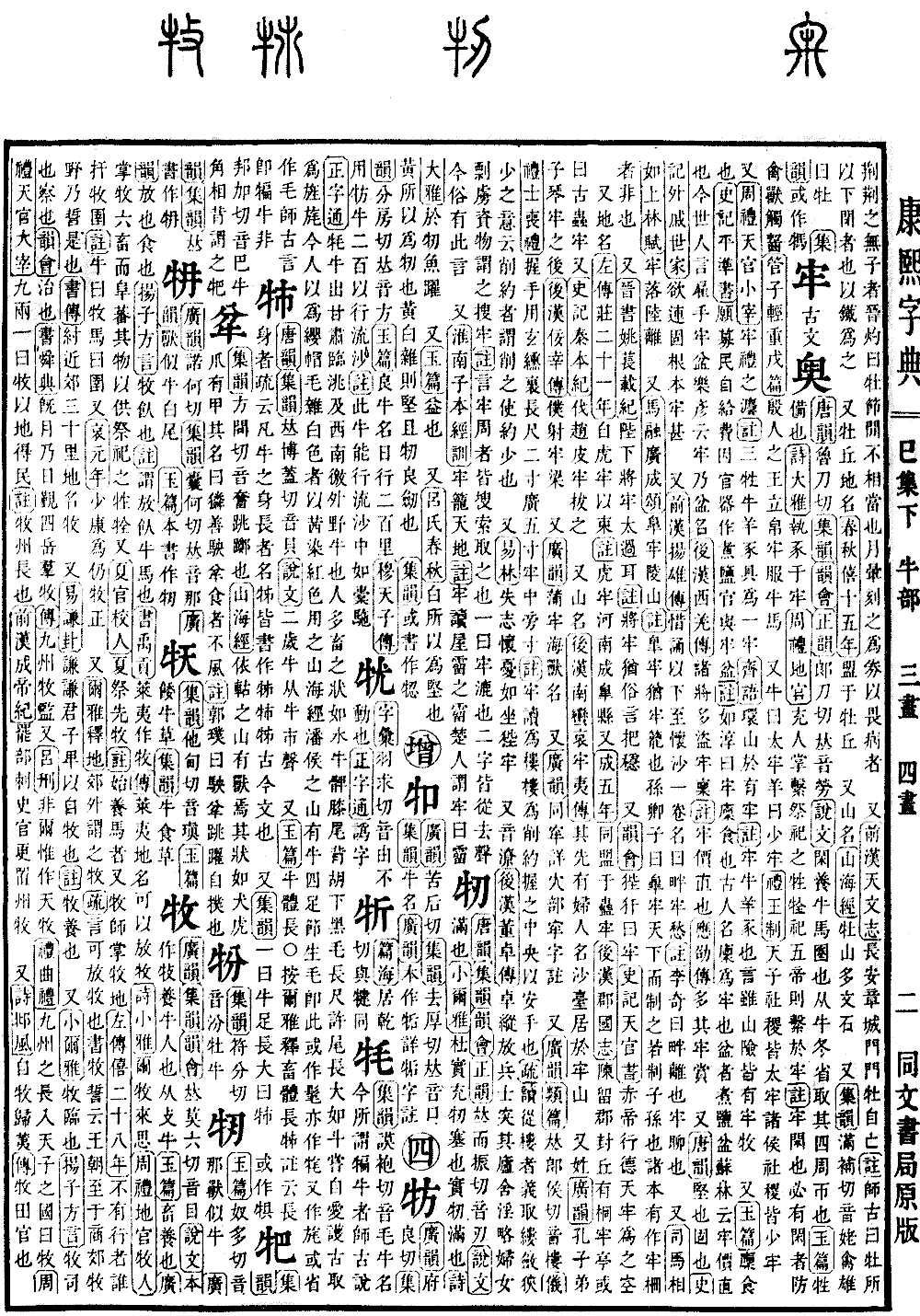
Si Collection, Lower Volume
Radical: Cow (niú)
Page 698, Entry 16
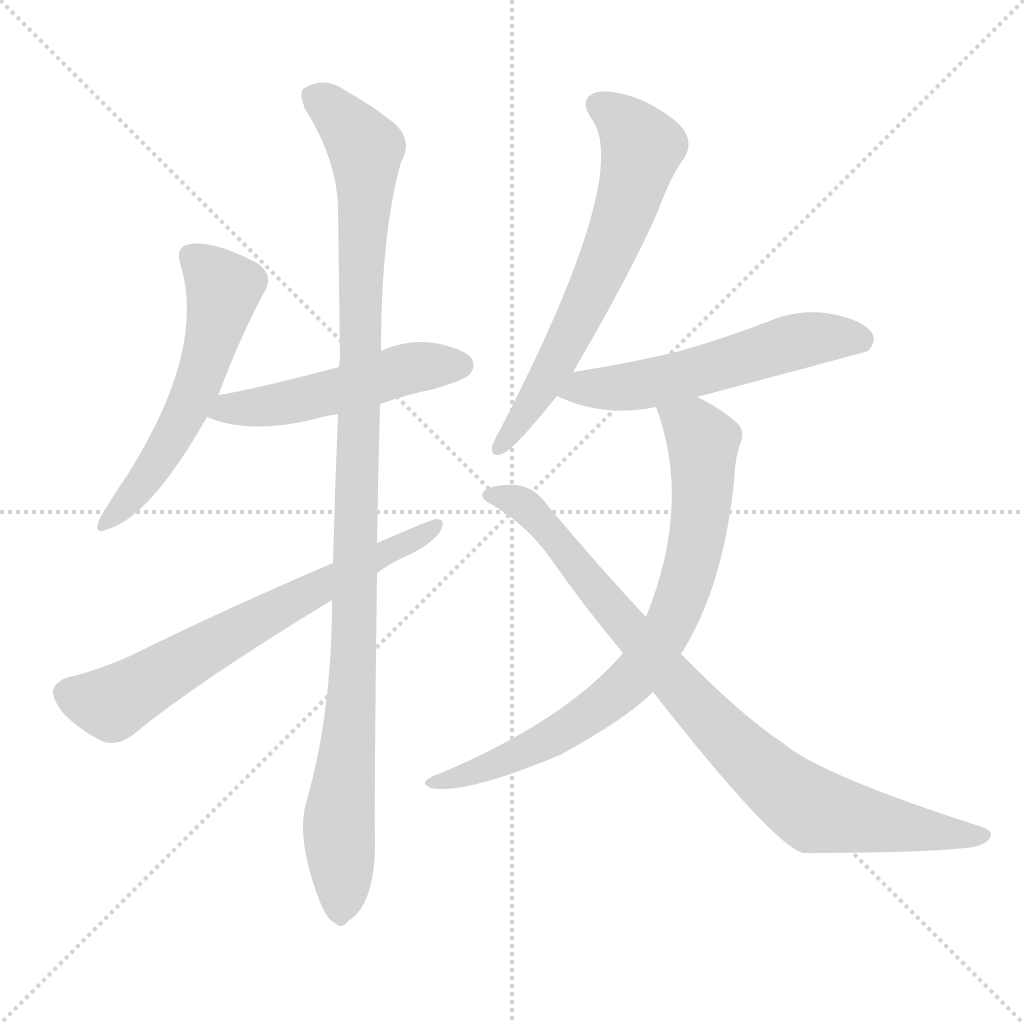
Guangyun, Jiyun, Yunhui: Pronounced mu.
Shuowen: Originally written as an ideogram representing a person who raises cattle. The form consists of the components for to strike and cow.
Yupian: Means to raise or keep livestock.
Guangyun: Means to pasture or feed.
Yangzi Fangyan: Mu means to feed.
Note: Refers to the pasturing and feeding of cattle and horses.
Book of Documents (Shujing), Yu Tribute (Yugong): In the region of Laiyi, people engage in pasturing.
Commentary: Laiyi is a place name where one may pasture.
Book of Odes (Shijing), Minor Odes (Xiaoya): Your herdsmen have arrived.
Rites of Zhou (Zhouli), Earth Office (Diguan), Herdsman: Responsible for the rearing of the six sacrificial animals and ensuring their prosperity, so as to supply pure-colored and intact animals for sacrifice.
Also, Summer Office (Xiaguan), School Official (Xiaoren): In the summer, offer sacrifice to the First Herdsman.
Note: Refers to the earliest horse breeder.
Also, the Herdsman Official manages pasture lands.
Zuo Commentary (Zuozhuan), 28th Year of Duke Xi: If there were no outsiders, who would defend those who pasture cattle and horses?
Note: Cattle are called mu, and horses are called yu.
Also, 1st Year of Duke Ai: Shaokang served as the Chief Herdsman of Reng.
Also, Er Ya, Explaining Places (Shidi): The outskirts are called mu.
Commentary: This means it is a place where one can pasture. The Book of Documents, Oath at Mu (Mushe), states: King Wu of Zhou arrived at the outskirts of the Shang capital at Muye in the morning and swore his troops, which refers to this place.
Shuchuan: The area within thirty li of the capital of King Zhou of Shang is called Mu.
Also, Book of Changes (Yijing), Humility Hexagram (Qian Gua): The superior man who is humble and continues to be humble uses this attitude to cultivate his virtue.
Note: Mu means to cultivate or nourish.
Also, Xiao Er Ya: Mu means to govern or control.
Yangzi Fangyan: Mu means to supervise or inspect.
Yunhui: Means to govern.
Book of Documents (Shujing), Canon of Shun (Shundian): In that month, Shun met daily with the Four Mountains and the chieftains of the various states.
Commentary: Refers to the provincial governors and inspecting officials of the Nine Provinces.
Also, Lu Penal Code (Luxing): Are you not governing the people on behalf of Heaven?
Book of Rites (Liji), Songs of the Various Officers (Quli): Provincial governors, when entering the royal domain of the Son of Heaven, refer to themselves as Mu.
Rites of Zhou (Zhouli), Heaven Office (Tianguan), Grand Administrator (Dazai): Among the nine methods of connecting with the populace, the first is called Mu, meaning to obtain the populace through the land.
Note: Mu refers to the provincial governor.
History of the Former Han (Qianhan), Annals of Emperor Cheng: Abolished the positions of circuit inspectors and replaced them with provincial governors.
Also, Book of Odes (Shijing), Odes of Bei (Beifeng): Gathered sprout grass from the pasture in the outskirts and sent it to me.
Commentary: Mu refers to the official who manages the fields.
Also, Book of Rites (Liji), Monthly Ordinances (Yueling): The boat master inspects the boats.
Note: Refers to the official in charge of boats.
Also, Rites of Zhou (Zhouli), Earth Office (Diguan), Minor Director of the Multitude (Xiaositu): Then surveyed the land and divided the fields according to the systems of well-fields and pastures.
Note: In low-lying, damp areas, the land for nine families constitutes one pasture, and two pastures are equivalent to one well-field. Nowadays, when building capitals and towns, land is granted to the people: there is the constant land, land that is cultivated one year and rested one year, and land that is cultivated one year and rested two years; the total ratio is two parts land to one part constant arable land, which is called well-pasturing.
Also, Rites of Zhou (Zhouli), Earth Office (Diguan), Official of the Districts (Suishi): Divided the field boundaries and planned the fields according to the well-pasturing method.
Note: Jingmu means to mark out field boundaries and well-fields.
Also, Guangyun: Means to put to work.
Also, Er Ya, Explaining Livestock (Shichu): A cow with a black belly is called Mu.
Commentary: A cow with a black belly is named Mu.
Also, Zuo Commentary (Zuozhuan), 5th Year of Duke Yin: The people of Zheng invaded the pastures of Wei.
Note: Mu is a city in the state of Wei.
Also, Guangmu is the name of a county. It was under the jurisdiction of Shuofang Commandery, as seen in the History of the Former Han (Qianhan), Treatise on Geography (Dilizhi).
Also, a personal name.
Records of the Grand Historian (Shiji), Annals of the Yellow Emperor (Huangdi Ji): Promoted Feng Hou and Li Mu.
Note: Ban Gu stated: Li Mu was the prime minister of the Yellow Emperor.
Also, a surname.
Fengsu Tong: In the Han dynasty, there was a Prefect of Yuexi named Mu Lang.
Also, Jiyun: Pronounced mao. A place name.
Shangshu Dazhuan: Muye. Liu Changzong reads it this way.
Also, another meaning is animal husbandry.
Book of Documents (Shujing), Yu Tribute (Yugong): Refers to the Laiyi and the land of animal husbandry. In Shiewen, Xu Miao gives the pronunciation as mu, and another pronunciation as mao.
Also, phonetic rhyme is pronounced mo-di.
Book of Odes (Shijing), Minor Odes (Xiaoya): I mobilize my war chariots to head to that pasture in the outskirts. From the Son of Heaven, I am commanded to come here. I gather the charioteers and tell them to load everything. The state is in danger, and the situation is truly urgent. The rhyme "lai" sounds like liu-zhi, and "zai" sounds like jie-li.