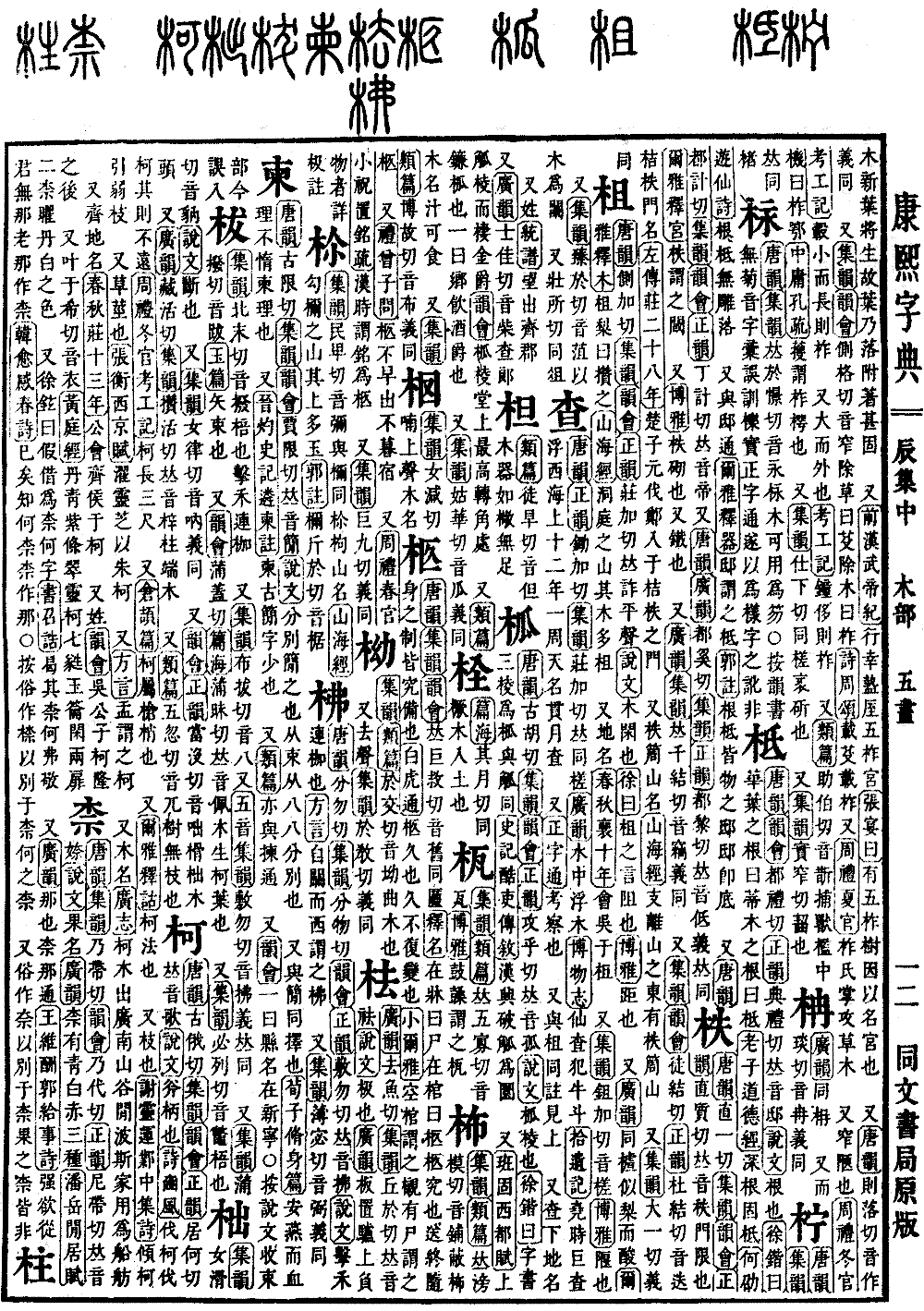
Chen Collection, Middle Volume
Radical: Wood (mù)
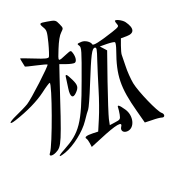
柧
Kangxi stroke count: 9
Page 520, Entry 09
Tang Rhyme (Tangyun) and other rhyming dictionaries record the pronunciation as gu.
According to the Explaining Graphs and Analyzing Characters (Shuowen), the term denotes a ridge or corner.
Xu Kai comments that in lexicons, a three-sided shape is called a ridge, which is the same as a goblet (gu).
In the Historical Records (Shiji), Biography of Harsh Officials, it is written: After the rise of the Han dynasty, they broke the sharp-edged goblets to make them round.
Furthermore, in Ban Gu's Western Capital Rhapsody (Xidu fu), it is written: Above the sharp-edged roof corners, the golden sparrows perch.
In the Collection of Rhymes (Yunhui), the term ridge refers to the highest turning corner of a hall.
Also, according to the Classified Chapters (Leipian), it refers to a sickle-like ridge, or alternatively, a wine goblet used in local drinking ceremonies.
Also according to the Collected Rhymes (Jiyun), pronounced gua. The meaning is the same.