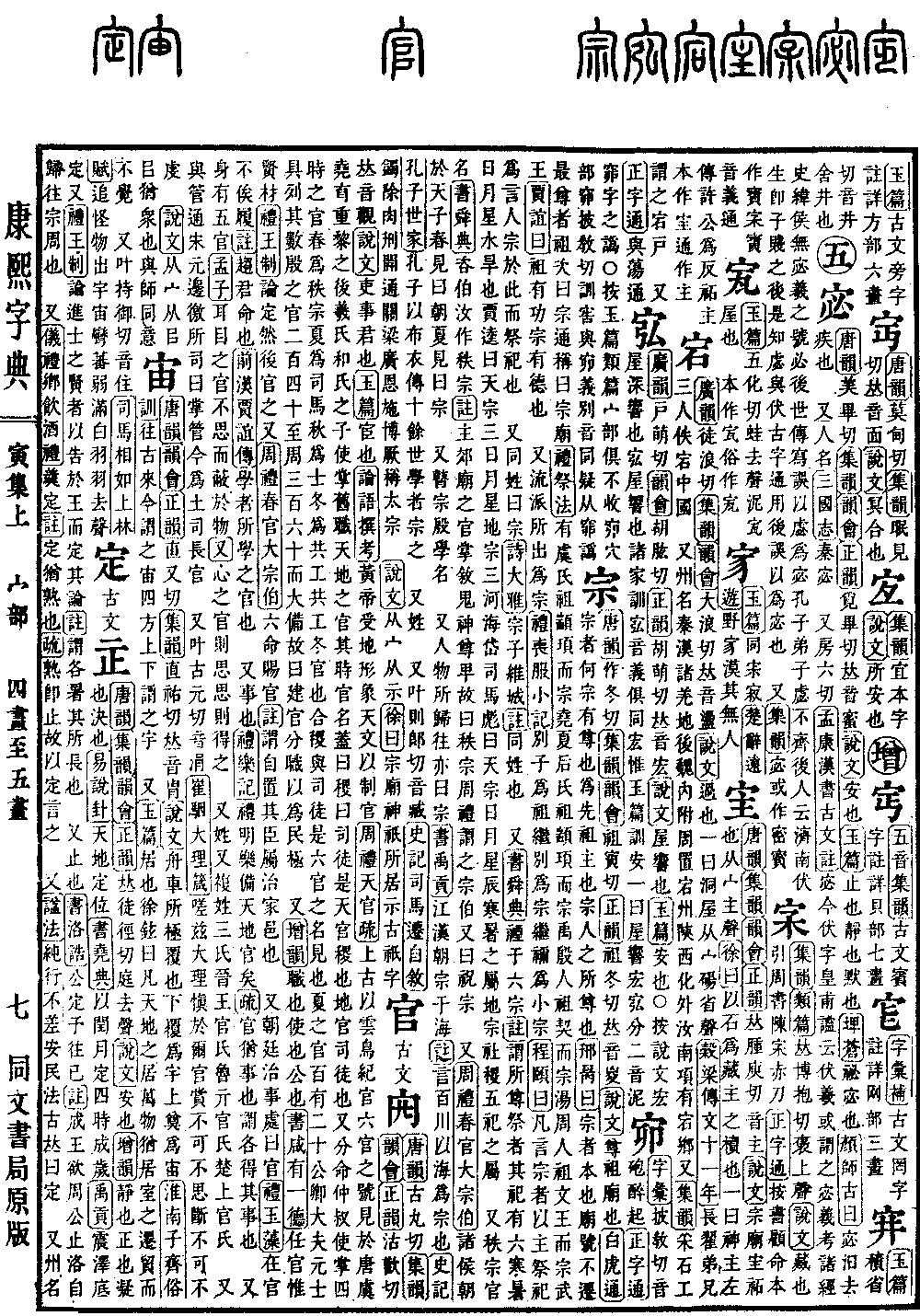
Yin Collection, Upper Volume
Radical: Roof (bù)
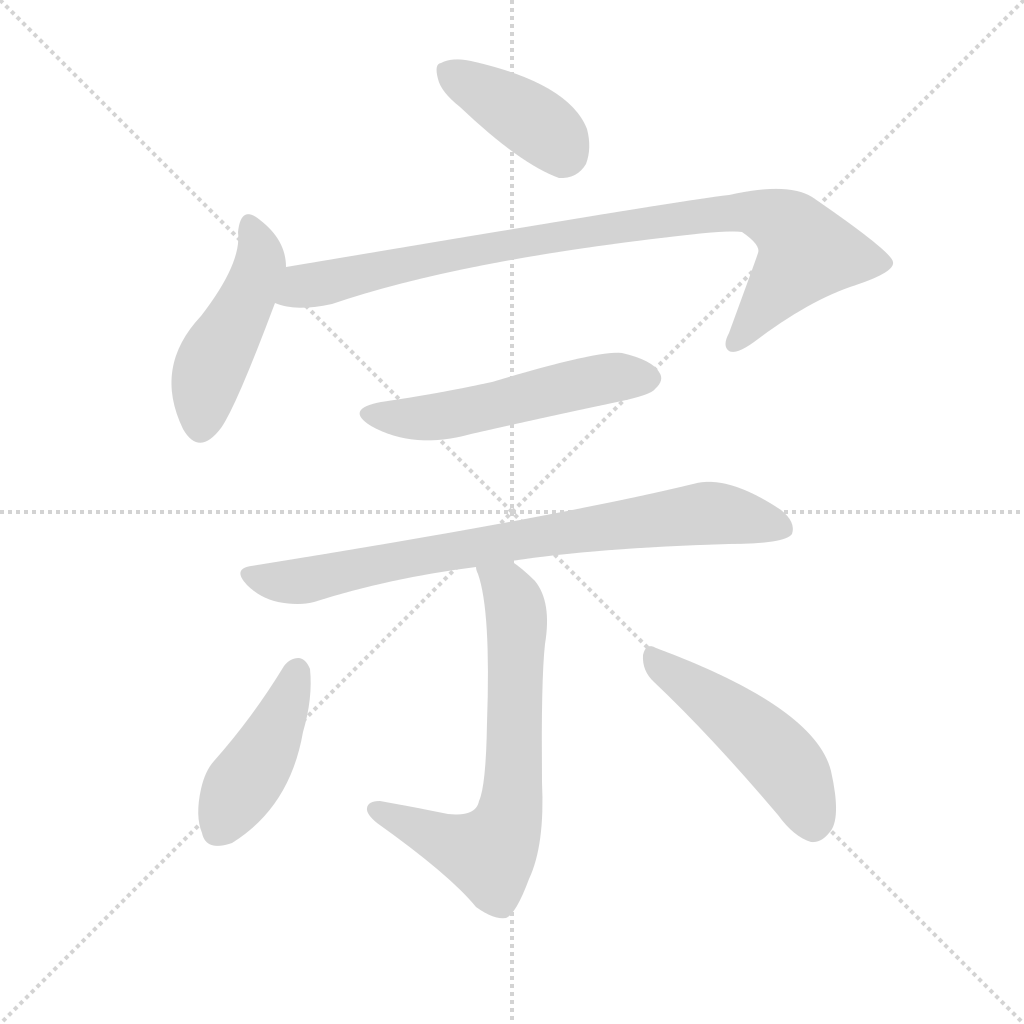
Zong
Kangxi stroke count: 8
Page 283, Entry 14
Pronounced zong
Pronounced zong
Pronounced zong
Pronounced zong
Shuowen Jiezi (Explanation of Simple and Compound Characters): To honor an ancestral temple.
Baihu Tong (Comprehensive Discussions in the White Tiger Hall): Zong carries the meaning of reverence. It refers to the spirit tablets used for offering sacrifices to ancestors, which are collectively venerated by members of the same clan.
Xing Bing states: Zong means the foundation. In temple names that remain unchanged, the most honored is called Zu, and those that follow are called Zong; collectively they are referred to as Zongmiao (ancestral temples).
Book of Rites (Liji), Ritual Law: The Yu tribe honored Zhuanxu as Zu and Yao as Zong. The Xia dynasty honored Zhuanxu as Zu and Yu as Zong. The Shang people honored Xie as Zu and Tang as Zong. The Zhou people honored King Wen as Zu and King Wu as Zong.
Jia Yi states: Zu refers to those with great achievements, while Zong refers to those with great virtue.
Also, the source from which a school of thought originates is called Zong.
Book of Rites (Liji), Records of Mourning Garments: A Biezi (a son other than the eldest) becomes the founding ancestor of a clan. Those who inherit the line of the Biezi form the Da Zong (Major Lineage), while those who inherit from their father (called Mi) form the Xiao Zong (Minor Lineage).
Cheng Yi states: Whenever the term Zong is used, it refers to those who preside over sacrificial rites, as people revere them and conduct sacrifices accordingly.
Also, those sharing the same surname are called Zong.
Book of Odes (Shijing), Greater Odes: The Zongzi (lineage head) is like a fortress wall. Commentary: This refers to those sharing the same surname.
Also, Book of Documents (Shangshu), Canon of Shun: Sacrificing to the six Zong. Commentary: This refers to the six objects of veneration and sacrifice, which are cold, heat, the sun, the moon, the stars, and water/drought. Jia Kui states: The three celestial Zong are the sun, the moon, and the stars. The three terrestrial Zong are the rivers, the seas, and Mount Tai. Sima Biao states: The celestial Zong are things like the sun, moon, stars, cold, and heat; the terrestrial Zong are things like the altars of earth and grain and the five offerings.
Also, Zhizong is the name of an official post.
Book of Documents (Shangshu), Canon of Shun: Consulted Boyi, you shall serve as Zhizong. Commentary: An official in charge of suburban and temple sacrifices, managing the order of precedence among ghosts and spirits, hence called Zhizong. In the Rites of Zhou (Zhouli), it is called Zongbo. Also called Zhuzong.
Also, Rites of Zhou (Zhouli), Spring Officials, Grand Zongbo: Using guest rites to make the feudal states close and attached; the spring audience is called Chao, and the summer audience is called Zong.
Also, Guzong is the name of a school in the Shang dynasty.
Also, that which people return to and admire is also called Zong.
Book of Documents (Shangshu), Tribute of Yu: The Yangtze and Han rivers rush toward the sea like feudal lords visiting the Emperor. Commentary: This means that all rivers take the great sea as their destination.
Records of the Grand Historian (Shiji), Hereditary House of Confucius: Confucius, as a commoner, passed down his teachings for over ten generations, and all scholars revere him.
Also, it is a surname.
Also, pronounced zang.
Records of the Grand Historian (Shiji), Autobiography of Sima Qian: Abolished corporal punishments, opened passes and bridges, widely bestowed benevolence, and he was called Taizong.
Shuowen Jiezi (Explanation of Simple and Compound Characters): Composed of the roof radical and the spirit radical.
Xu Kai states: An ancestral temple is the place where spirits dwell. The spirit radical is the ancient character for deity.
Textual research: Rites of Zhou (Zhouli), Spring Officials, Grand Zongbo: When feudal lords visit the Emperor, the spring audience is called Chao, the summer audience is called Zong. Strictly following the original text, changed from the feudal lords visiting the emperor to guest rites to make the states close.