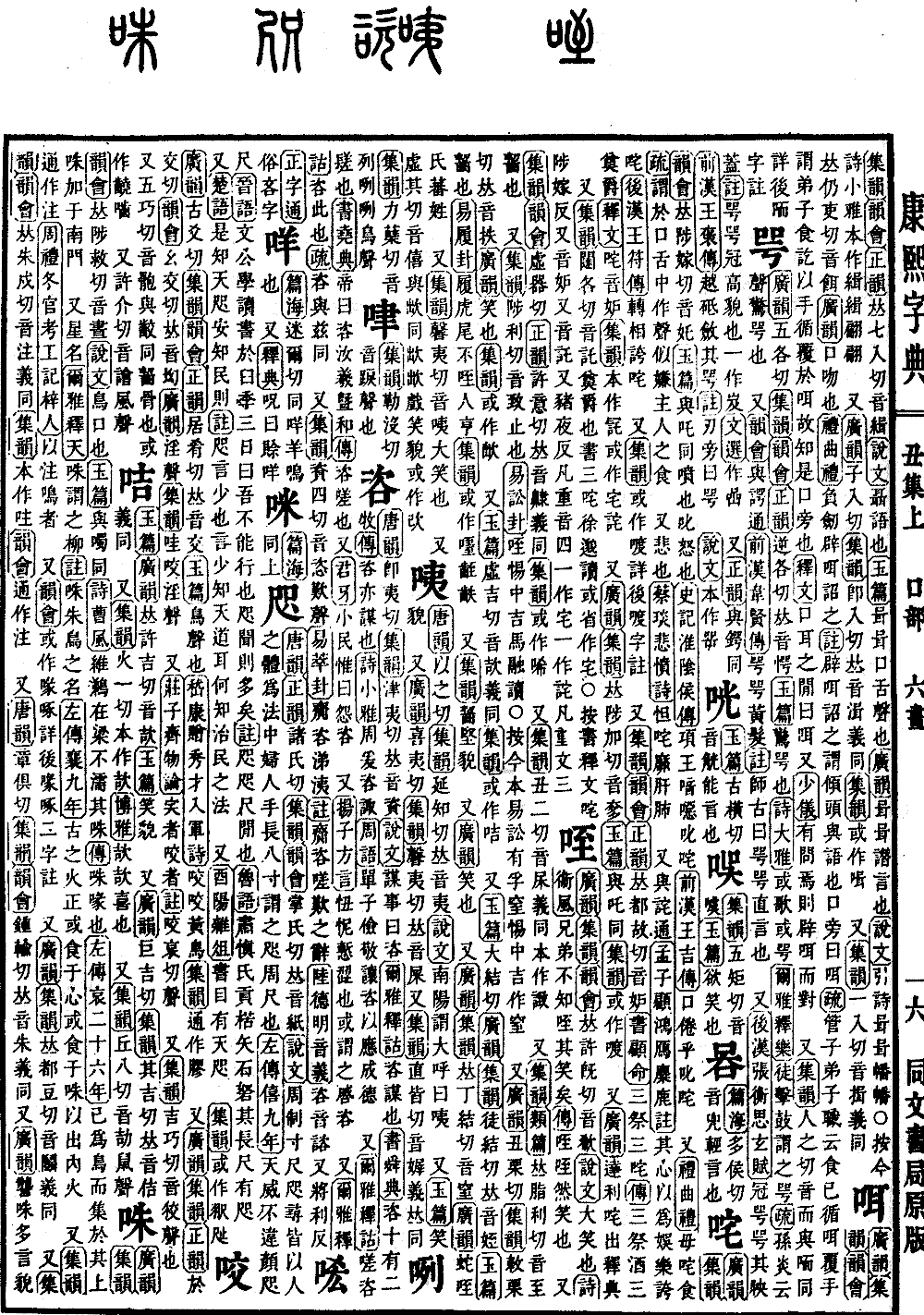
Chou Collection, Upper Volume
Radical: Mouth (kǒu)
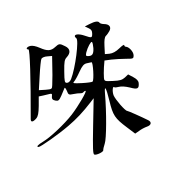
Character: Zhou
Kangxi strokes: 9
Page 186, Entry 18
According to the Extensive Rhymes (Guangyun), Collected Rhymes (Jiyun), and Rhyme Compendium (Yunhui), the pronunciation is zhou (falling tone).
According to the Explaining Graphs and Analyzing Characters (Shuowen), it is the beak of a bird.
According to the Jade Chapters (Yupian), it is the same as zhou (beak).
Book of Odes (Shijing), Odes of Cao: The pelican is on the bridge, not wetting its beak.
Commentary: Zhou means beak.
Zuo Tradition (Zuozhuan), twenty-sixth year of Duke Ai: It has already become a bird and gathered above it, with its beak resting on the south gate.
Also, it is the name of a star.
Literary Expositor (Erya), Interpretation of Heaven: Zhou is called Liu.
Note: Zhou is the name of a vermilion bird.
Zuo Tradition (Zuozhuan), ninth year of Duke Xiang: The fire officials of antiquity, some were responsible for the Heart constellation, some for the Zhou constellation, to regulate the manifestation and seclusion of fire.
Also, according to the Collected Rhymes (Jiyun), it is interchangeable with zhu (to pour).
Rites of Zhou (Zhouli), Winter Officials, Record of Trades (Kaogongji), Carpentry: Those that sing with a zhu (beak).
Also, according to the Rhyme Compendium (Yunhui), it may be written as hui (beak) or zhuo (to peck); see the detailed notes on the characters hui and zhuo later.
Also, according to the Extensive Rhymes (Guangyun) and Collected Rhymes (Jiyun), the pronunciation is dou (falling tone). The meaning is the same.
Also, according to the Collected Rhymes (Jiyun) and Rhyme Compendium (Yunhui), the pronunciation is zhu (falling tone). The meaning is the same.
Collected Rhymes (Jiyun): This is the original form.
Rhyme Compendium (Yunhui): It is used interchangeably with zhu (to pour).
Also, according to the Tang Rhymes (Tangyun), the pronunciation is zhu (level tone); according to the Collected Rhymes (Jiyun) and Rhyme Compendium (Yunhui), the pronunciation is zhu (level tone). The meaning is the same.
Also, according to the Extensive Rhymes (Guangyun), zhe-zhou refers to the appearance of speaking too much.
Also, according to the Extensive Rhymes (Guangyun), the pronunciation is zhu (falling tone).
Extensive Rhymes (Guangyun): The sound of a bird.
Also, according to the Collected Rhymes (Jiyun), the pronunciation is ru (level tone). It is the same as ru (to chew/mumble). Nie-ru means to speak too much. It is sometimes written as dou.
Also, according to the Extensive Rhymes (Guangyun), Collected Rhymes (Jiyun), and Rhyme Compendium (Yunhui), the pronunciation is zhou (level tone).
Extensive Rhymes (Guangyun): A curved beak.