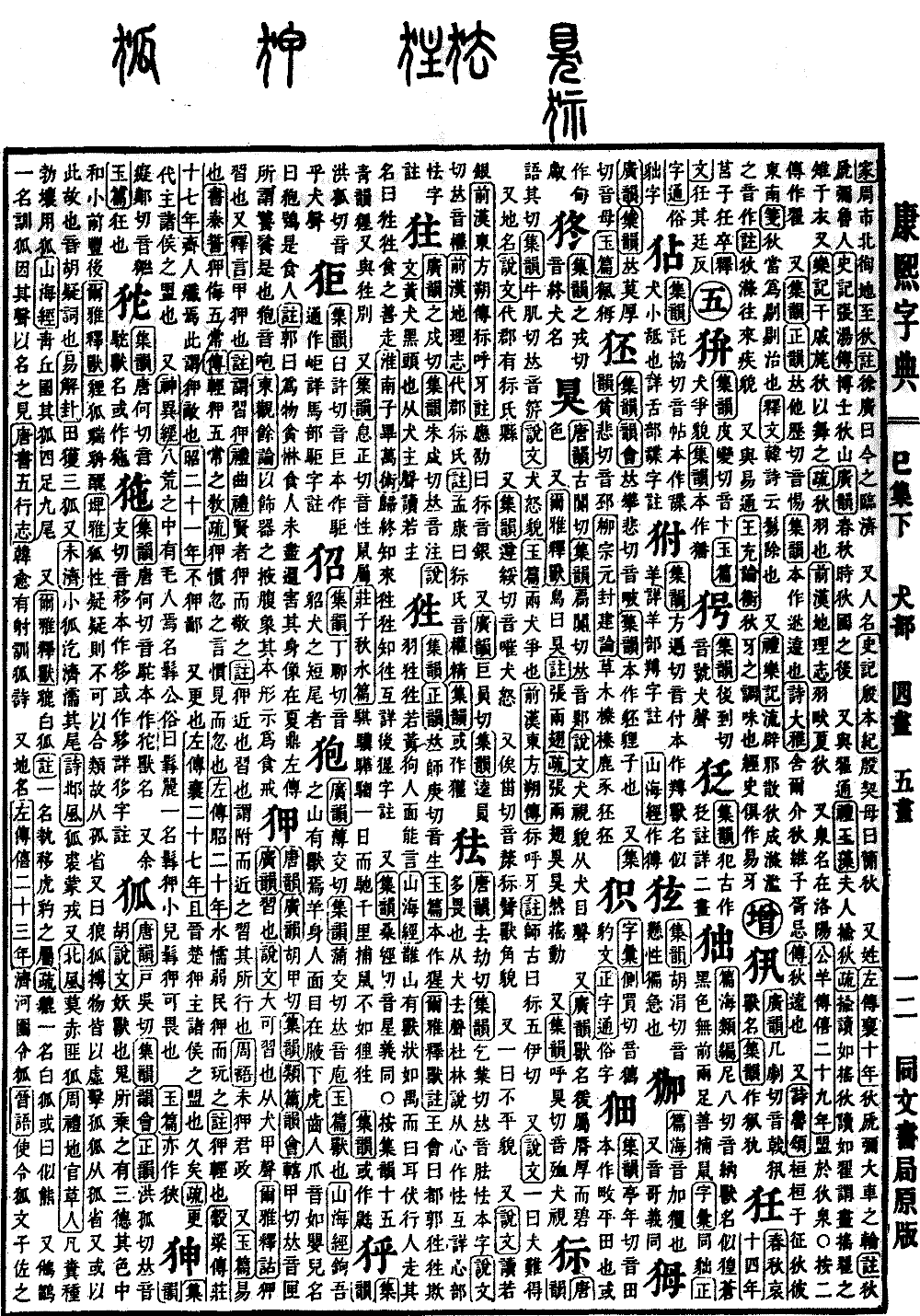
Si Collection, Lower Volume
Radical: Dog (quǎn)
Page 708, Entry 17
Pronounced qi
According to the Explaining Graphs and Analyzing Characters (Shuowen Jiezi): The appearance of a dog expressing anger.
According to the Jade Chapters (Yupian): Two dogs fighting.
In the Biography of Dongfang Shuo in the History of the Former Han Dynasty (Qian Hanshu): The phrase yi hong ya. The commentary by Yan Shigu states: Pronounced yi.
According to the Explaining Graphs and Analyzing Characters (Shuowen Jiezi): Another interpretation is a dog that is difficult to obtain.
Also a place name. According to the Explaining Graphs and Analyzing Characters (Shuowen Jiezi): There is a Yishi County in Dai Commandery.
Pronounced zui
A dog expressing anger.
Pronounced li
The term yiyi refers to the appearance of the horns of a wild beast. Another interpretation is the appearance of something being uneven.
According to the Explaining Graphs and Analyzing Characters (Shuowen Jiezi): Pronounced yin.
In the Biography of Dongfang Shuo in the History of the Former Han Dynasty (Qian Hanshu): The commentary by Ying Shao states: Pronounced yin.
Pronounced quan
In the Treatise on Geography in the History of the Former Han Dynasty (Qian Hanshu): Dai Commandery Yishi. The commentary by Meng Kang states: Yishi is pronounced quan jing.
According to the Collected Rhymes (Jiyun): Sometimes written as a variant form (huan).
Correction: In the Biography of Dongfang Shuo in the History of the Former Han Dynasty (Qian Hanshu), the text reads yi hong ya. Following the original text, the two occurrences of the character hu have been corrected to hong.