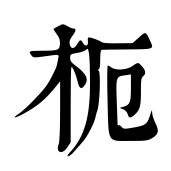
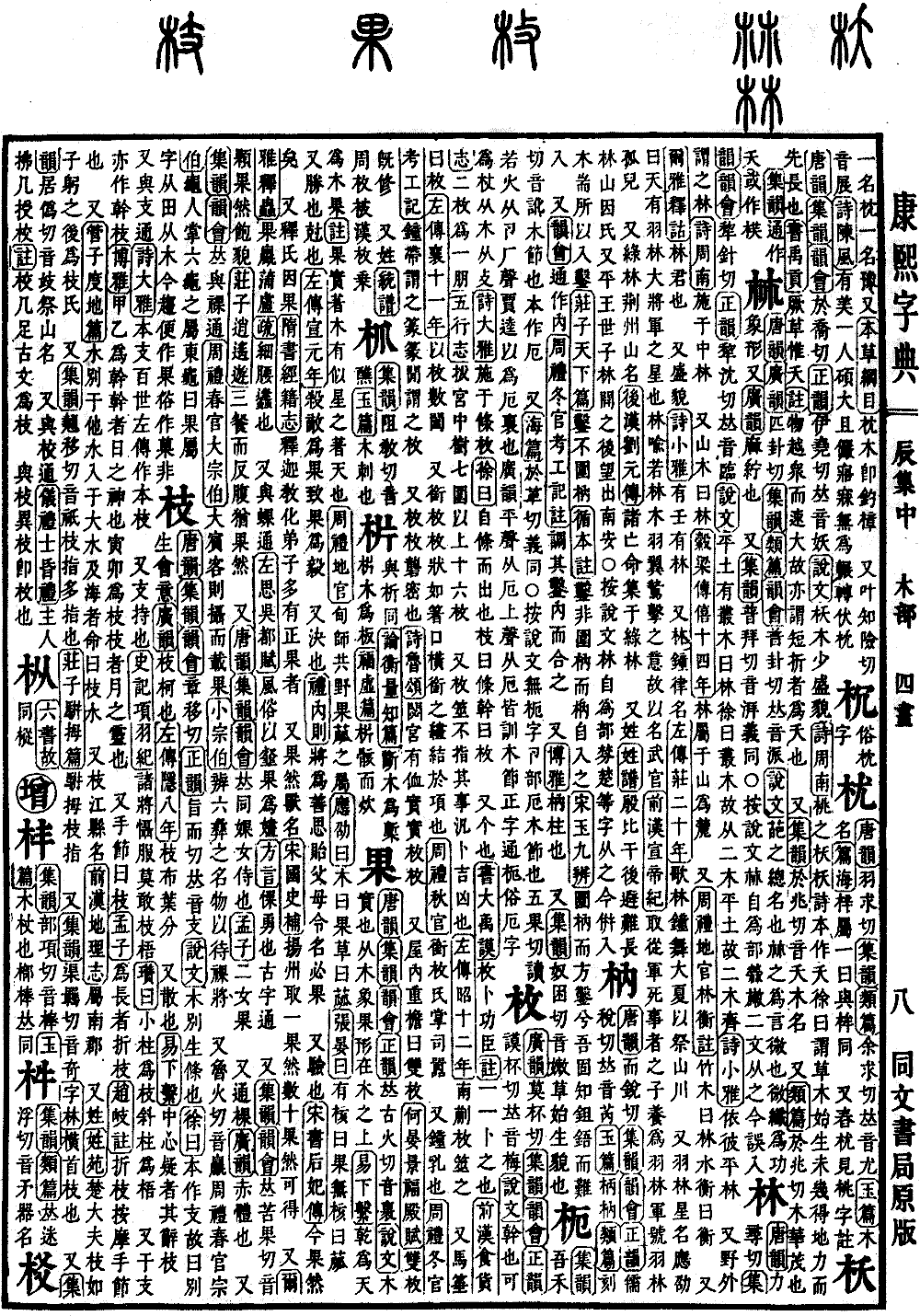
Chen Collection, Middle Volume. Radical: Tree (mù). Kangxi stroke count: 8. Page 516, Entry 07.
According to the Sound Rhymes (Jiyun), pronounced e. It refers to a knot in wood. Originally written as e. Also, according to the Sea Compilation (Haipian), pronounced ge. The meaning is the same. Note: The Analytical Dictionary of Characters (Shuowen) does not contain the character for this entry. Under the knot radical, e is defined as a knot in wood, pronounced huo, spelled with the initials for wu and guo, read like huo. It is formed from the knot radical with chang as the phonetic element. Jia Kui considered it to be the wrapping of a knot. The Extensive Dictionary of Rhymes (Guangyun) indicates that both the level tone and the rising tone are used to denote a knot in wood. The Correct Meaning Guide (Zhengzitong) states that this character is a vulgar form of e. Textual verification: Jia Kui considered it to be the wrapping of a knot. The character guo (wrapping) has been corrected according to the Analytical Dictionary of Characters (Shuowen).