Zi Collection, Page Position: Lower
Radical: Cover (mì)
Kangxi stroke count: 8
Page number: 130, entry 21
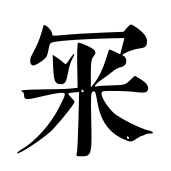
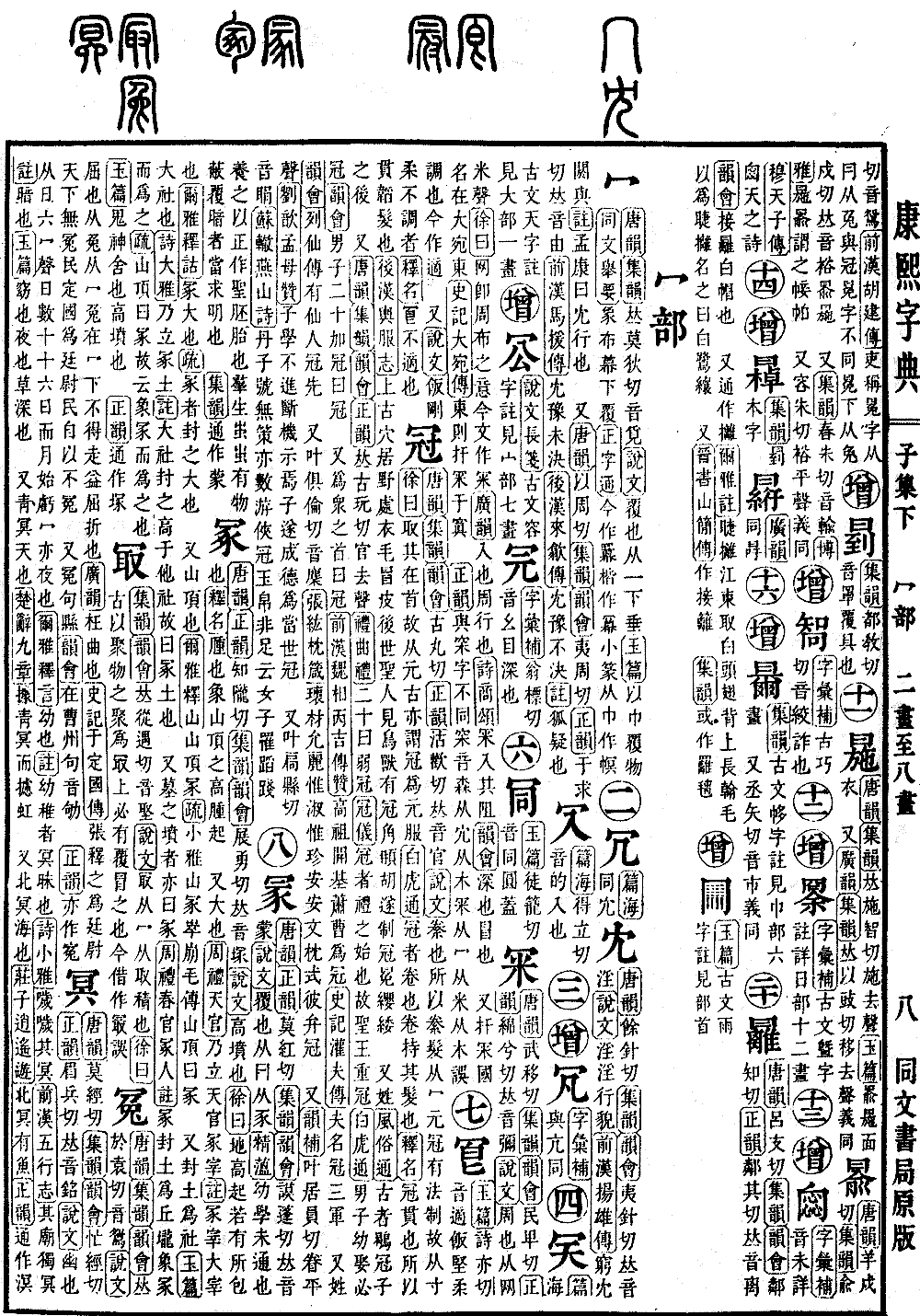
Pronounced mí in the Tang Yun, Jiyun, Yunhui, and Zheng Yun. The Shuowen Jiezi (Shuōwén Jiězì) says it means 'to surround' or 'all around'. It is formed from 'net' (wǎng) with 'rice' (mǐ) as the phonetic component. Xu Kai (Xú Kǎi) comments: 'net' (wǎng) implies the meaning of being spread all around. The modern form is written as 冞. The Guangyun (Guǎngyùn) defines it as 'to enter' or 'to circulate widely'. In the Odes of Shang (Shāng Sòng) from the Book of Odes (Shijing): "to deeply penetrate its obstacles." The Yunhui (Yùnhuì) defines it as 'deep' or 'to cover'. Also, Hanmi (Hànmí) is the name of a country located to the east of Dayuan (Dàyuān). In the Records of the Grand Historian (Shǐjì), Chapter on Dayuan: "To the east are Hanmi (Hànmí) and Yutian (Yútián)." The Zheng Yun (Zhèngyùn) notes that it is different from the character sēn. The character sēn is pronounced sēn and is composed of 'cave' (xuè) and 'wood' (mù). The character mí (冞) is composed of 'cover' (mì) and 'rice' (mǐ). Using 'wood' (mù) as a component is an error. The character mí (meaning full, extensive) is synonymous with duǒ.