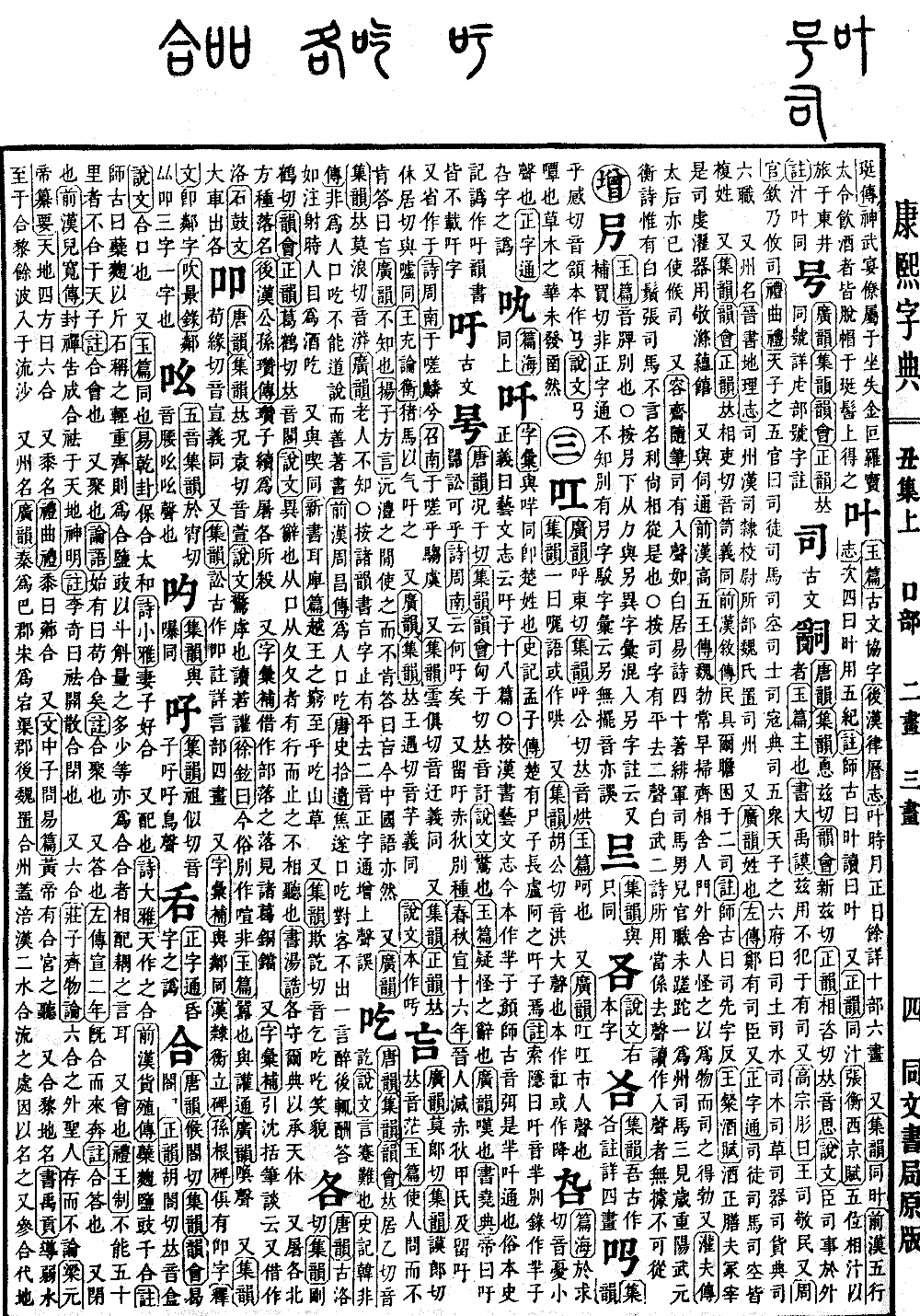
Chou Collection, Upper Volume
Radical: Mouth (kǒu)
Kangxi stroke count: 15
Page 174, Entry 01
Jade Chapters (Yupian): This is an ancient form of the character for harmony (xié).
History of the Later Han (Hou Hanshu), Treatise on Harmonics and Calendars: Harmonizing the seasons and months, and verifying the dates. For remaining details, see the Ten Collection, Six Strokes.
Also, Collected Rhymes (Jiyun): Identical to the character (shí).
History of the Former Han (Hanshu), Treatise on the Five Phases: The fourth item states that (shí) utilizes the five chronologies. Note: Shigu states that (shí) is pronounced the same as (yè).
Also, Orthography of Rhymes (Zhengyun): Identical to the character for juice (zhī).
Zhang Heng, Western Capital Rhapsody (Xijing Fu): The five positions harmonize with one another, moving in sequence to the Eastern Well asterism. Note: Juice (zhī) is the same as (yè).
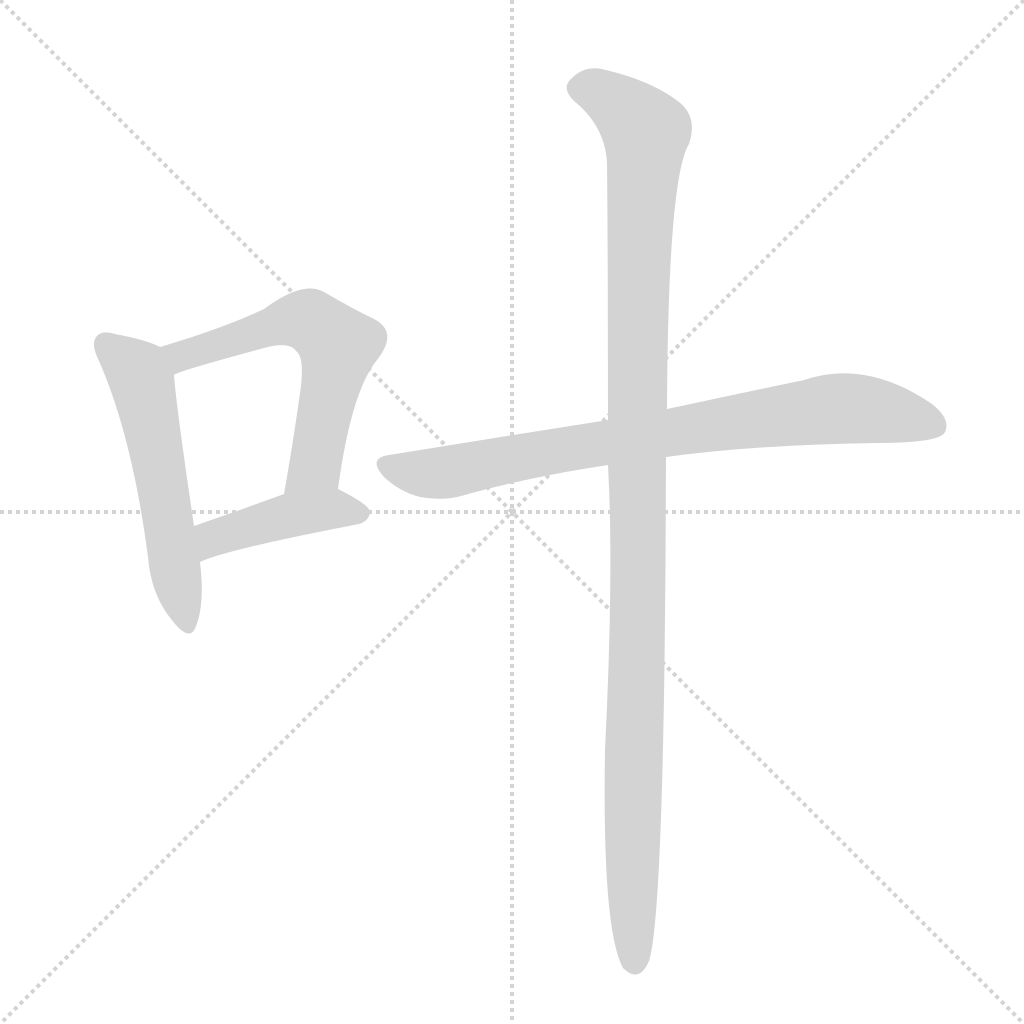
(yè)
Tang Rhymes (Tangyun): Pronounced shè.
Collected Rhymes (Jiyun) and Orthography of Rhymes (Zhengyun): Pronounced yè.
Explanation of Simple and Compound Characters (Shuowen Jiezi): Refers to the leaves of plants and trees.
Lu You Poetry Notes: People in the Wu region directly refer to mulberry leaves as (yè).
Also refers to generations.
Book of Odes (Shijing), Hymns of Shang: In the distant middle generations, there was a tremor and a great undertaking.
Also, Extensive Eulogies (Boya): Means to gather or accumulate.
Also refers to a book or scroll.
Ouyang Xiu: People in the Tang dynasty stored books as scrolls, but later developed leaves, which are similar to modern volumes.
Also a surname.
Comprehensive Records (Tongzhi), Treatise on Clans: The Ye clan was formerly pronounced shè, but in later generations, it is pronounced the same as the leaf of a tree.
Also interchangeable with the character (xié).
Book of Etiquette and Ceremonial (Yili), Guest Ritual for Scholars: The assistant washes in the room, scoops sweet wine from the side, adds a ladle, and turns it so the bowl of the ladle faces upward. Note: In ancient texts, (yè) was written as (xié).
Also pronounced shè.
Zuo Commentary (Zuo Zhuan), Notes on Ye: Ye refers to the present-day Ye County in Nanyang.
Also, Rhyme Supplement (Yunbu): Pronounced nüè.
Forest of Changes (Yilin): The mulberry tree is fragrant and about to wither, dropping its yellow leaves.
Also pronounced jí.
Forest of Changes (Yilin): Different leaves grow from the same trunk, bringing joy to the virtuous. The neighboring state to the east admires our morality and comes to assist our country.
Also, Collected Rhymes (Jiyun): Pronounced dié. Identical to the character for a book section (dié), referring to the title of a chapter in a book.
Collection of Rhymes (Yunhui): Sometimes written as (dié), which is incorrect.