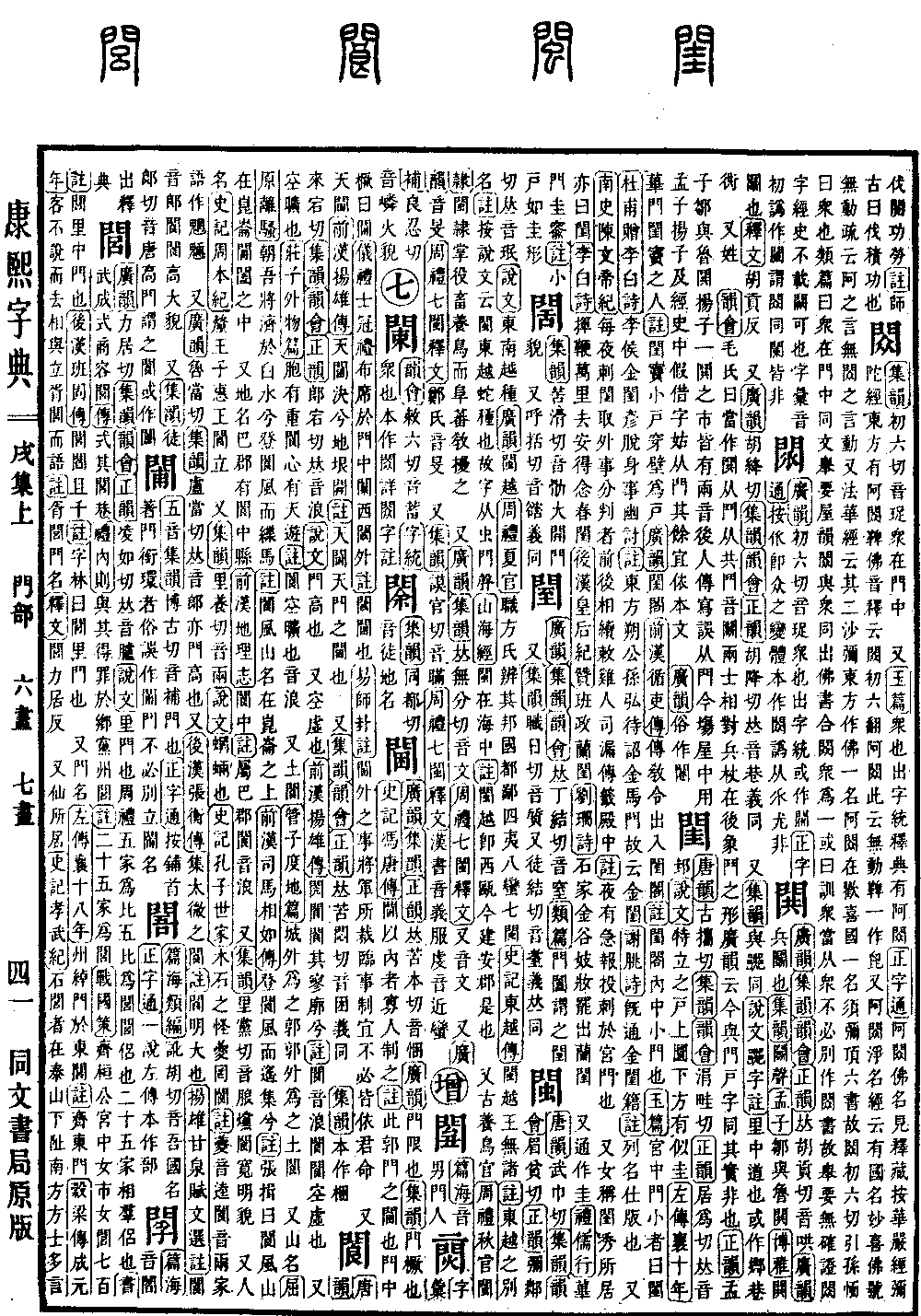
Xu Collection, Upper Volume
Radical: Gate (mén)
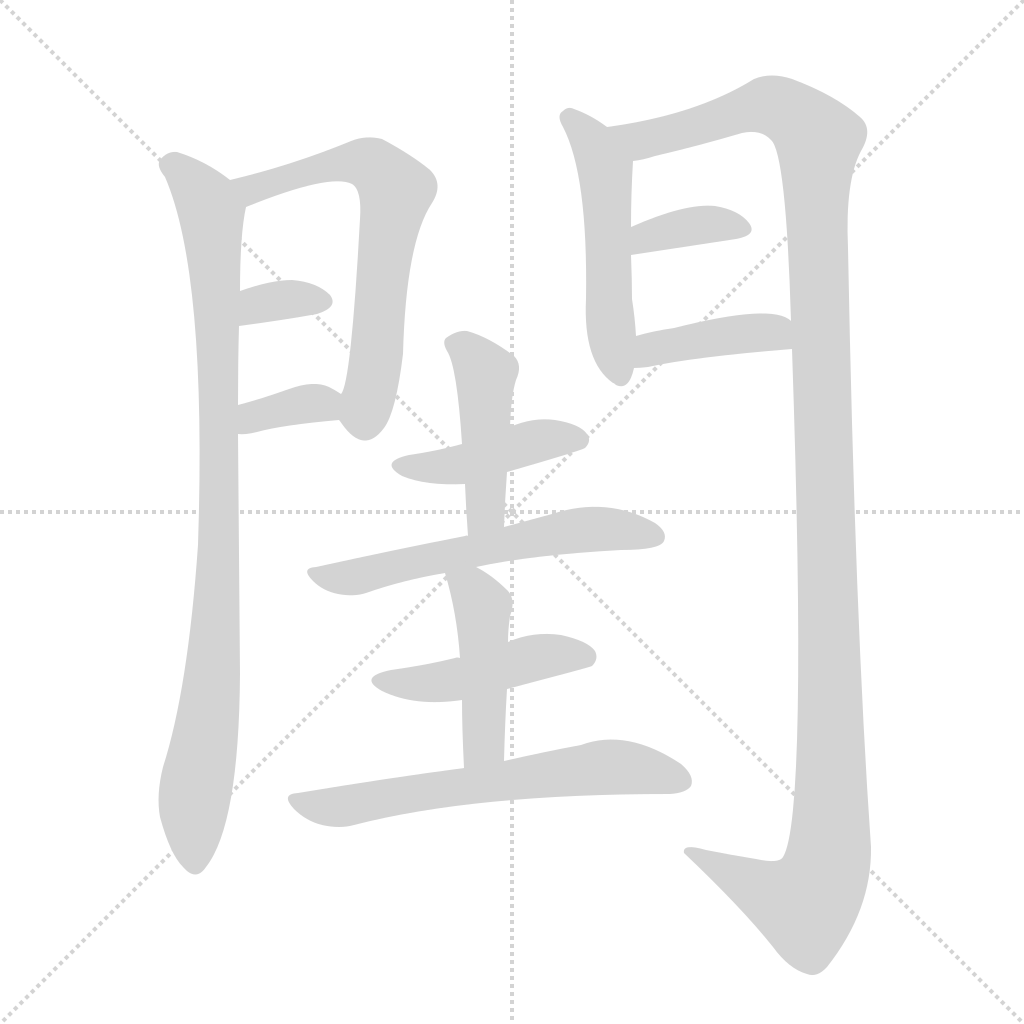
閨
Kangxi strokes: 14
Page 1335, Entry 04
Pronounced gui.
As defined in Explaining and Analyzing Characters (Shuowen jiezi), a private door. Round at the top and square at the bottom, resembling a jade tablet (gui).
As mentioned in the Zuo Commentary (Zuozhuan), Year 10 of Duke Xiang: A person living in a house with a brushwood door and a small opening. The commentary states that the opening is a small door, created by piercing a wall to serve as a door.
As defined in the Extensive Dictionary of Rhymes (Guangyun): A private chamber.
As mentioned in the History of the Former Han (Qianhan shu), Biography of Meritorious Officials: Spreading instructions and orders, entering and exiting the private chambers. The commentary notes that private chambers refer to small inner doors.
As defined in the Jade Chapters (Yupian): A small door within a palace is called a gui.
As mentioned in the poetry of Du Fu, "Gift to Li Bai": Master Li, a refined scholar of the golden chamber, cast off his status to pursue secluded studies. The commentary notes that Dongfang Shuo and Gongsun Hong waited for an imperial summons at the Golden Horse Gate, hence the term golden chamber.
As mentioned in the poetry of Xie Tiao: Having been entered into the registry of the golden chamber. The commentary notes this refers to being listed in the official civil register.
Furthermore, as mentioned in the History of the Southern Dynasties (Nan shi), Annals of Emperor Wen: Every night, the emperor would receive visiting cards thrown through the palace gate regarding external affairs to be adjudicated, with officials arriving one after another, and he would order the timekeeper to monitor the water clock and pass bamboo tallies to the palace attendants. The commentary notes that when there were urgent reports at night, the cards were thrown into the palace gate.
Furthermore, women are referred to as refined ladies (guixiu), and the place where they reside is also called a private chamber (gui).
As mentioned in the poetry of Li Bai: Brandishing the whip to travel ten thousand miles, how could I think of the spring chamber?
As mentioned in the History of the Later Han (Houhan shu), Annals of the Empresses: Organizing administration in the orchid chamber.
As mentioned in the poetry of Liu Shan: The courtesans of the Shi family's Golden Valley, finished with their makeup, emerge from the orchid chamber.
Also, it is sometimes used interchangeably with the character for jade tablet (gui). As mentioned in the Book of Rites (Liji), Conduct of Scholars: A brushwood door and an opening shaped like a jade tablet. The commentary notes that it is a small door shaped like a jade tablet.