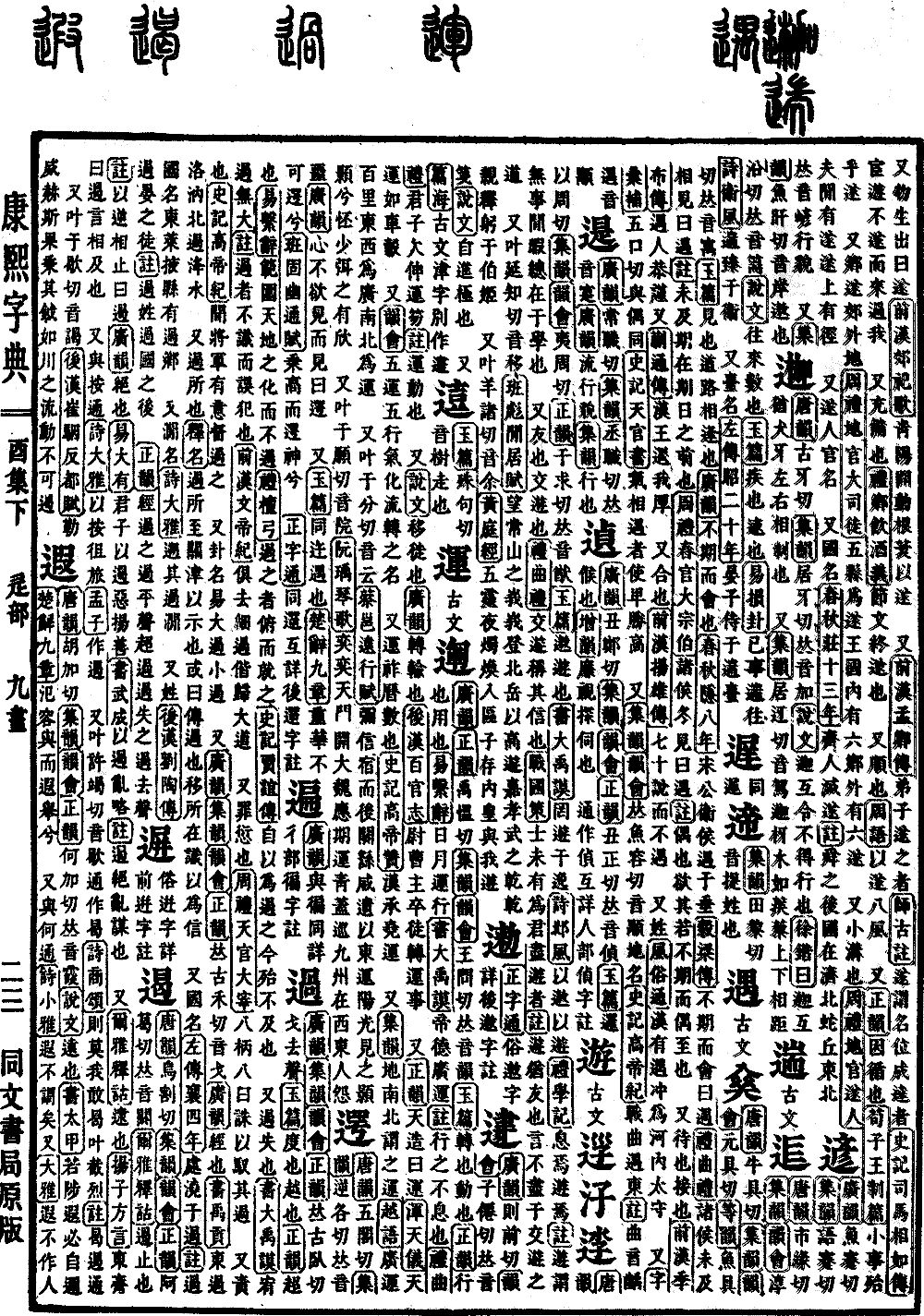
You Collection, Lower Volume
Radical: Walk (chuò)
Kangxi Strokes: 16
Page 1261, Entry 07
Ancient form: Pronounced yu (falling tone)
According to the Tang Rhyme (Tangyun), Collected Rhymes (Jiyun), Rhyme Compilation (Yunhui), and Ranked Rhymes (Dengyun), the sound is yu (falling tone).
In Jade Chapters (Yupian), it means to see, or to meet on the road.
In Extensive Rhymes (Guangyun), it means an unexpected meeting.
In Spring and Autumn Annals (Chunqiu), Eighth Year of Duke Yin: The Duke of Song and the Marquis of Wei met at Chui.
In Guliang Commentary (Guliang Zhuan), an unexpected meeting is called yu.
In Book of Rites (Liji), Songs of Propriety: When feudal lords meet before the appointed time, it is called yu. The commentary states: Before the appointed time means arriving before the scheduled day.
In Rites of Zhou (Zhouli), Spring Offices, Grand Master of Ceremonies: When feudal lords meet in winter, it is called yu. The commentary states: It means to pair; it is desired that they arrive as if by chance and without prior arrangement.
It also means to treat or to receive.
In History of the Former Han (Qianhan Shu), Biography of Ji Bu: He treated people with respect and care.
Also in Biography of Kuai Tong: The King of Han treated me generously.
It also means to fit or to align.
In History of the Former Han (Qianhan Shu), Biography of Yang Xiong: He spoke seventy times but did not meet with favor.
Also a surname. In Comprehensive Customs (Fengsu Tong), there was a Han dynasty official named Yu Chong who served as the Governor of Henei.
Also, in Collected Characters Supplement (Zihui Bu), pronounced ou (rising tone), same as ou.
In Records of the Grand Historian (Shiji), Treatise on the Celestial Offices: When influences meet, cause the superior to prevail.
Also, according to Collected Rhymes (Jiyun) and Rhyme Compilation (Yunhui), pronounced yong (level tone). A place name.
In Records of the Grand Historian (Shiji), Annals of Emperor Gao: Fought at Quyu in the east. The commentary states: Qu is pronounced qu (third tone), and yu is pronounced yong (level tone).
Textual Research:
In Book of Rites (Liji), Songs of Propriety: When feudal lords meet before the appointed time, it is called yu. Strictly following the original text, the character for time was added after before.
In Records of the Grand Historian (Shiji), Treatise on the Celestial Offices: When influences meet, cause the superior to prevail. Strictly following the original text, the word cause was omitted.