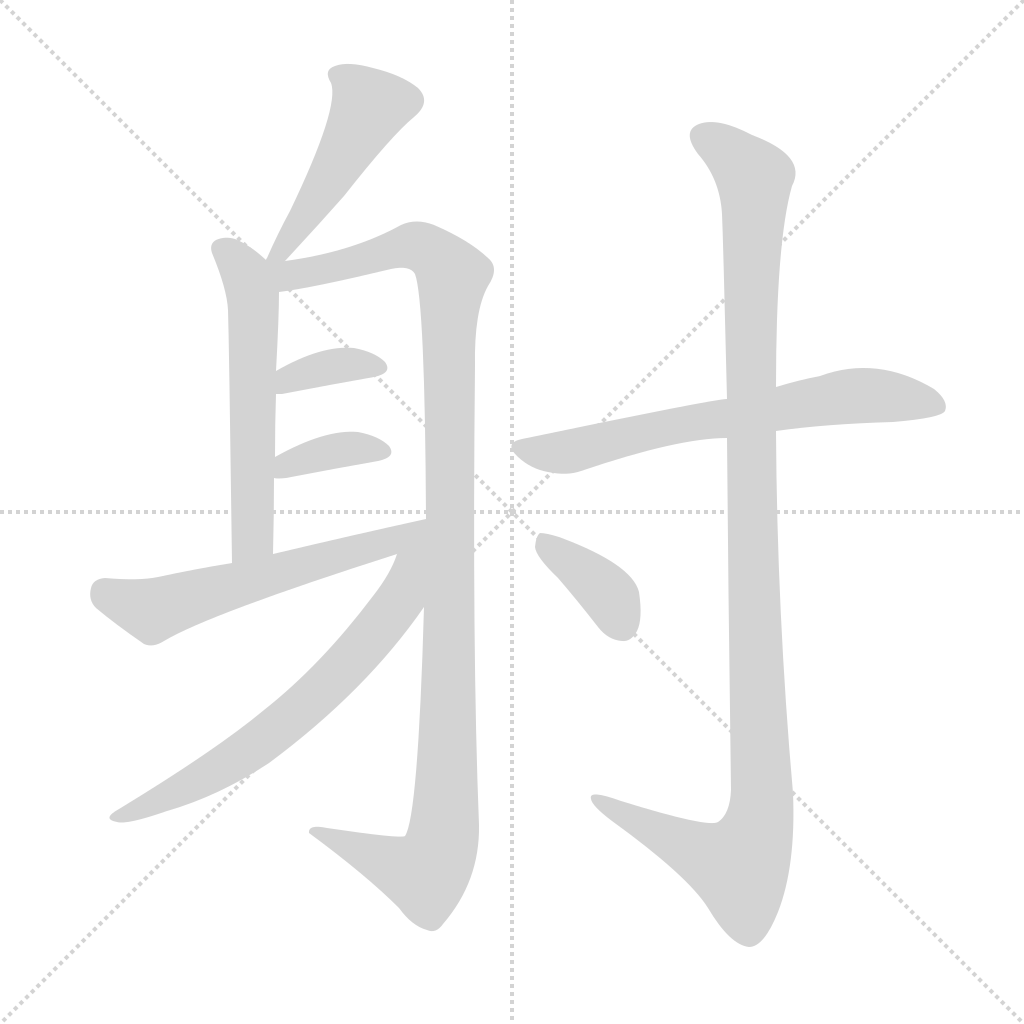
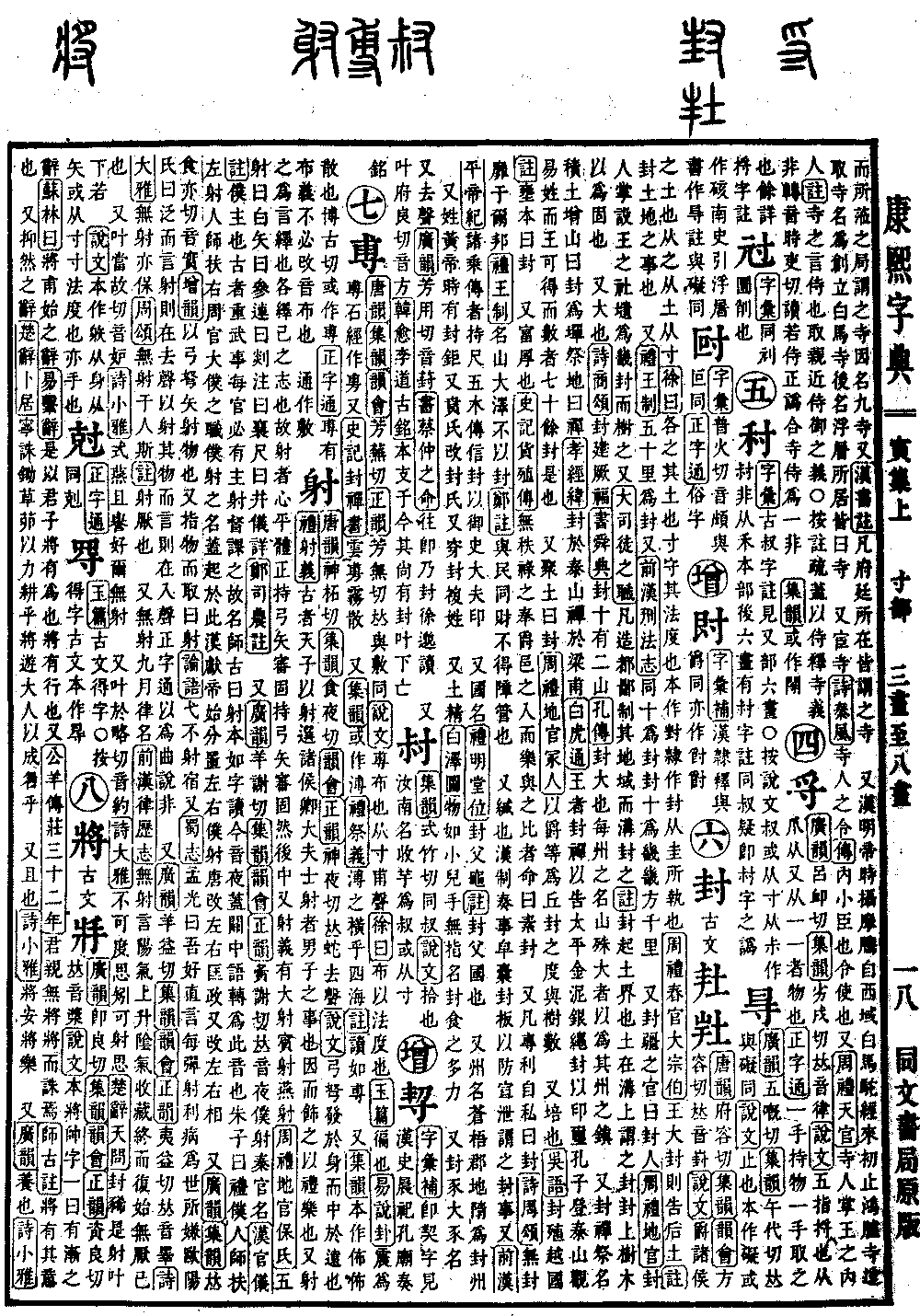
Yin Collection, Upper Volume. Radical: Inch (cùn). Kangxi stroke count: 10. Page 294, Entry 13.
Pronounced she (falling tone).
In the Shuowen Jiezi (Explanation of Graphs and Analysis of Characters), it is defined as using a crossbow to launch an arrow from one’s side to strike a distant target.
Book of Rites (Liji), Meaning of Archery (Sheyi) records: In ancient times, the Son of Heaven selected feudal lords, high officials, grand masters, and gentlemen through archery. Archery was a skill that men were expected to master, and it was thus refined through rites and music. It further states that the character for archery (she) carries the meaning of unfolding (yi). Unfolding refers to each person expressing their own ambitions. Therefore, when the mind is calm, the body is upright, and the bow and arrow are held with stability and focus, one will hit the target. Additionally, the Meaning of Archery records different ritual occasions such as grand archery, guest archery, and banquet archery.
Rites of Zhou (Zhouli), Earth Officer (Diguan), Protector (Baoshi) records five archery techniques, known as white arrow, connected shots, sharp injection, side step, and well formation. For detailed explanations, see the commentary by Zheng Sinong.
Also, pronounced ye (falling tone). Refers to the title of a servant of archery (pushé), a government office title from the Qin dynasty.
The Han Official Rituals and Commentaries (Hanguan Yizhu) explains: Servant (pu) means to be in charge of. In ancient times, military affairs were highly valued, and for every government office, someone was often appointed to supervise archery for examinations, hence the name. Yan Shigu says: The character for archery was originally pronounced she, but is now pronounced ye, which is likely a shift in the regional language of the Guanzhong area. Zhu Xi states: According to the ritual system, a servant supports the left side, and an archer supports the right side. The duties of the Grand Servant (dapu) in the Zhou dynasty are likely the origin of this title. During the time of Emperor Xian of Han, the offices of Left and Right Servant of Archery were established; in the Tang dynasty, these were changed to Left and Right Ministers of State.
Also, pronounced shi.
The Zengyun (Additional Rhymes) defines it as using a bow or crossbow to shoot projectiles at an object. It is also used to mean pointing at something to obtain it.
Analects (Lunyu): Confucius would not shoot at birds nesting at night, nor would he use a bow on birds resting in their nests.
Also, Records of the Three Kingdoms (Sanguozhi), Records of Shu: Meng Guang said: I am fond of speaking plainly and often point out the advantages and disadvantages of matters, which makes me disliked by the world. Ouyang says: When speaking of the act of archery in general, it is pronounced she (falling tone); when referring to hitting a specific object, it is pronounced shi (entering tone). The Zhengzitong (Correction of Characters) considers this a forced explanation and incorrect.
Also, pronounced yi (falling tone).
Classic of Poetry (Shijing), Greater Odes (Daya): "Without satiety (wuyi), I still protect." Classic of Poetry (Shijing), Eulogies of Zhou (Zhousong): "Without satiety towards others." Commentary: The character for archery here means to be disgusted or weary.
There is also the term Wuyi, which is the name of a musical pitch in the ninth month. The History of the Former Han (Qianhanshu), Treatise on Pitch Pipes and Calendars (Lüli Zhi): Wuyi means that the yang energy rises and the yin energy is stored, circulating without end.
Also, rhyming at the end of a line, pronounced as du (falling tone). Classic of Poetry (Shijing), Lesser Odes (Xiaoya): "To feast and to praise, do not be weary (she) of your goodness."
Also, rhyming at the end of a line, pronounced as yue. Classic of Poetry (Shijing), Greater Odes (Daya): "It cannot be measured, how then can it be treated with weariness (she)?" Chu Ci (Verses of Chu), Heavenly Questions (Tianwen): "The fat pig is shot (she)." It rhymes with the character ruo in the following sentence.
The Shuowen Jiezi notes the original form was written as 䠶, composed of body and arrow. The variant form is written as 射, using the radical for inch. Inch represents standard measure and also indicates the hand.