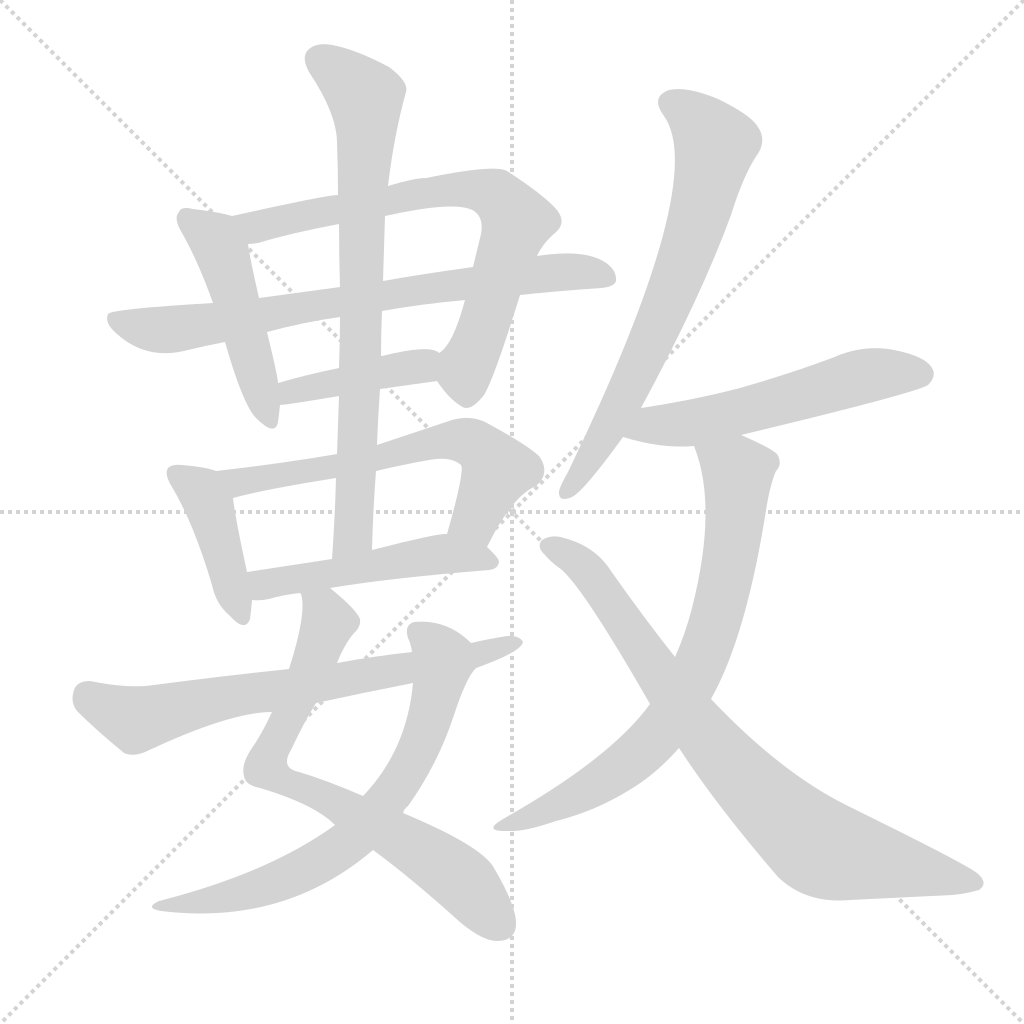
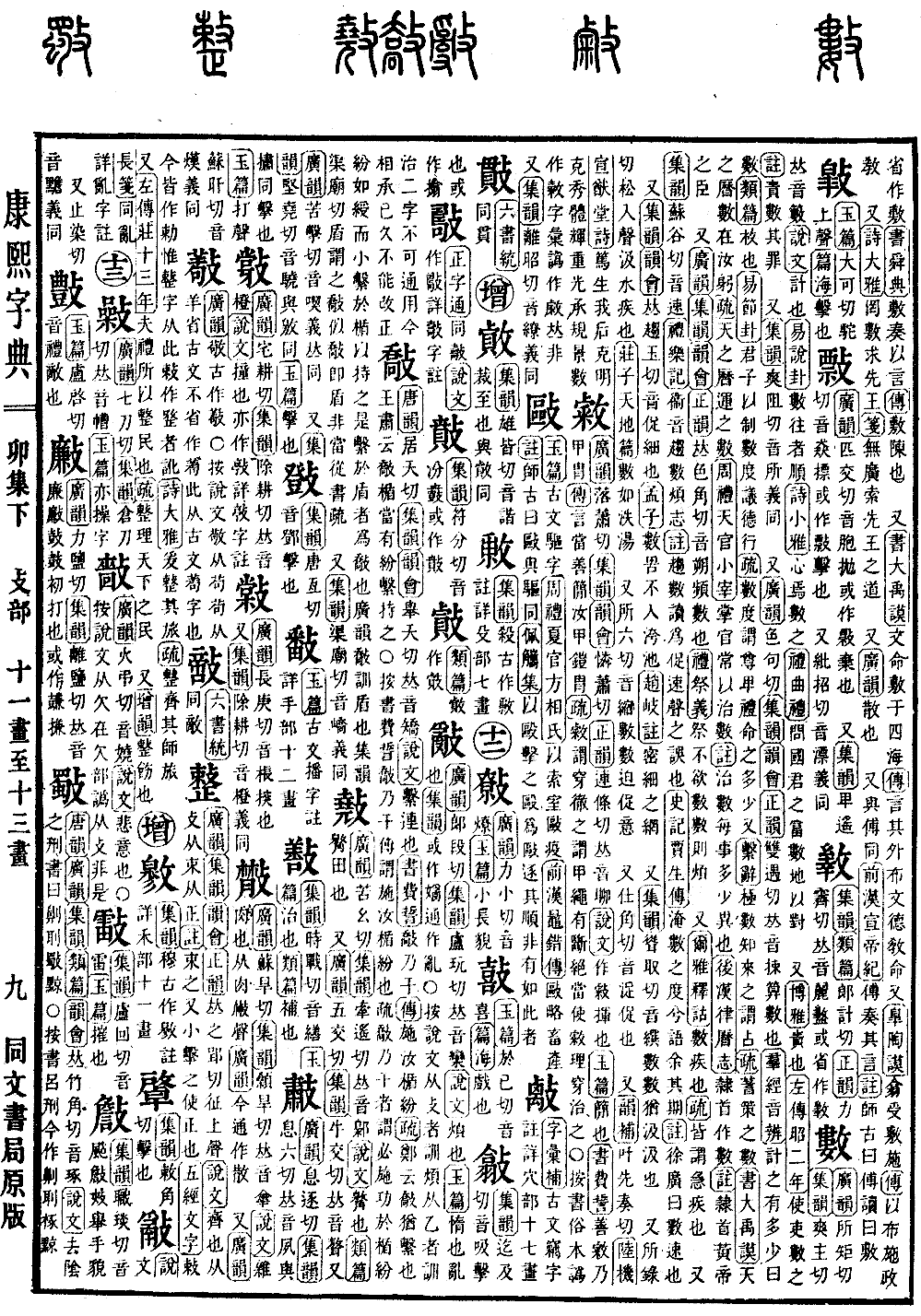
Mao Collection, Lower Volume
Radical: Tapping (pū)
Kangxi Strokes: 15
Page 475, Entry 04
Pronounced shu.
Comprehensive Rhymes (Guangyun): The meaning of calculating.
Book of Changes (Yijing): To calculate past events is to follow the chronological order.
Book of Odes (Shijing): Calculating it in one's heart.
Book of Rites (Liji): When asked about the wealth of a ruler, answer by calculating the area of the land.
Also, Extensive Eulogies (Boya): The meaning of to reproach.
Zuo Tradition (Zuozhuan): Sent an official to reproach him. Commentary: To enumerate his crimes and rebuke him.
Also, Collected Rhymes (Jiyun): Pronounced suo. The meaning is the same.
Also, Pronounced shu. Arithmetic; mathematics.
Distinctions of Sounds in the Classics (Qunjing Yinbian): Calculating how many there are is called shu.
Category Dictionary (Leipian): A measure word, used for counting.
Book of Changes (Yijing): The superior man thereby establishes rites, standards, and deliberates on moral conduct. Commentary: Numerical standards refer to the quantities of ranks and ceremonial levels.
Also, Commentary on the Appended Phrases (Xici): To exhaust the changes in the numbers of milfoil stalks to foresee the future is called divination. Commentary: Refers to the number of stalks used in divination.
Book of Documents (Shangshu): The calendar and destiny ordained by Heaven rest upon you. Commentary: Refers to the fixed cycle of the calendar and the fortunes ordained by Heaven.
Rites of Zhou (Zhouli): Manage the regular duties of officials to handle the quantities of various affairs. Commentary: Managing numbers refers to the differences in the quantities of each affair.
History of the Later Han (Hou Hanshu): Lishou invented numbers. Commentary: Lishou was a minister of the Yellow Emperor.
Also, Pronounced shuo. The meaning of repeatedly or frequently.
Book of Rites (Liji): Sacrifices should not be too frequent; frequency leads to boredom.
Also, Approaching Glosses (Erya): Shu means fast. Commentary: Both refer to swiftness.
Also, Pronounced su.
Book of Rites (Liji): The music of the state of Wei is hurried, making the heart and mind chaotic. Commentary: Hurried shu should be read as cu su, which is an error in pronunciation.
Records of the Grand Historian (Shiji): The destined length of life, pray tell me its limit. Commentary: Xu Guang says: Shu means fast.
Also, Pronounced cu. The meaning of fine or dense.
Mencius: A fine-meshed fishing net does not enter a large pond. Zhao Qi's Commentary: Refers to a net with small, dense meshes.
Also, Pronounced xuan. Describing an urgent appearance.
Also, Pronounced song. Describing drawing water very quickly.
Zhuangzi: As swift as boiling water overflowing.
Also, Pronounced suo. Describing an urgent appearance.
Also, Pronounced zhuo. The meaning of to urge.
Also, Rhyme Supplement (Yunbu): Rhymes with zou.
Lu Ji's Poem of Xuanyou Hall: Making my ruler prosperous, virtuous and excellent. Shining brightly, inheriting laws and following destiny.