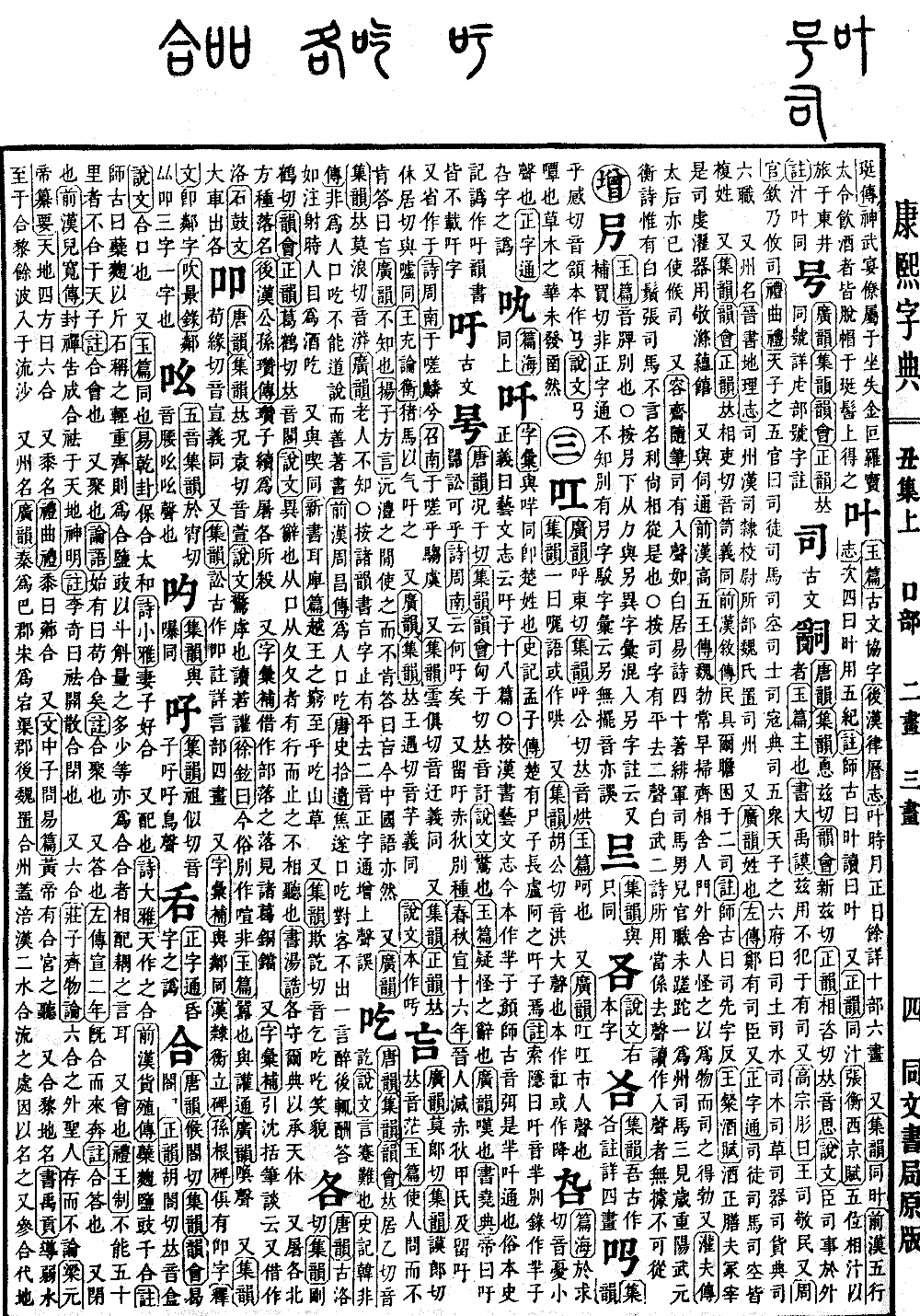
Shen Collection, Upper Volume
Radical: Grass (cǎo)
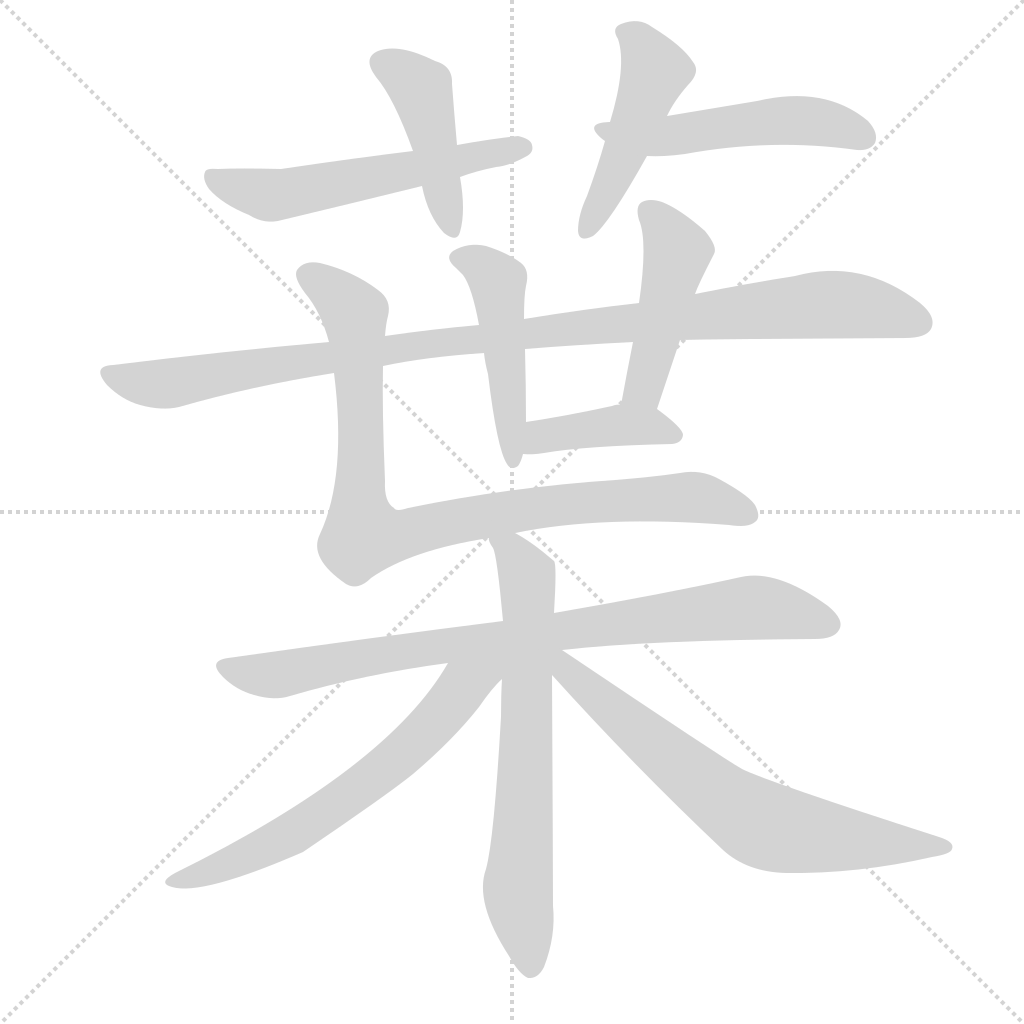
Ye
Kangxi stroke count: 15
Page 174, Entry 01
Pronounced ye (falling tone).
According to the Explaining Graphs and Analyzing Characters (Shuowen Jiezi), it refers to the leaves of plants and trees.
According to the notes on the poetry of Lu You, the people of Wu specifically refer to mulberry leaves as ye.
It also denotes a generation.
As seen in the Book of Odes (Shijing), in the middle generation of the past, there was a shaking and a great achievement.
According to the Broad Etymological Dictionary (Boya), it means to gather.
It also refers to the leaves or pages of a book.
Ouyang Xiu stated that the people of the Tang dynasty kept books in scrolls, and later they used leaf pages, which resemble the booklets of the present day.
It is also a surname.
According to the Comprehensive Treatises on Clans and Lineages (Tongzhi Shizu Lue), the Ye surname was formerly pronounced she, but in later generations, it took the same pronunciation as the word for tree leaves.
It is also interchangeable with the character meaning to harmonize.
As seen in the Book of Etiquette and Ceremonial (Yili), the assistant washes the vessels in the side chamber, pours the sweet wine, adds the ladle, and covers it with a surface layer.
The commentary notes that in ancient script, ye was written as a different character.
Also pronounced she (falling tone).
According to the commentary on the Zuo Tradition (Zuo Zhuan) regarding the entry for Ye, it refers to Ye County in modern-day Nanyang.
Also pronounced nue (entering tone) based on the Supplementary Rhymes (Yunbu).
According to the Forest of Changes (Yilin), the mulberry fragrant and about to fall, shedding its yellow leaves.
Also pronounced ji (entering tone).
According to the Forest of Changes (Yilin), same roots but different leaves, joyfully following the highest virtue. The eastern neighbor admires righteousness and comes to flourish in our state.
According to the Collected Rhymes (Jiyun), pronounced die (entering tone). It is synonymous with a character that serves as the title of a written work.
According to the Dictionary of Rhymes (Yunhui), sometimes it is written in a variant form, which is incorrect.