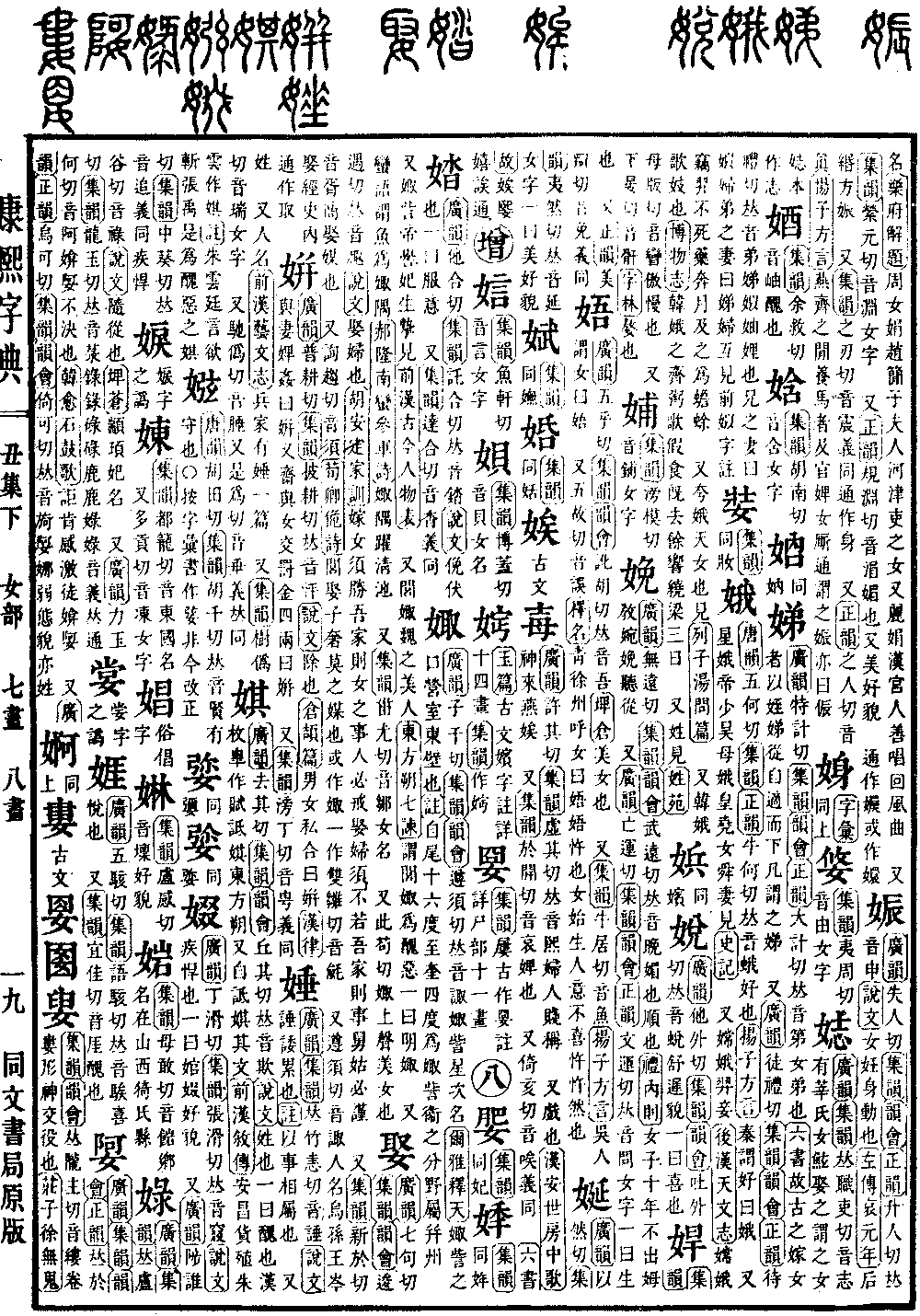
Chou Collection, Lower Volume
Radical: Woman (nǚ)
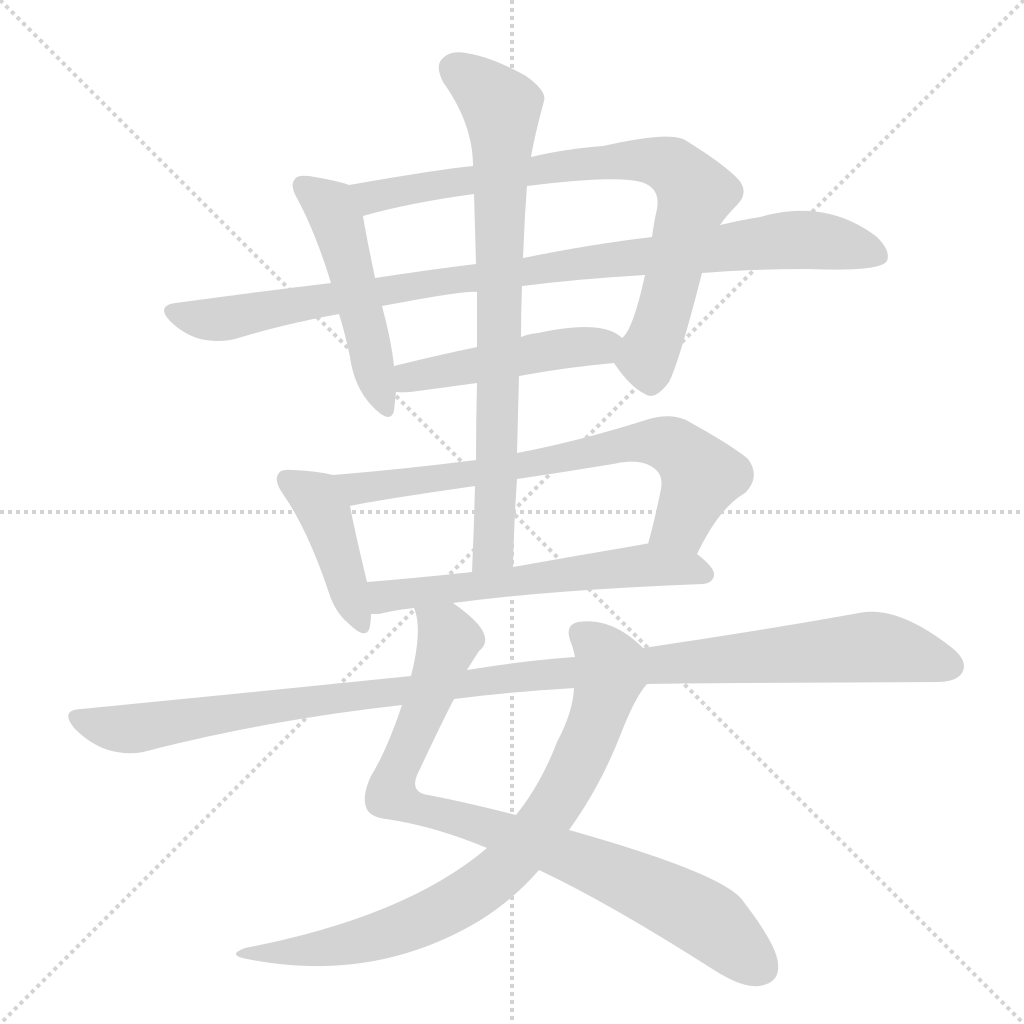
婁
Kangxi stroke count: 11
Page 263, Entry 01
Ancient character form.
According to Rhyme Compilation (Jiyun) and Collected Rhymes (Yunhui), the pronunciation is lu.
Juanlou, refers to the exhaustion of physical form and spirit through labor.
Book of Master Zhuang (Zhuangzi): Shun raised the land of the barren earth; his teeth grew long and his brightness faded, yet he could not find rest or retirement. This is what is meant by juanlou.
Also, tying a horse is called wei; tying an ox is called lou. The tying of oxen and horses is called weilou, see Gongyang Commentary (Gongyang Zhuan).
According to Rhyme Compilation (Jiyun) and Correct Rhymes (Zhengyun), same as lu (frequent). To be troublesome or numerous.
History of the Former Han (Qianhan Shu): The Emperor was initiating great works and frequently (lou) recommended virtuous and capable men.
Also, History of the Former Han (Qianhan Shu): The common people frequently (lou) encountered disasters and misfortunes.
According to Rhyme Compilation (Jiyun), the pronunciation is lei.
Dianlou, a place name in the Western Qiang territories.
According to Broad Rhymes (Guangyun), Rhyme Compilation (Jiyun), Collected Rhymes (Yunhui), and Correct Rhymes (Zhengyun), the pronunciation is lou.
Name of a star.
Book of Rites (Liji): In the last month of winter, the sun is in the Nü constellation at dusk and in the Lou constellation.
Master of Huainan (Huainanzi): In the second month, the constellations Kui and Lou are aligned.
Also a place name.
Spring and Autumn Annals (Chunqiu): The people of Ju attacked Qi and took Moulou.
Also: The Duke of Wei stationed troops at Zilou.
Also name of a river.
Records of the Grand Historian (Shiji) Commentary: The river flows northeast for over three hundred li and enters the sea, known as the Lou River. Today, the district of Lou is under the jurisdiction of Songjiang.
Also a person's name.
Lilu, a legendary figure from antiquity known for his keen eyesight.
Songs of Chu (Chuchai): Lilu glances slightly, yet the blind think he has no vision.
Also Qianlou, a recluse from the state of Qi, who wrote the four-part book Qianlouzi.
Also a surname.
Han dynasty official Lou Jing, who was granted the surname Liu by Emperor Gaozu. Tang dynasty official Lou Shide.
Also the name of a beast.
Han Poetry Outer Commentary (Hanshi Waizhuan): In the north, there is a beast named lou that eats and looks about alternately.
Also the same as.
Zuo Commentary (Zuo Zhuan): Having already determined your lou-pig (sacrificial pig).
According to Rhyme Compilation (Jiyun) and Correct Rhymes (Zhengyun), the pronunciation is lou.
To drag.
Book of Odes (Shijing): You have garments that you neither trail nor drag (lou).
Also, the appearance of being carved or engraved.
He Yan's Rhapsody on the Jingfu Hall (Jingfu Dian Fu): Adorned with ornate ceilings, knitted with colorful screens. Red flowers are interlaced, vermilion silk is intricately carved (lilou).
Commentary: Lilou means that the carvings and engravings are distinct and clear.
Also, foolish or dull.
Su's Extended Meanings (Sushi Yanyi): Contemporary people refer to those who cannot distinguish things as Zhulou-blind. Zhulou was a small state; it refers to petty people unable to make distinctions.
Six Writings Origins (Liushu Gu): The state of Zhu during the Spring and Autumn period was known as Zhulou.
According to Rhyme Compilation (Jiyun) and Correct Rhymes (Zhengyun), the same as lou (mound). A small hill.
Zuo Commentary (Zuo Zhuan): Uncle Taishu said: On the mound (bulou), there are no pine or cypress trees.
The original character does not use the cliff radical.
Also an ancient form of lou.
The character is composed of mother in the middle of woman.
The character is a common form.
Textual research: The phrase tying a horse is wei, tying an ox is lou. The tying of oxen and horses is weilou, see Zuo Commentary (Zuo Zhuan). Note: The cited passage comes from the Gongyang Commentary (Gongyang Zhuan). The Zuo Commentary has been corrected to Gongyang Commentary.
Zuo Commentary (Zuo Zhuan): The people of Ju attacked Qi and took Moulou. Note: The cited passage is from the text of the Spring and Autumn Annals (Chunqiu). The Zuo Commentary has been corrected to Spring and Autumn Annals.