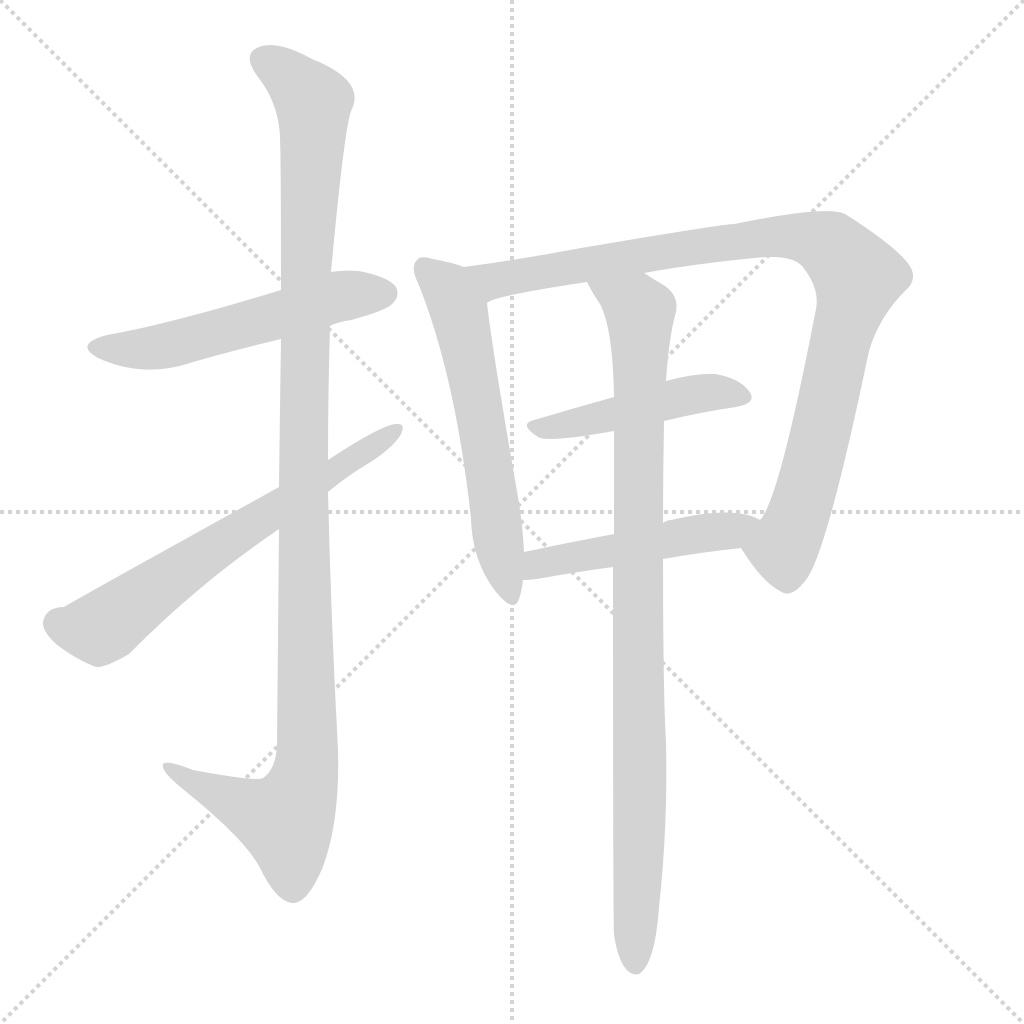
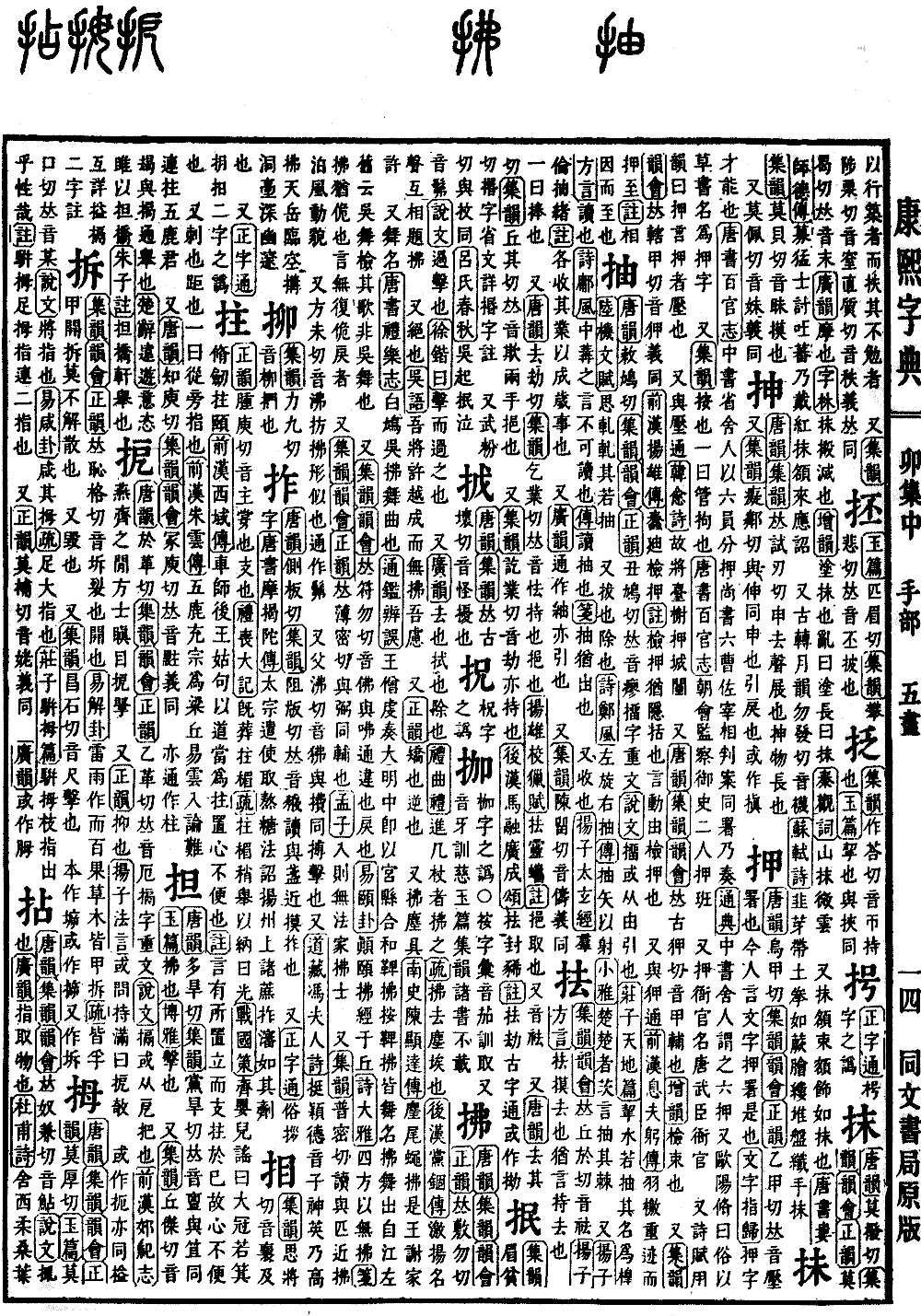
Mao Collection, Middle Volume. Radical: Hand (shou). Kangxi Strokes: 9. Page 424, Entry 07.
Pronounced ya. Meaning to sign or endorse. It is in this sense that people today speak of signing documents. In The Principles of Characters (Wenzi Zhigui), it is stated that a signature (ya) is a manifestation of talent. In the Book of Tang (Tangshu), Record of Officials (Baiguan Zhi), it is written that the drafters of the Secretariat were tasked with assigning six officials to be responsible for signing off on the six ministries of the Department of State Affairs, assisting the prime minister in handling cases, and submitting reports only after joint signing. In the Comprehensive Institutions (Tongdian), the Secretariat drafters are referred to as the six endorsers. Furthermore, Ouyang Xiu states: Among the common people, cursive script is called a signature (ya). Also, according to the Collected Rhymes (Jiyun), it means to press down. Another interpretation is to restrain or detain. In the Book of Tang, Record of Officials, it is noted that during court assemblies, two investigating censors were responsible for maintaining order in the ranks. There is also the title Ya-ya, an official post representing the staff officers of military officials during the Tang Dynasty. Additionally, in poetry and prose, using rhyme is called rhyming (ya-yun). To say ya is to mean to press. It is also interchangeable with the character for press (ya). In the poetry of Han Yu, it is written: Therefore, the terraces and pavilions press against the city gates.
Also pronounced jia. Meaning to assist. According to the Augmented Rhymes (Zengyun), it means to inspect and restrain.
Also pronounced xia. The meaning is the same. In the Book of Han (Hanshu), Biography of Yang Xiong, it is written: To follow rules and exercise restraint. The commentary notes that restraint (jian-ya) is like a tool used to straighten bent bamboo or wood, meaning that actions must be subject to regulation. It is also interchangeable with the character for familiar (xia). In the Book of Han, Biography of Xifu Gong, it is written: The urgent dispatches arrived in quick succession and were delivered (ya). The commentary notes: This refers to items arriving one after another.