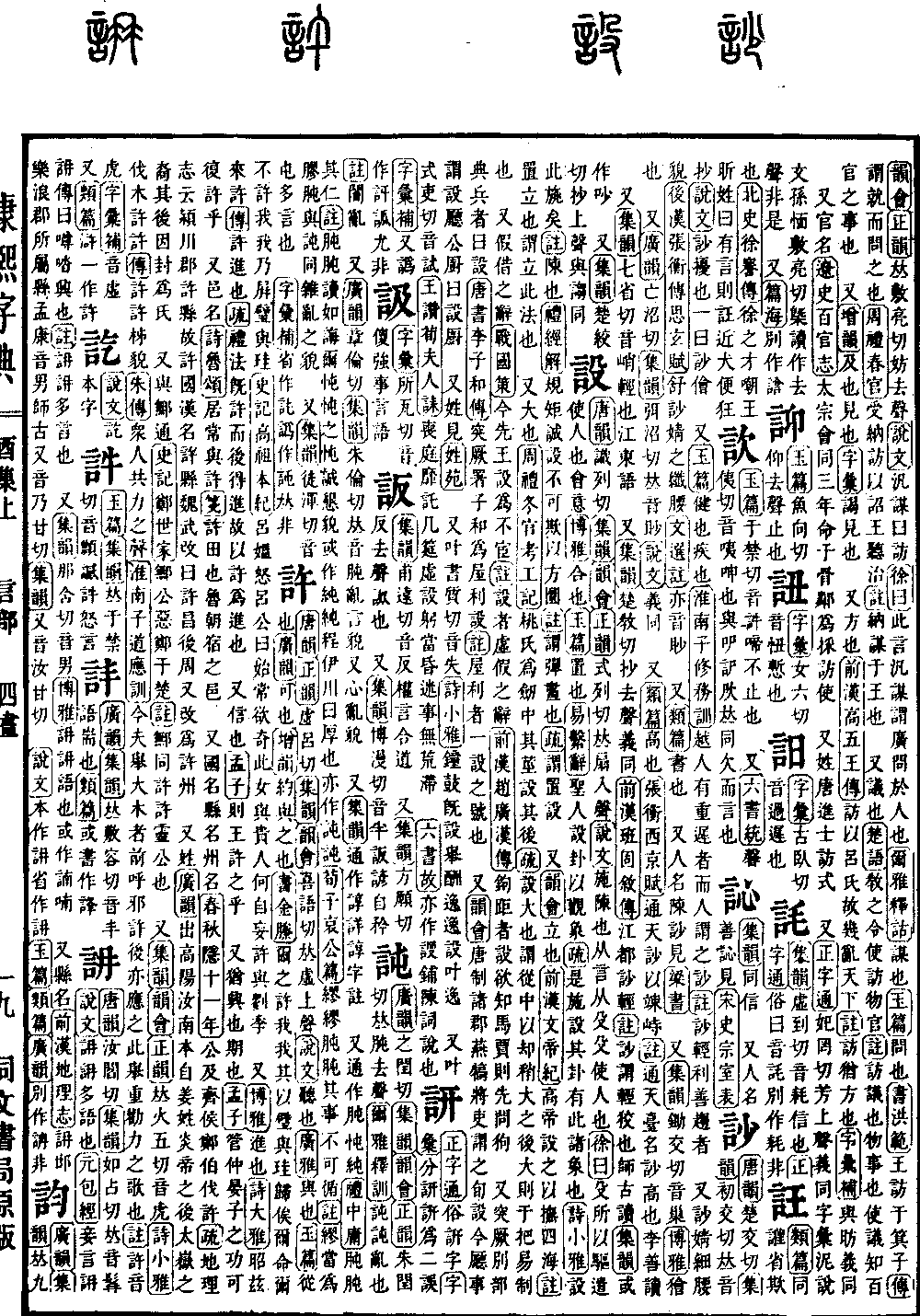
You Collection, Upper Volume
Radical: Speech (yán)
Kangxi Strokes: 11
Page 1151, Entry 09
Pronounced shè (entering tone).
Shuowen Jiezi (Explanation of Graphs and Analysis of Characters): To implement. Composed of the radicals for speech and a weapon (shū). The character for the weapon implies to cause others to act. Xu Shen says: The weapon is that which drives and compels others to act; this is a compound ideograph.
Guangya (Expanded Glosses): To assemble.
Yupian (Jade Chapters): To place.
Book of Changes (Yijing), Commentary on the Appended Statements: The sages established the hexagrams to observe the images. Commentary: This means to implement or set up the hexagrams so that these various images appear.
Book of Odes (Shijing), Lesser Odes: To set up this banner. Commentary: To display.
Book of Rites (Liji), Explanations of the Classics: When the compass and square are correctly set, one cannot be deceived regarding the square and the round. Commentary: This refers to marking with an ink line. Commentary: This refers to placing or setting up.
Also, Yunhui (Collection of Rhymes): To establish.
Book of Han (Hanshu), Annals of Emperor Wen: The Gao Emperor established this to pacify the four seas. Commentary: To set up and establish; it refers to the establishment of these laws.
Also: Great.
Rites of Zhou (Zhouli), Winter Offices, Artificer's Record: The peach-wood maker crafts a sword; the center is its shaft, and the rear is enlarged. Commentary: "She" means great. It refers to the part from the center toward the rear that gradually becomes larger; being larger makes it easier to control when held by the handle.
Also: A term for a false or hypothetical premise.
Strategies of the Warring States (Zhanguo Ce): Now, sir, you set forth a hypothetical premise that you will not take office. Commentary: "She" is a term for something false or hypothetical.
Book of Han (Hanshu), Biography of Zhao Guanghan: The hook-and-leverage method means that if one wishes to know the price of a horse, one first asks about the dog.
Also: In the Turkic tribes, those who lead troops are called she.
Old Book of Tang (Tangshu), Biography of Li Zihe: The Turks appointed Zihe as the Wuli She. Commentary: Wuli is the title of a specific she.
Also, Yunhui (Collection of Rhymes): In the Tang dynasty system, the banquets and rewards for generals and officials in the various prefectures were called xunshe. In modern usage, these are called she, and the public kitchen is called a shechu.
Also: A surname, found in the Xingyuan (Garden of Surnames).
Also, rhyming with shi (entering tone). Book of Odes (Shijing), Lesser Odes: The bells and drums have been set, the toasts are performed with ease. (She rhymes with yi).
Also, rhyming with shi (entering tone). Wang Zan, Eulogy for Lady Xun: The mourning courtyard has no support, the ceremonial table and mats are set in vain. Personally enduring confusion, there are no matters left neglected.
Liushu Gu (Origins of the Six Writings): Also written in a variant form. Refers to embellishing words to explain something.