Zi Collection, Middle Volume
Radical: Person (rén)
傭
Kangxi Strokes: 13
Page 114, Entry 11
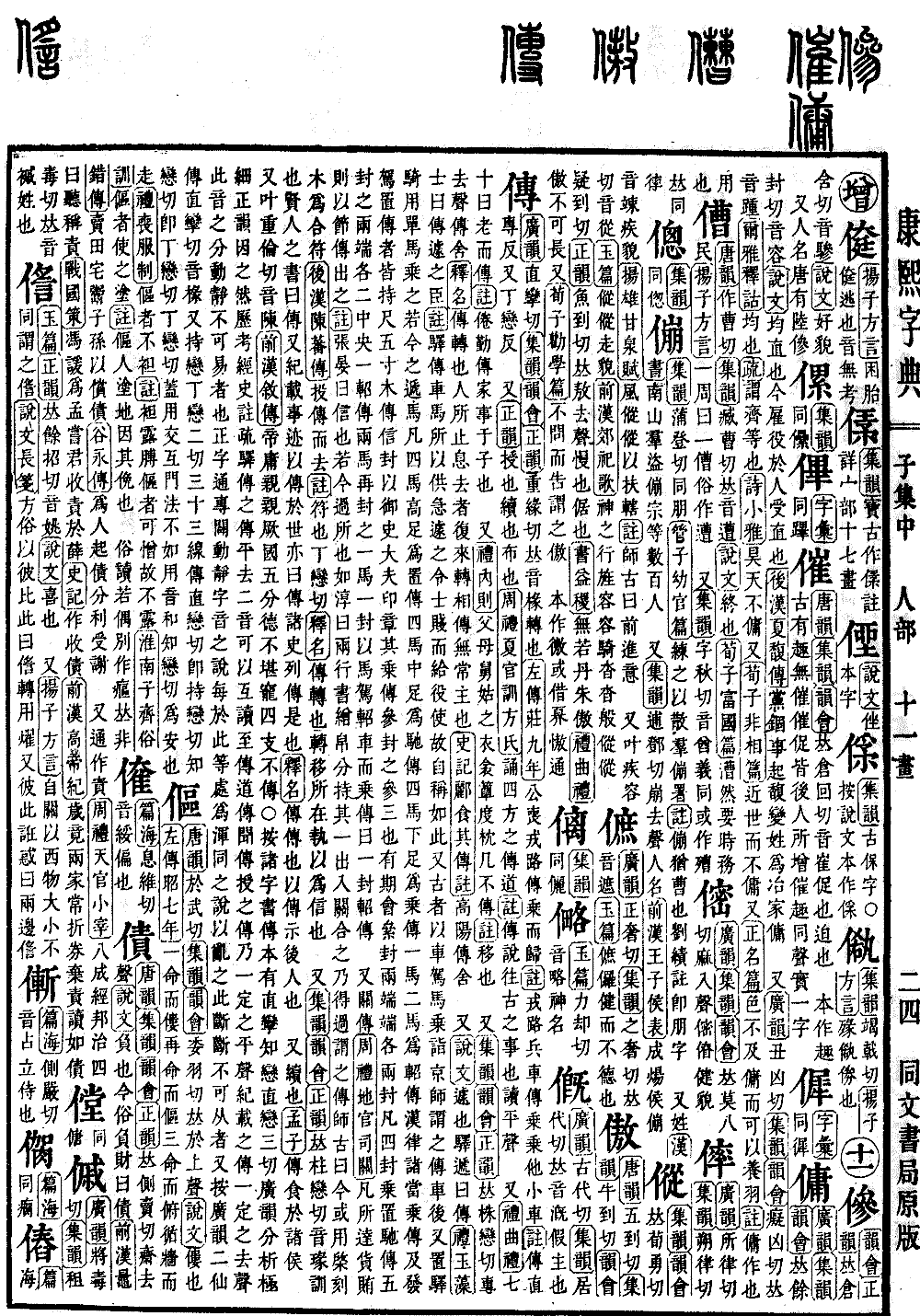
Guangyun, Jiyun, and Yunhui dictionaries: Pronounced róng. Shuowen Jiezi says it means to equalize payment. Now it refers to one who is hired to perform labor for another in exchange for wages. In the Biography of Xia Fu from the Book of the Later Han (Hou Hanshu), when the Partisan Prohibitions incident began, Fu changed his surname and worked as a hired laborer for a metalworker.
Also, according to Guangyun, Jiyun, and Yunhui dictionaries: Pronounced chǒng. Erya: Shiyan says it means to equalize. The commentary explains this as being of equal status. In the Book of Odes (Shijing), Xiaoya section: Vast heaven is not impartial. Also, in the Xunzi, Feixiang chapter: In the recent age, one is not made uniform. Also, in the Zhengming chapter: If the appearance is not quite ordinary, it can still nourish the eyes. The commentary notes that yōng here means to work or to employ.
Textual Research:
In the Erya: Shigu, it states that it means to equalize. According to the original book, Shigu has been corrected from Shiyan. In the Zhengming chapter, the text reads: If the appearance is not quite ordinary, it can still nourish the eyes. According to the original text, nourish the feathers has been corrected to nourish the eyes.