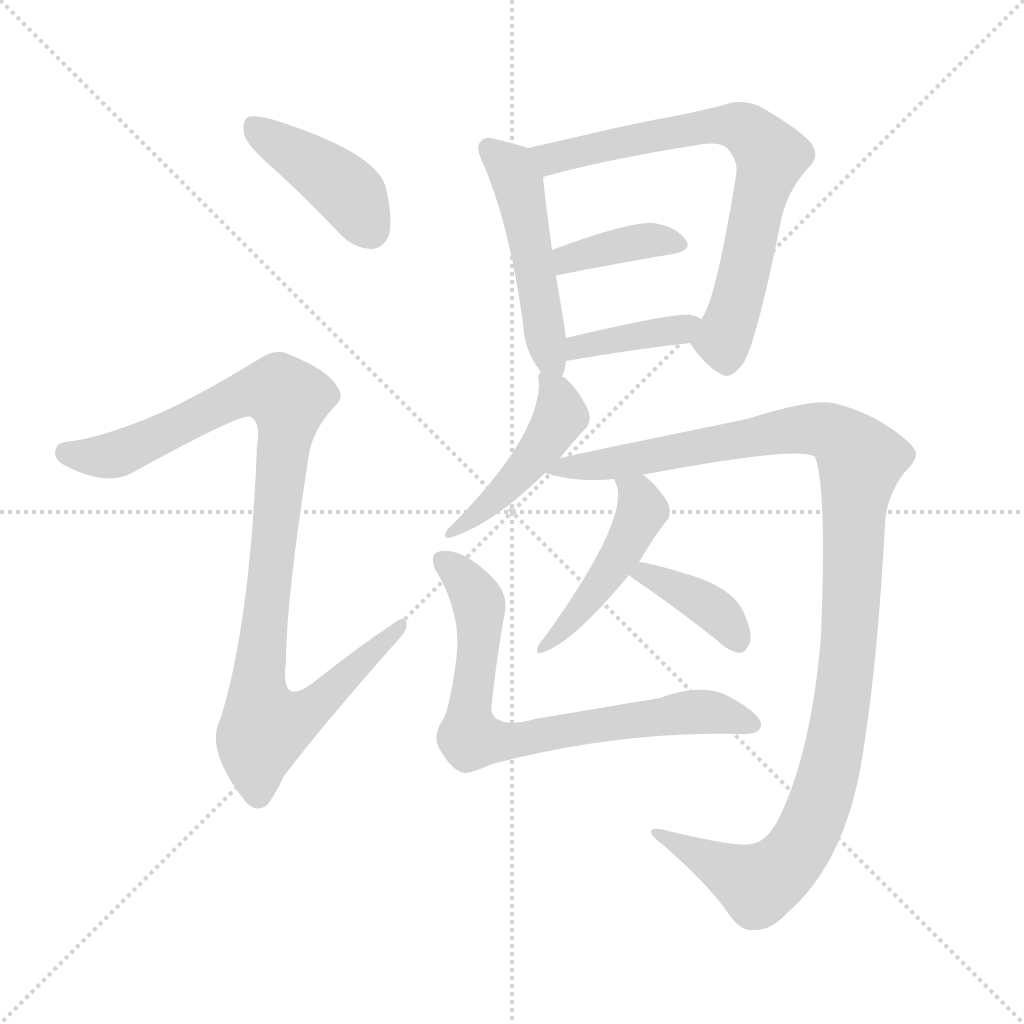
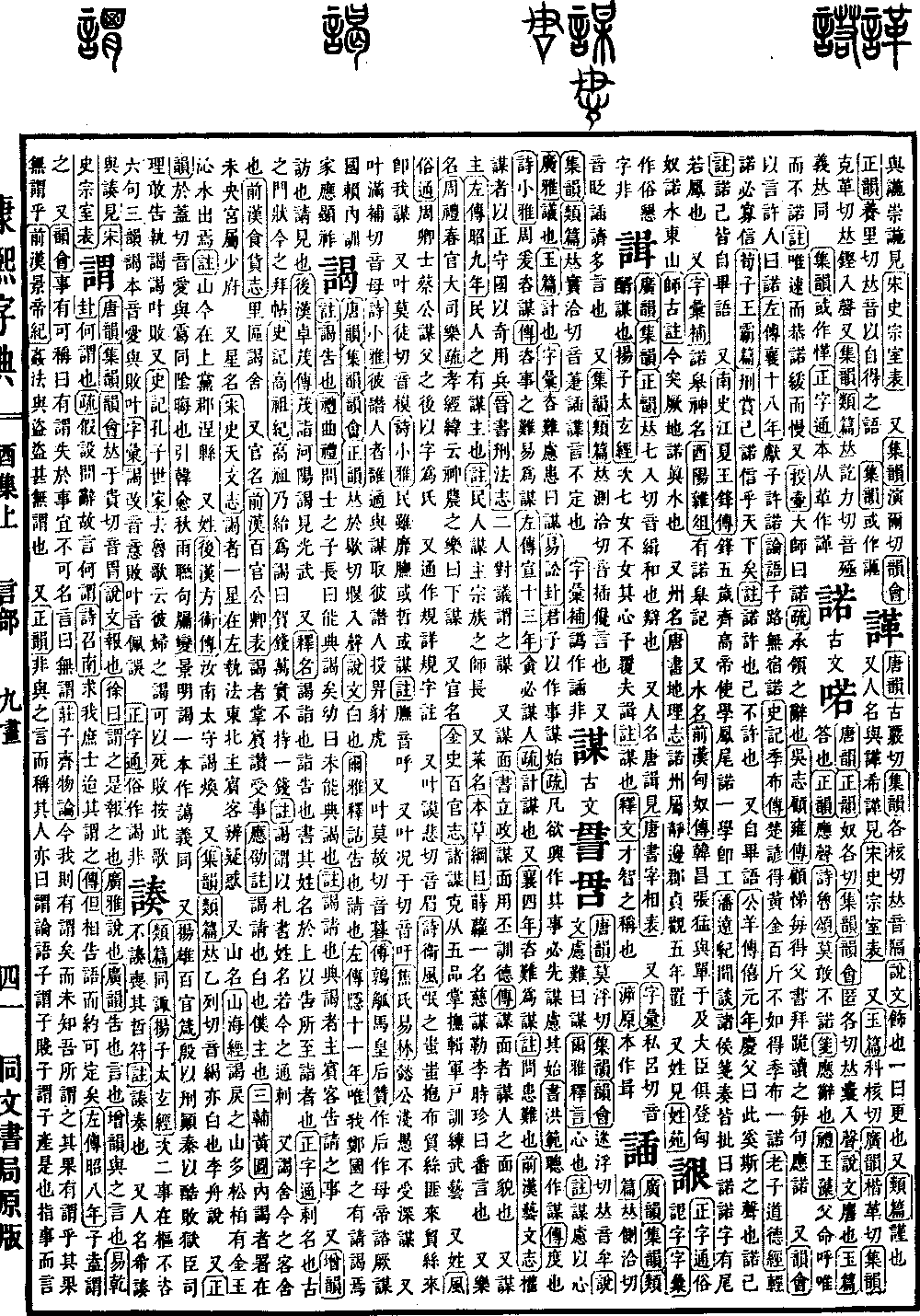
You Collection, Upper Volume
Radical: Speech (yán)
Page 1173, Entry 16
Pronounced ye (entering tone).
In the Explaining Graphs and Analyzing Characters (Shuowen Jiezi), it means to inform.
In the Er Ya: Explanation of Words (Er Ya: Shigu), it means to announce, to request.
In the Zuo Commentary (Zuo Zhuan), under the eleventh year of Duke Yin, it says: Only my state of Zheng has requests to present. The commentary notes that to present means to inform.
In the Book of Rites (Liji), specifically the Summary of the Rules of Propriety (Quli) section, it says: When asking about a scholar's son, if he is older, say he is capable of managing presentations; if younger, say he is not yet capable of managing presentations. The commentary notes that to present means to request. A manager of presentations is one who handles the affairs of informing and requesting for guests.
Additionally, according to the Supplemented Rhymes (Zengyun), it means to visit or to request an audience.
In the History of the Later Han (Hou Hanshu), in the Biography of Zhuo Mao, it says: Mao went to Heyang to request an audience with the Guangwu Emperor.
According to the Explanation of Names (Shiming), to present is to go to someone; it means to go and inform. One writes one's name on a tablet to inform the person one is visiting.
The Correct Meaning of Characters (Zhengzitong) states that it refers to a name card. In ancient times, these were doorway tablets; today, they are visiting cards.
In the Records of the Grand Historian (Shiji), in the Basic Annals of Gaozu, it says: Gaozu then falsely made a visiting card stating: Congratulations of ten thousand coins. In reality, he did not carry a single coin. The commentary notes that a visiting card refers to writing one's name on a wooden tablet, similar to a visiting card today.
It also refers to a lodge, which are modern-day guest houses. In the History of the Former Han (Hanshu), Treatise on Food and Money, it mentions neighborhood quarters and guest lodges.
It is also the name of an official post. In the History of the Former Han (Hanshu), Table of Officials and Ministers, it mentions the Presentation Official, who was in charge of guests, welcoming, and receiving affairs. Ying Shao’s commentary notes that to present means to request, to inform, and to serve as a master of ceremonies.
In the Yellow Maps of the Three Capitals (Sanfu Huangtu), it notes that the Inner Presentation Official had an office in the Weiyang Palace, subordinate to the Lesser Treasury.
It is also the name of a star. The History of the Song (Songshi), Treatise on Astronomy, states that the Presentation Star is one star located northeast of the Left Law-Enforcer, governing guests and distinguishing doubts.
It is also the name of a mountain. The Classic of Mountains and Seas (Shanhai Jing) states that Mount Yeli has many pine and cypress trees, contains gold and jade, and the Qin River originates there. The commentary notes that the mountain is currently in Nie County, Shangdang Commandery.
It is also a surname. In the History of the Later Han (Hou Hanshu), Biography of Arts, it mentions the Administrator of Runan, Ye Huan.
Pronounced yi. It also means to inform, according to the explanation by Li Zhou.
Pronounced ai. Equivalent to the character meaning overcast or gloomy. Quoting Han Yu’s Autumn Rain Couplets: The window changes, the scenery is clear, the light is dim. One version of the text uses the character for gloomy, with the same meaning.
In Yang Xiong’s Admonitions on Official Posts, it says: The Yin fell due to disorder, the Qin failed due to cruelty. The prison officials manage the laws; I dare to inform the governing authorities. Here, the character rhymes with defeat (bai).
In the Records of the Grand Historian (Shiji), in the Hereditary House of Confucius, it says: Upon leaving Lu, he sang: The meddling of that woman can lead to death and ruin. Note that this song has six lines and three rhymes. The character originally has the sound ai and rhymes with defeat (bai). The Dictionary of Characters (Zihui) suggests changing the pronunciation to yi and the rhyme of defeat to pei, which is an error.
The Correct Meaning of Characters (Zhengzitong) states that the common form is an error.