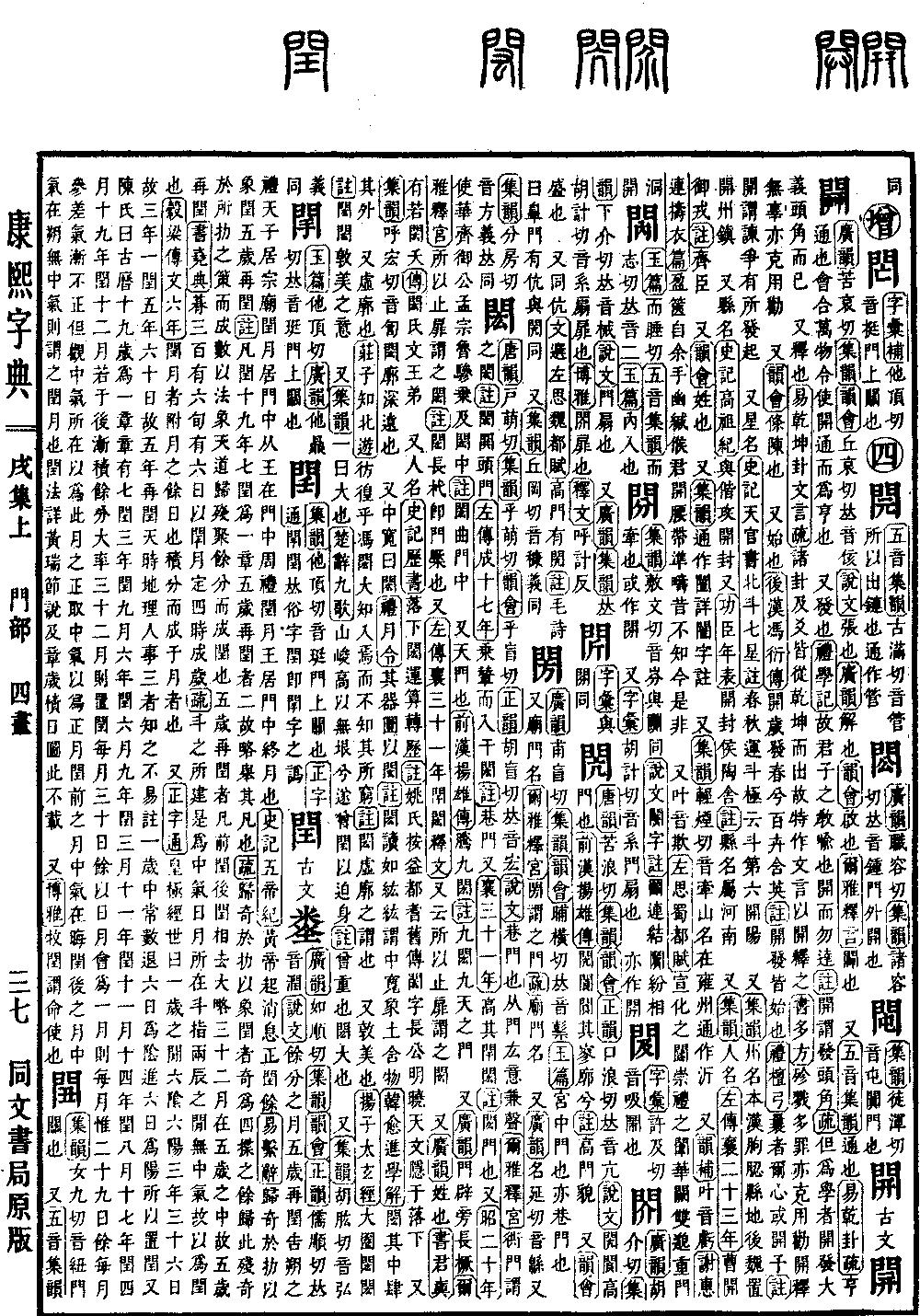
Xu Collection, Upper Volume
Radical: Gate (mén)
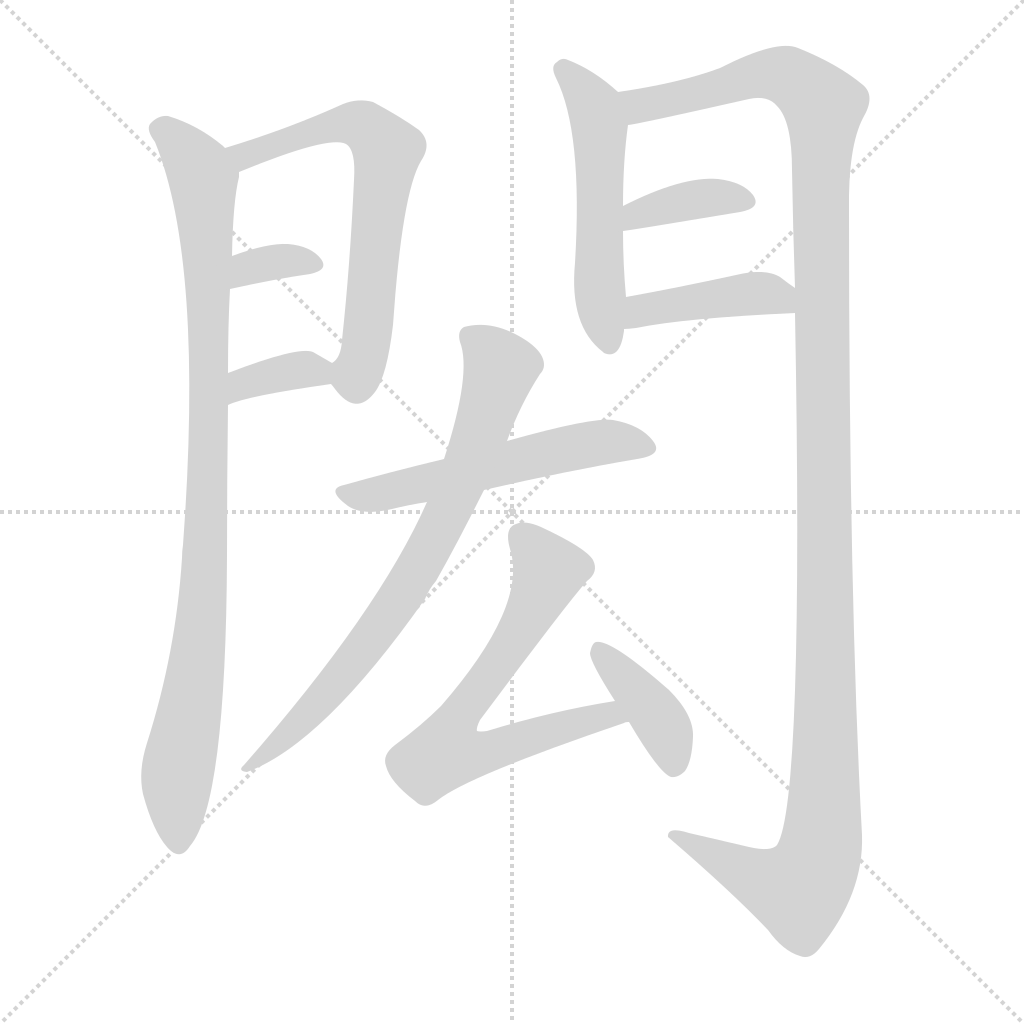
Hong
Kangxi strokes: 12
Page 1331, Entry 15
Pronounced hong.
In the Explaining Graphs and Analyzing Characters (Shuowen Jiezi), it refers to an alley gate. It is formed from the components for gate and arm, with the latter implying both meaning and sound.
In the Approaching the Standard (Erya), section on dwellings: An alley gate is called a hong. Commentary: A hong is the large gate at the entrance of an alley.
In the Commentary of Zuo (Zuo Zhuan), seventeenth year of Duke Cheng: Rode in a carriage and entered through the hong. Commentary: An alley gate.
Also, in the thirty-first year of Duke Xiang: Raised high his gate walls and gate. Commentary: Hong means gate.
Also, in the twentieth year of Duke Zhao: Ordered Hua Qi to drive for Gong Meng, with Zong Lu as the third chariot rider, arriving at the inner part of the hong. Commentary: Hong refers to the inner side of a curved gate passage.
It also refers to the gate of heaven. In the History of the Former Han (Qian Han Shu), Biography of Yang Xiong: Soaring through the nine hong. Commentary: Nine hong refers to the gates of the nine heavens.
According to the Broad Rhymes (Guangyun), it refers to the long wooden peg used to secure gate leaves. In the Approaching the Standard (Erya), section on dwellings: That which stops a door is called a hong. Commentary: A hong is a long wooden post, essentially a gate peg.
In the Commentary of Zuo (Zuo Zhuan), thirty-first year of Duke Xiang, Exegesis on gate walls and gates: It is also explained that what is used to wedge a door leaf is called a hong.
According to the Broad Rhymes (Guangyun), it is a surname. In the Book of Documents (Shujing), Chapter of Jun Shi: There was Hong Yao. Commentary: The Hong clan, younger brother of King Wen of Zhou.
Also a personal name. In the Records of the Grand Historian (Shiji), Treatise on the Calendar: Luo Xiahong calculated the rotating calendar. Commentary: Yao notes that according to the Elders of Yidu Records, the courtesy name of Hong was Chang Gong; he was well-versed in astronomy and lived in seclusion at Luoxia.
According to the Collected Rhymes (Jiyun), pronounced hong. Hong-kuo means deep and far-reaching.
Also, an area that is wide in the middle is called hong. In the Book of Rites (Liji), Monthly Ordinances: Its vessel is round and hong. Commentary: Hong is pronounced like hong (cord). Hong refers to being wide in the middle, symbolizing the earth’s capacity to contain all things.
In Han Yu’s Exhortation to Learning: The content is vast and the writing style is unrestrained.
It also refers to being vast and empty. In the Zhuangzi, Knowledge Wandered North: Wandering in a vast and empty realm; people of great wisdom enter it, yet do not know where its end lies. Commentary: Hong means vast and empty.
It also refers to being sincere, generous, and beautiful. In the Model Mystery (Taixuanjing) by Master Yang: The great circle is hong-hong. Commentary: Hong-hong means sincere, generous, and beautiful.
According to the Collected Rhymes (Jiyun), another interpretation is vast and great. In the Songs of Chu (Chucix), Nine Songs: The mountain ridges are high and steep without limit; thus they layer upon layer press toward my body. Commentary: Ceng means overlapping; hong means vast and great.
According to the Collected Rhymes (Jiyun), pronounced hong, with the same meaning.