Mao Collection, Lower Volume
Radical: Dipper (dǒu)
Kangxi Strokes: 11
Page 478, Entry 15
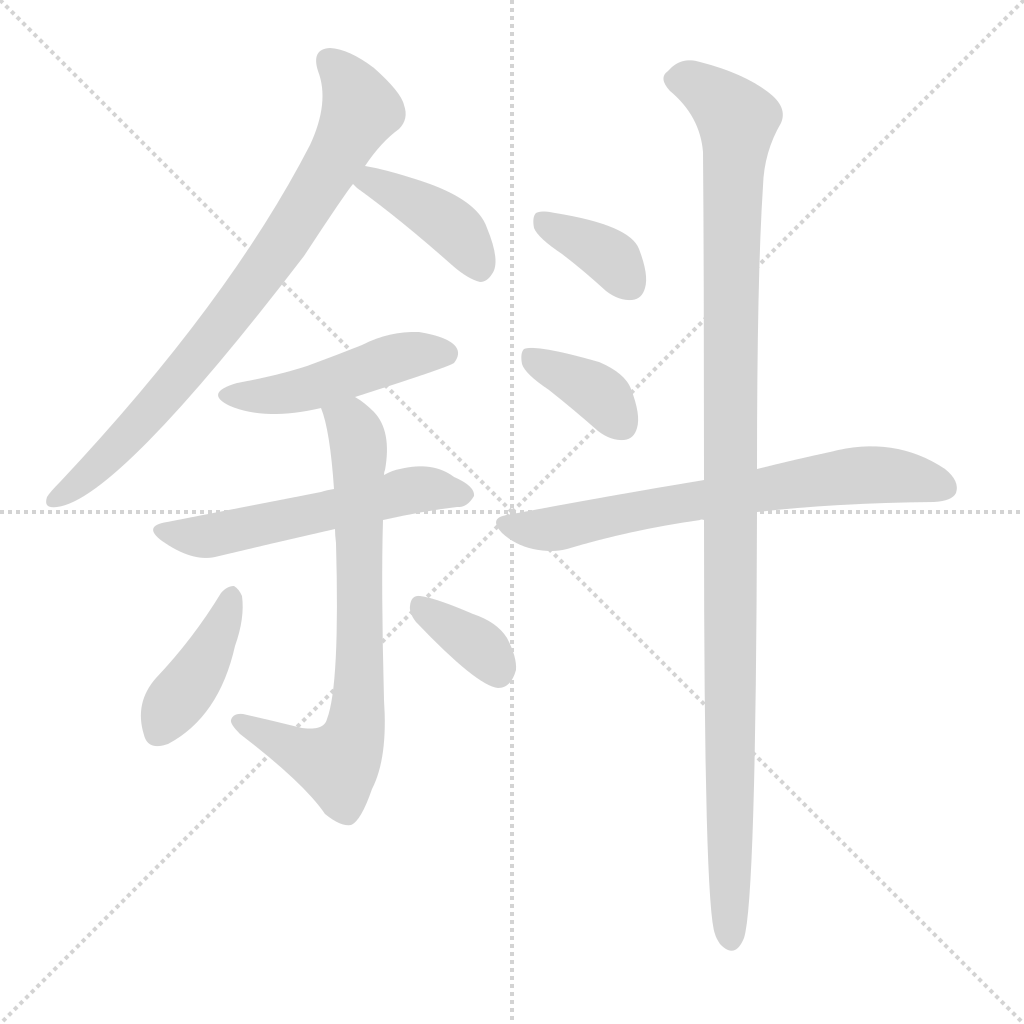
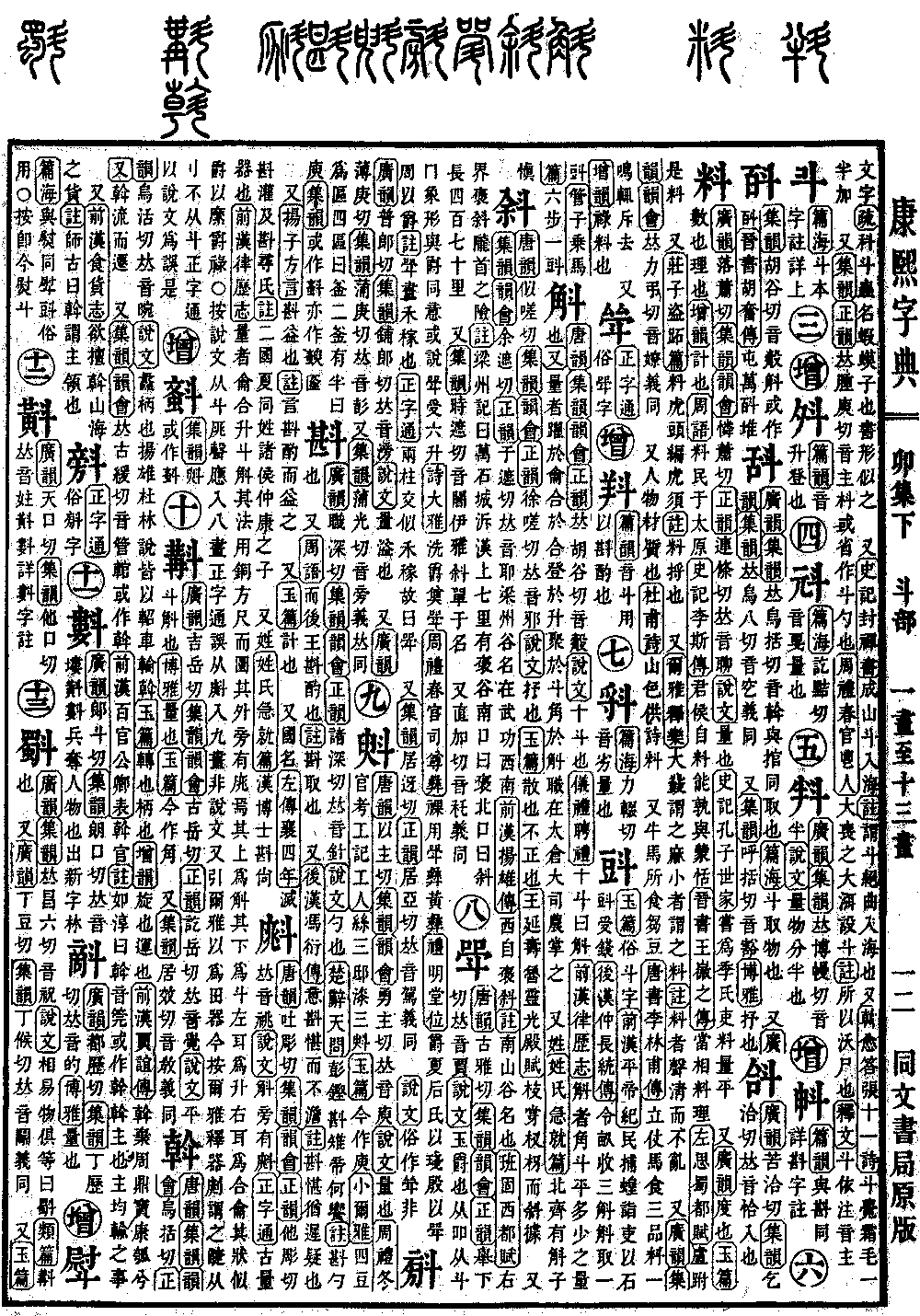
Pronounced xie. According to the Tang Rhyme (Tangyun), Collected Rhymes (Jiyun), Rhyme Compilation (Yunhui), and Orthodox Rhymes (Zhengyun), it is pronounced xie, with a sound identical to xie. As defined in the Explaining Graphs and Analyzing Characters (Shuowen), it refers to ladling out or pouring out. According to the Jade Chapters (Yupian), it signifies being scattered or not upright. From the Rhapsody on the Lingguang Hall of Lu (Lu Lingguang Dian Fu) by Wang Yanshou: The branches diverge and extend at an angle.
Also pronounced ye, according to the Collected Rhymes (Jiyun) and Rhyme Compilation (Yunhui), with a sound identical to ye. It is the name of a mountain valley in Liangzhou, located southwest of Wugong. From the Biography of Yang Xiong in the History of the Former Han (Qianhan Shu): Beginning in the west at Baoxie. The commentary states: It is a valley name in the Nanshan Mountains. From the Rhapsody on the Western Capital (Xi Du Fu) by Ban Gu: On the right it joins Baoxie, and the Long Mountains are the first of the dangerous passes. The commentary states: The Record of Liangzhou (Liangzhou Ji) records that following the Han River upstream from Wanshi City, after seven li one reaches the Bao Valley. The southern mouth is called Bao, and the northern mouth is called Xie. The total length is four hundred and seventy li.
Also pronounced she, according to the Collected Rhymes (Jiyun). Yiyashe is the name of a Chanyu.
Also pronounced zha, with the same meaning.