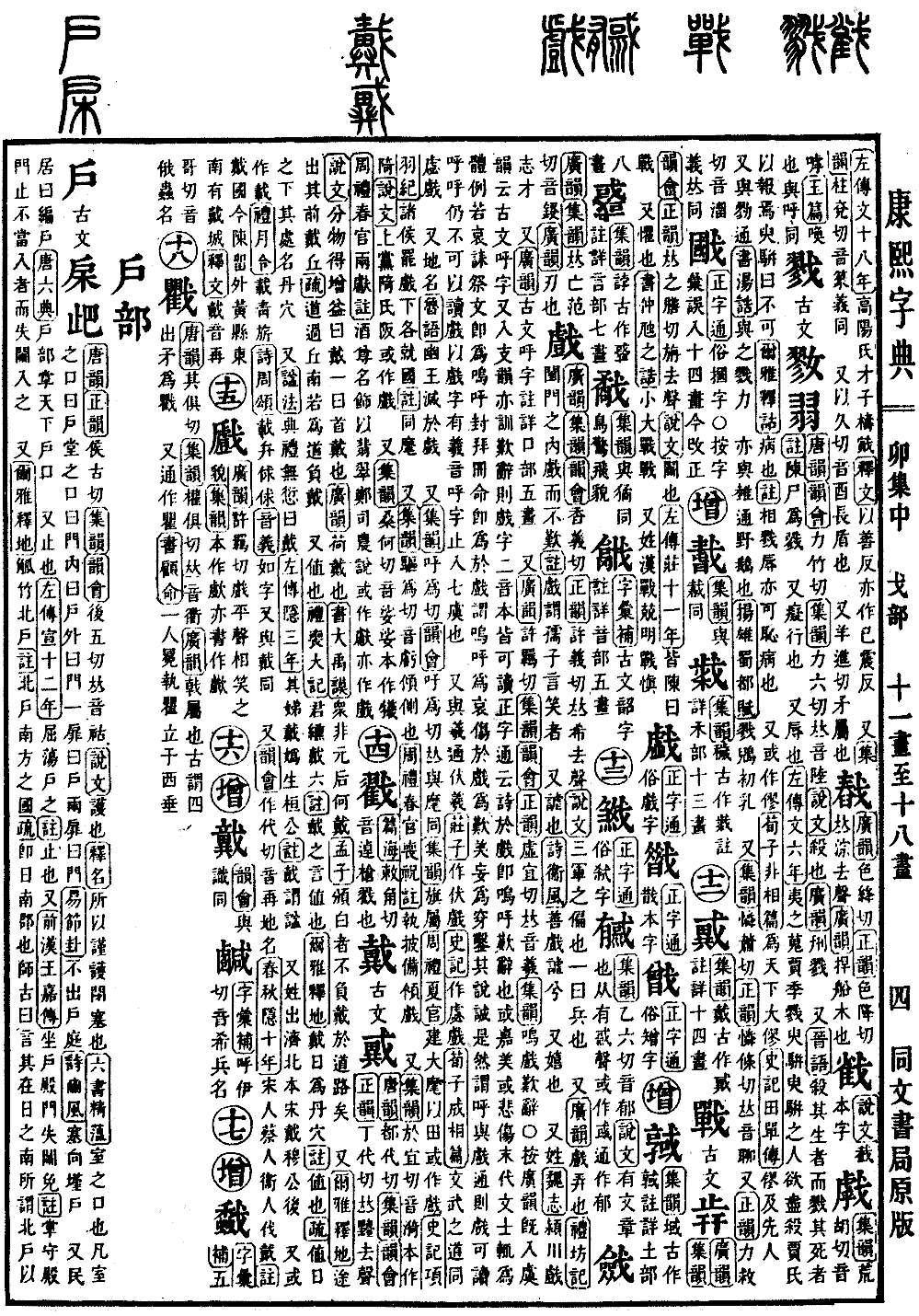
Mao Collection, Middle Volume
Radical: Dagger-axe (gē)
Kangxi stroke count: 17
Page 414, Entry 01
Pronounced xi (falling tone).
According to the Explaining Graphs and Analyzing Characters (Shuowen Jiezi), it refers to a flanking force within the three armies. Another interpretation suggests it refers to weaponry.
Also, according to the Broad Rhymes (Guangyun), it refers to teasing or playing.
Book of Rites (Liji), Record of Fangji (Fangji): Within the inner quarters, one may play but not sigh. Annotation: Play refers to children laughing and talking.
Also refers to joking or banter.
Book of Odes (Shijing), Odes of Wei (Weifeng): Good at joking and banter.
Also refers to recreation.
Also a surname.
Records of Wei (Weizhi): Xi Zhicai from Yingchuan.
Also, according to the Broad Rhymes (Guangyun), it is the ancient character for call (hū). Detailed explanation provided under the Mouth radical, five strokes.
Also, pronounced xi (level tone).
According to the Collected Rhymes (Jiyun), wu xi is an exclamation. Note: The Broad Rhymes (Guangyun) classifies this character under the yu rhyme, identifying it as the ancient character for call; however, it also classifies it under the zhi rhyme, defining it as an exclamation. Thus, the character has two pronunciations, both of which are valid. The Correcting Character Essentials (Zhengzitong) states that the expression yu xi in the Book of Odes (Shijing) is the same as wu hu, an exclamation used to express either praise or sorrow. Later scholars treated this as a fixed convention, using wu hu for funeral orations and yu xi for formal imperial appointment documents. The belief that wu hu denotes sorrow while yu xi denotes praise is a forced, erroneous interpretation; this criticism is correct. However, to say that call and this character are interchangeable means this character can be pronounced as call, but call cannot be pronounced as this character, because this character has the pronunciation xi, while call is restricted to the yu rhyme.
Also interchangeable with xi. Fuxi.
Zhuangzi: Written as Fuxi.
Records of the Grand Historian (Shiji): Written as Fuxi.
Xunzi, Chengxiang Chapter: The way of Wen and Wu is the same as that of Fuxi.
Also a place name.
Discourses of Lu (Luyu): King You perished at Yuxi.
Also, pronounced hui. Equivalent to the character for command standard (huī).
According to the Collected Rhymes (Jiyun), it refers to a type of banner.
Rites of Zhou (Zhouli), Summer Offices: Set up the great command standard for hunting. Some versions write this as the character in question.
Records of the Grand Historian (Shiji), Annals of Xiang Yu: The feudal lords disbanded from the command tent and returned to their states. Annotation: Equivalent to command standard (huī).
Also, pronounced kui. Refers to leaning or tilting.
Rites of Zhou (Zhouli), Spring Offices, Funeral Invoker Annotation: Hold the carriage curtain to prepare for tilting.
Also, pronounced yi. Originally the character (yī).
According to the Explaining Graphs and Analyzing Characters (Shuowen Jiezi), the Yishi slope in Shangdang. Some versions write this as the character in question.
Also, pronounced suo. Originally the character for sacrificial animal (xī).
Rites of Zhou (Zhouli), Spring Offices, Two Offerings Annotation: A name for a wine vessel decorated with kingfisher feathers. According to the scholar Zheng Sinong, some versions write this as sacrifice (xiàn), while others write it as the character in question.