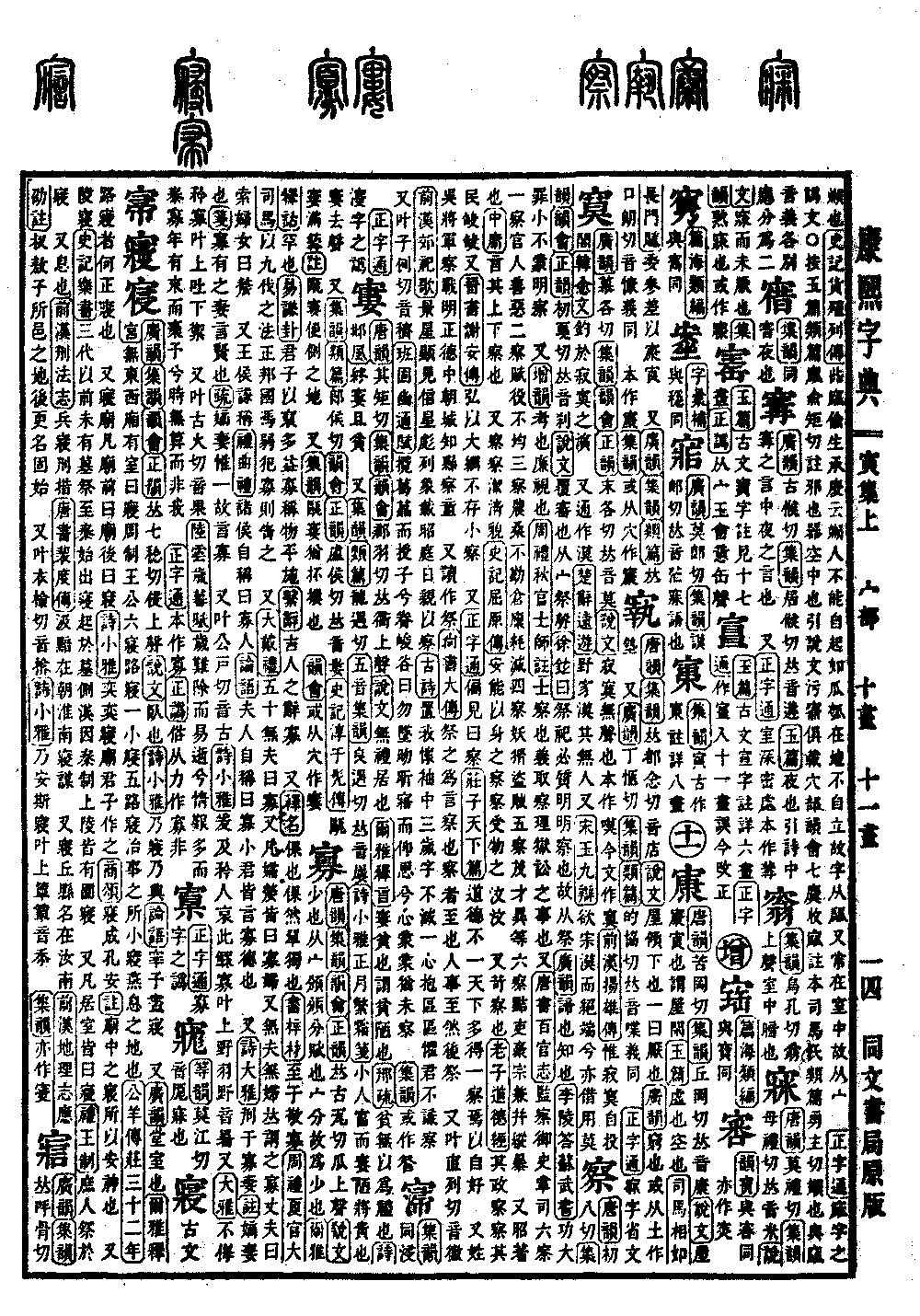
Yin Collection, Upper Volume
Radical: Roof (bù)
Character: 寢
Kangxi Dictionary Strokes: 14
Page 290, Entry 12
Ancient form: 寑
Pronounced qǐn (rising tone)
According to the Shuowen Jiezi, it means to lie down. In the Book of Odes (Shijing), it says, "He lies down and he rises." In the Analects (Lunyu), it states, "Zai Yu sleeps during the day."
Also, according to the Guangyun, it refers to a hall or chamber. According to the Erya, a building without east and west side rooms is called a qin. Under the Zhou system, kings and dukes had six qin: one great hall and five small chambers. The great hall was where state affairs were administered, and the small chambers were where they rested. In the Gongyang Zhuan, it asks, "What is the great hall? It is the main hall."
Also, it refers to a qin temple. Generally, concerning temples, the front is called a temple and the rear is called a qin. In the Book of Odes (Shijing), it says, "Majestic is the temple." In the Shang Song, it says, "The temple was completed in great peace." The commentary states that the qin within a temple is the place where the spirit is settled.
Also, it refers to an imperial mausoleum. According to the Records of the Grand Historian (Shiji), prior to the Three Dynasties, there were no sacrifices at graves. By the Qin Dynasty, the qin emerged, constructed beside the grave. The Han Dynasty followed the Qin system, and all imperial tombs had garden qin.
Also, any living quarters are called qin. According to the Book of Rites (Liji), commoners perform sacrifices in the qin.
Also, to cease. According to the Book of Han (Hanshu), military affairs ceased. According to the Book of Tang (Tangshu), when Ji An was at court, the Prince of Huainan ceased his schemes.
Also, Qinqiu, the name of a county in Runan. According to the commentary by Ying Shao in the Geography Records of the Book of Han (Hanshu), it was the fief of the son of Sunshu Ao; it was later renamed Gushi.
Also, read as yan (falling tone). In the Book of Odes (Shijing), it says, "Then he finds this rest." It rhymes with dian. Dian is pronounced tian (rising tone).
Also written in a variant form.