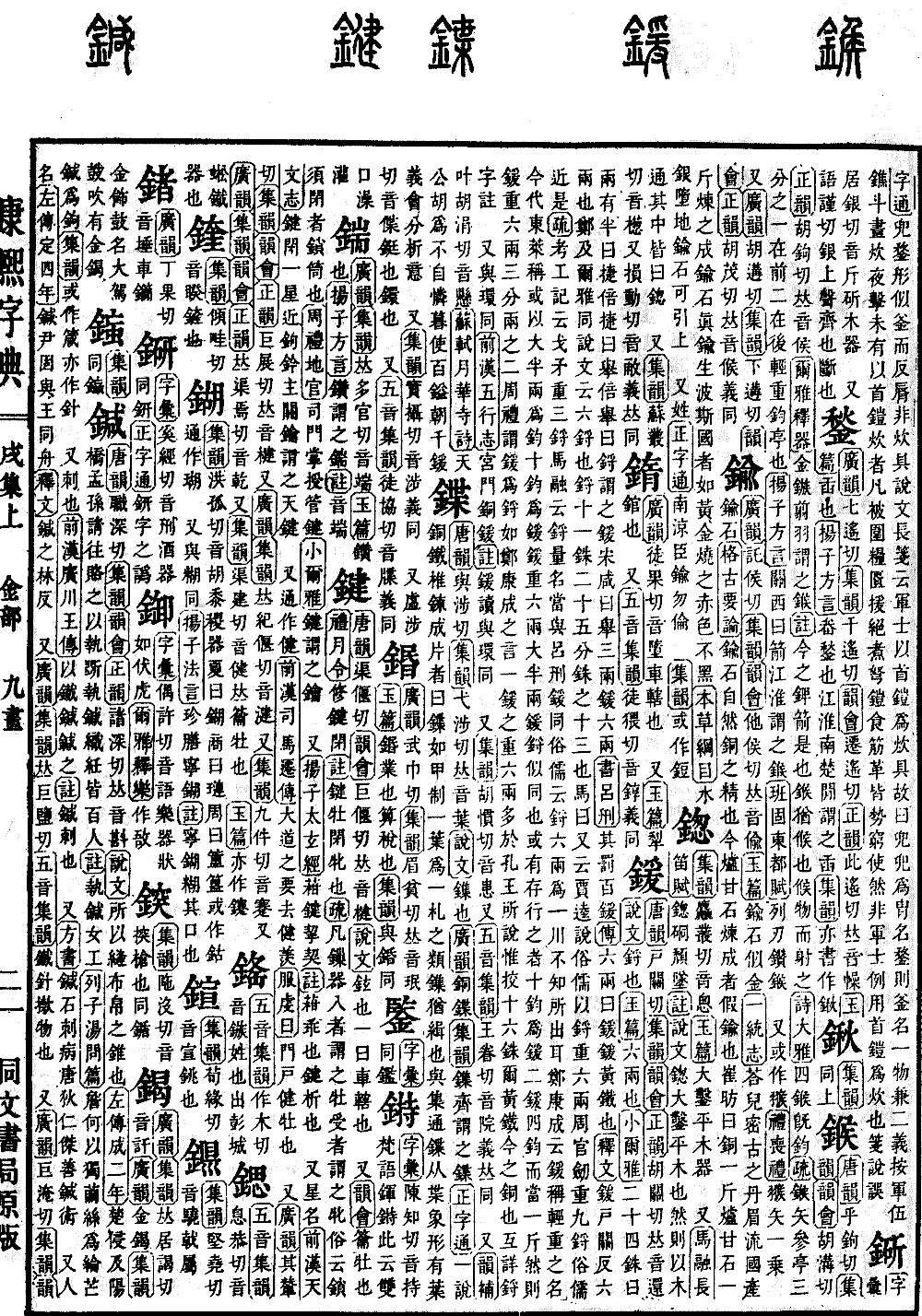
Xu Collection, Upper Volume
Radical: Metal (jīn)
Huan
Kangxi strokes: 17
Page 1315, Entry 18
Tangyun (Tang Dictionary): Pronounced huan. Jiyun (Collected Rhymes), Yunhui (Collection of Rhymes), Zhengyun (Correct Rhymes): Pronounced huan.
Shuowen Jiezi (Explanation of Writing and Analysis of Characters): A unit of weight.
Yupian (Jade Chapters): Six liang (taels).
Xiao Erya (Small Literary Expositor): Twenty-four zhu make one liang; a half is called jie; double jie is called ju; double ju is called lüe; this is called huan. Song Xian states: ju is three liang, huan is six liang.
Book of Documents (Shujing), Lu Punishments: The penalty is one hundred huan.
Commentary: Six liang is called huan. Huan is yellow metal.
Expository Notes: Huan is pronounced huan. Six liang. Zheng Xuan agrees with the Erya. The Shuowen Jiezi says it is six lüe. A lüe is eleven zhu and twenty-five thirteen-twenty-fifths of a zhu. Ma Rong agrees. Furthermore, Jia Kui says that common scholars consider a lüe to weigh six liang. The Rites of Zhou (Zhouguan) states that a sword weighs nine lüe. The view of the common scholars is close to the truth.
Sub-commentary: The Record of Trades (Kaogongji) states that a dagger-axe and a spear weigh three lüe. Ma Rong says: lüe is a unit of measurement. It should be the same as the huan in the Lu Punishments. Common scholars say: six lüe make one chuan. The source of this is unknown. Zheng Kangcheng says: huan is a name for a weight. In the customs of Donglai, some use two-thirds of a liang as a jun, and ten jun as a huan. A huan weighs six and two-thirds liang. Huan and lüe seem to be the same. Or, as some still use, ten jun make a huan, and two huan and four jun equal one jin (catty). Then a huan weighs six and two-thirds liang. The Rites of Zhou (Zhouli) calls huan a lüe; according to Zheng Kangcheng, one huan weighs six liang, which is more than what Kong Anguo and Wang Su said, differing only by sixteen zhu. Yellow metal refers to what is now called copper. See the note under the character lüe for details.
Also pronounced the same as huan (ring).
History of the Former Han (Qianhan Shu), Treatise on the Five Phases: Bronze huan on the palace gate.
Note: Huan is pronounced the same as huan (ring).
Also Jiyun: Pronounced huan (falling tone).
Also Wuyin Jiyun (Five Tones Collection of Rhymes): Pronounced yuan (falling tone). The meaning is the same.
Also Yunbu (Supplement to Rhymes): Rhymes with xuan.
Su Shi, Moon Splendor Temple Poem: Why does the Heavenly Lord not pity himself, sending one hundred yi and a thousand huan to court in the evening.
Textual Research:
Book of Documents, Lu Punishments: The penalty is one hundred huan. Expository Notes: Huan is pronounced huan. Six liang. Zheng and Erya agree. Shuowen Jiezi says six lüe. A lüe is eleven zhu and twenty-five thirteen-twenty-fifths of a zhu. Ma Rong says: Note: Corrected based on the original text.