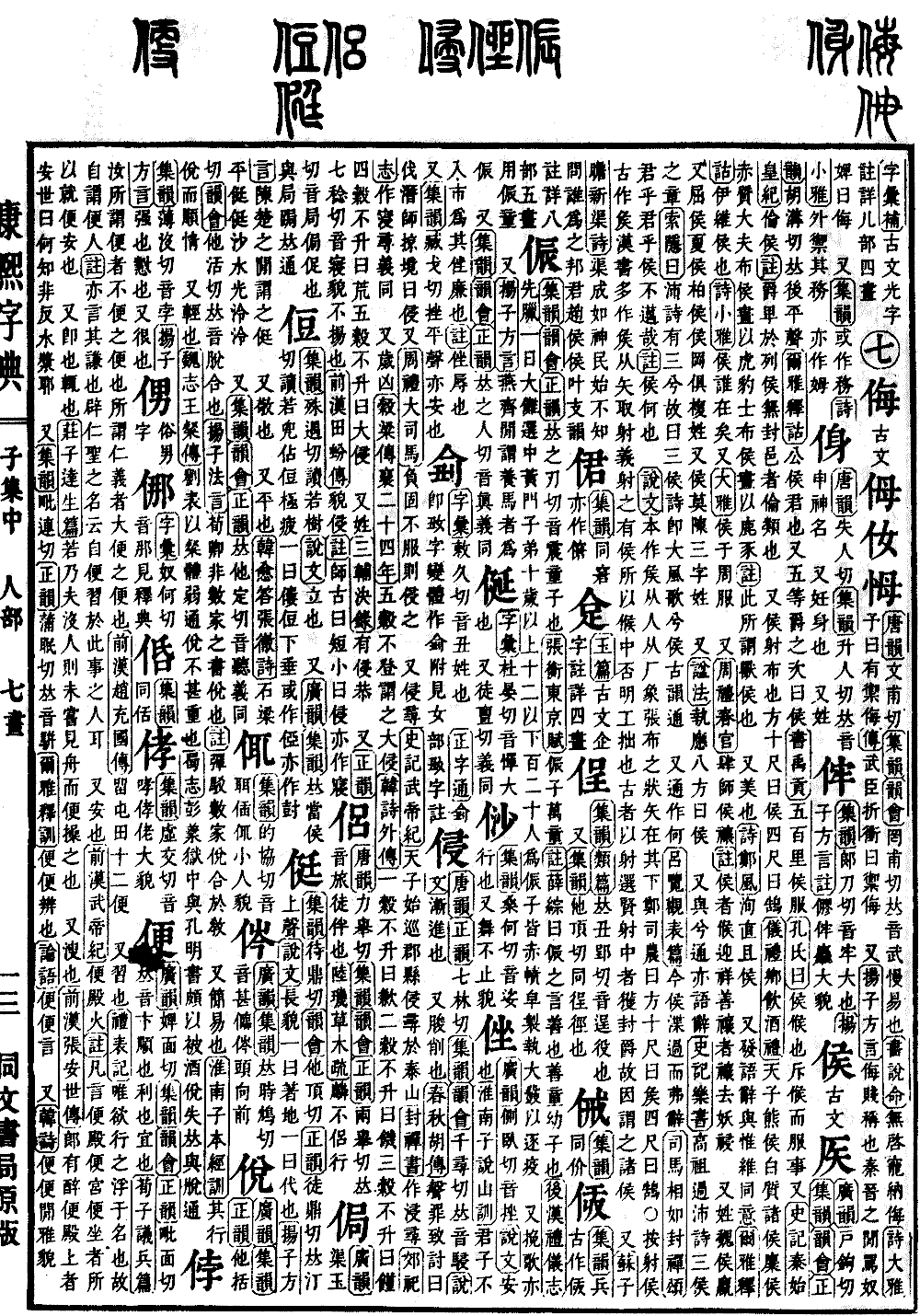
Zi Collection, Middle Volume
Radical: Person (rén)
Invasion; Kangxi stroke count: 9; Page 103, Entry 19
Pronounced qin.
In the Shuowen Jiezi (Explanation of Graphs and Analysis of Characters), it is defined as advancing gradually. It also carries the meanings of weakening and eroding.
The Commentary of Hu on the Spring and Autumn Annals (Chunqiu Hu Zhuan) notes that a public denunciation of crimes followed by a military strike is called fa, while secretly sending troops to plunder the border is called qin.
The Rites of Zhou (Zhouli), Section on the Great Marshal (Da Sima), records that for those who rely on dangerous, fortified terrain and refuse to submit, one employs the method of qin.
There is also the term qinxun.
The Records of the Grand Historian (Shiji), Annals of Emperor Wu (Wudi Ji), records that the Son of Heaven began to tour the commanderies and counties, gradually arriving at the region of Mount Tai.
In the Treatise on the Suburban Sacrifices (Fengshan Shu), it is written as qinxun using a variant form.
In the Treatise on Suburban and Ancestral Sacrifices (Jiaosi Zhi), it is written as qinxun using another variant form. The meaning is the same.
It also refers to a poor harvest.
The Commentary of Guliang on the Spring and Autumn Annals (Guliang Zhuan), twenty-fourth year of Duke Xiang, records that when the five grains do not ripen, it is called daqin.
The Han Shi Waizhuan (Outer Commentary on the Han School of the Classic of Poetry) states that when one type of grain does not ripen it is called qian, when two do not ripen it is called ji, when three do not ripen it is called jin, when four do not ripen it is called huang, and when five do not ripen it is called daqin.
It is also a surname.
The Sanfu Juelu (Record of Decided Cases in the Three Capital Districts) records a person named Qin Gong.
Also, according to the Zheng Yun (Correction of Rhymes), it is pronounced qin (rising tone). It refers to an unattractive appearance.
The Book of the Former Han (Qian Hanshu), Biography of Tian Fen, mentions an unattractive appearance. The commentary by Shigu states: Short and small is called qin. It is also written as qin (using a variant form).