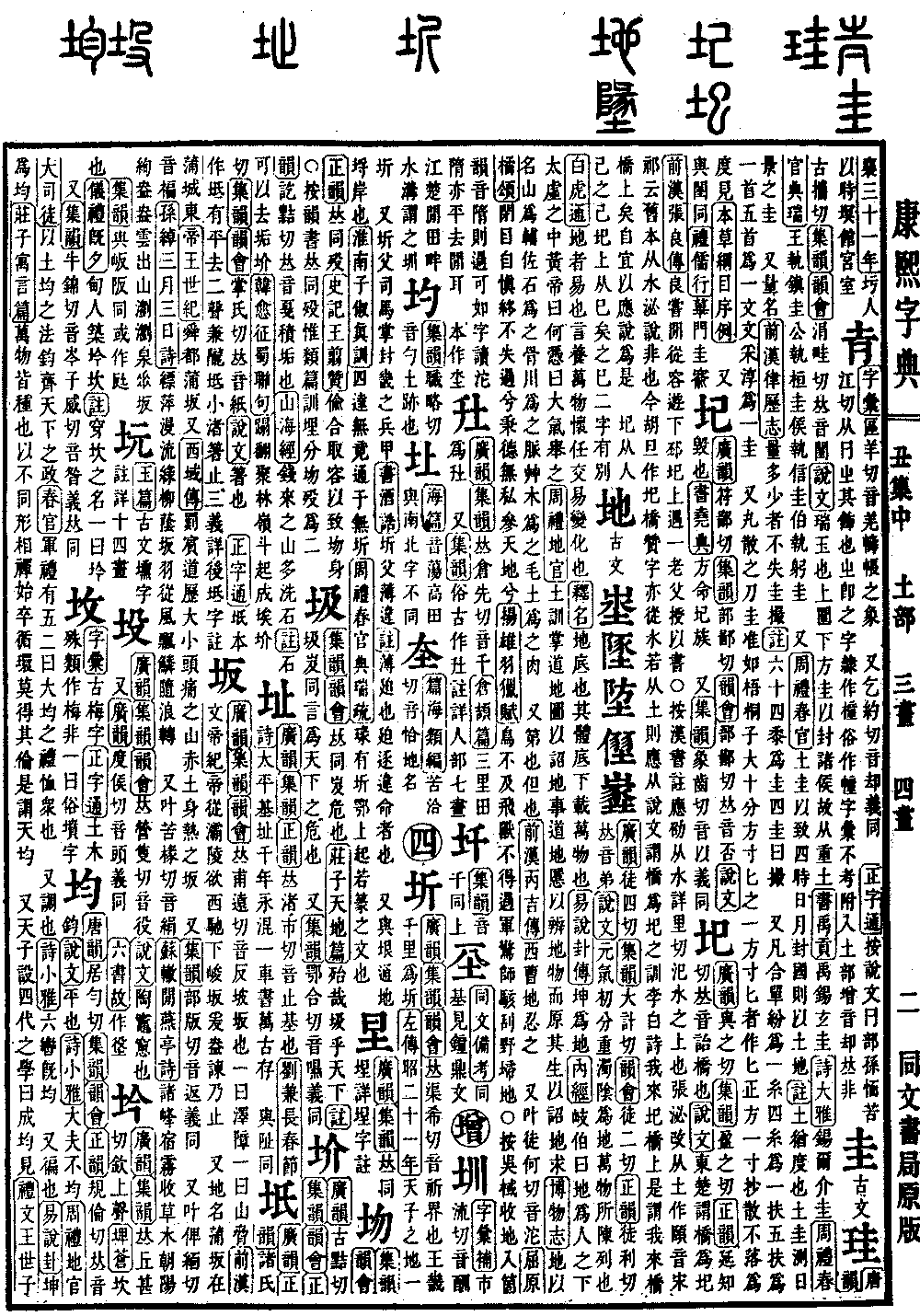
Xu Collection, Middle Volume, Radical: Mound (fù)
Page 224, Entry 01
Pronounced fǎn (falling tone) — "Records of Rhymes" (Tang Yun), "Collected Rhymes" (Jiyun), "Rhyme Compendium" (Yunhui)
A slope is called a slope (bǎn). Another meaning is a dike in a marsh. Another meaning is the flank of a mountain. — "Explaining the Characters" (Shuowen)
Steepness. — "Jade Letters" (Yupian)
A large, uneven dike. — "Broad Rhymes" (Guangyun)
Look at the sloped fields on the plain. — "Book of Odes" (Shijing), "Minor Odes" (Xiaoya)
Sloped fields are places that are rugged and stony. — Commentary
Carefully observe hills, slopes, dangerous places, plains, and marshes. — "Book of Rites" (Li), "Monthly Ordinances" (Yueling)
Slopes stretch far. — "Warring States" (Zhanguo Ce)
Slope, meaning a slope. — Commentary
To the right are the Long and Shu regions, to the left are the passes and slopes. — "Records of the Grand Historian" (Shiji), "Biography of Fan Sui" (Fan Sui Zhuan)
According to "Zheng Feng," "At the East Gate, where the plants grow on the slope, though her home is near, the person is very far away." The characters "bǎn" and "yuǎn" are both in the Ruan rhyme category in "Broad Rhymes." Zhu's commentary states that "bǎn" rhymes with "fú" and "luán" (falling tone). "Zihui" and "Zhengtong" follow this, stating that it is also pronounced "xiǎn" (falling tone).
Also a place name.
The three tribes of Yi, Wei, Lu, and Zheng, and the three Bo and Ban officials. — "Book of Documents" (Shu), "Establishing Politics" (Lizheng)
Lord Shan followed the Ban road, and Lord Liu followed the Yin road to attack Yin. — "Zuo Zhuan" (Zuo Zhuan), 23rd Year of Duke Zhao
Commentary on the "Book of Documents" and "Zuo Zhuan" interprets "bǎn" as the official in charge of the place Ban, but "Zuo Zhuan" states that Ban Road and Yin Road are two place names, and should be followed according to "Zuo Shi."
Also, the commentary on "Book of Odes" and "Book of Rites" treats the character "bǎn" as having both the pronunciations "fǎn" and "bàn," while only the "Ban Yin" in the "Book of Documents" is exclusively pronounced "fǎn."
Also, the same as "bǎn" (falling tone). — "Broad Rhymes" (Guangyun)
Also the same as "pán." See commentary on "bǎn" and "bǎn." — "Collected Rhymes" (Jiyun)
Also the same as "fǎn."
The first sage. — "Xunzi" (Xunzi), "Cheng Xiang Pian" (Cheng Xiang Pian)
This means the same as "fǎn." It refers to what the first sage did. — Commentary
Also pronounced bǎn (entering tone) — "Jade Letters" (Yupian), "Collected Rhymes" (Jiyun)
A dike. — "Collected Rhymes" (Jiyun)
Also pronounced bǎn (falling tone) — "Collected Rhymes" (Jiyun)
Ban Quan, a place name.
Encountered the Yellow Emperor battling at the site of Ban Quan. — "Zuo Zhuan" (Zuo Zhuan), 25th Year of Duke Xi
Also rhymes with the ping tone.
From the army, they crossed the Long slopes, and urged their horses over the passes and mountains. — "Wang Bao" (Wang Bao), "Passes and Mountains" (Guanshan Pian)
Verification: The original text reads "San Hao Ban Yin" in "Establishing Politics" (Lizheng) of the "Book of Documents" (Shu). The character "Hao" has been corrected to "Bo" according to the original text.