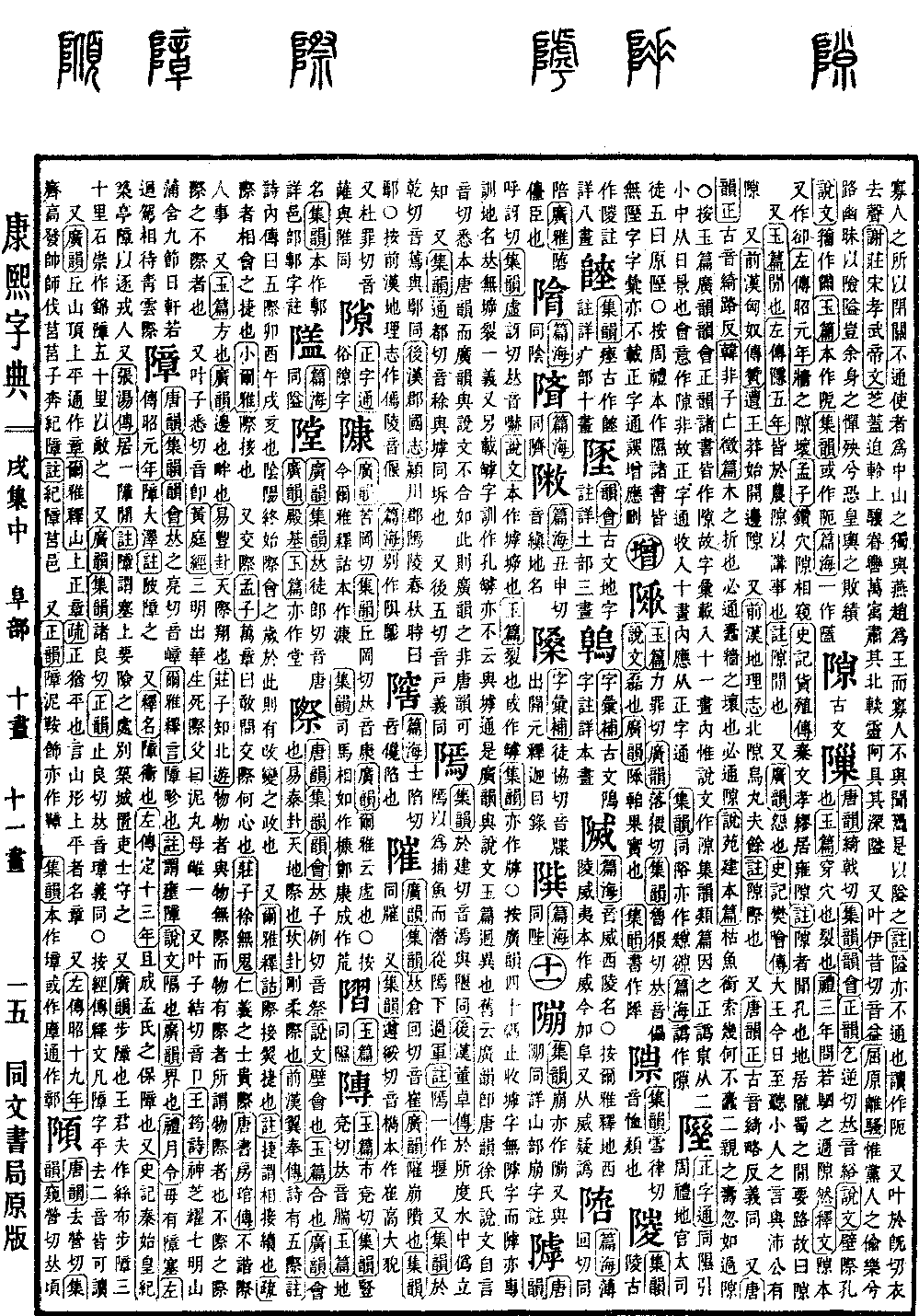
Xu Collection, Middle Volume
Radical: Mound (fù)
Kangxi strokes: 18
Page number: 1359, entry 22
The ancient form is written "jì".
The Tang Rhyme (Tángyùn) provides the fanqie pronunciation "qǐjǐ qiē". The Collected Rhymes (Jíyùn), Rhyme Compendium (Yùnhuì), and Correct Rhymes (Zhèngyùn) provide the fanqie pronunciation "qǐnì qiē", read similarly to "gé".
The Shuowen Jiezi (Shuōwén Jiězì) defines it as a hole in a wall.
The Yupian (Yùpiān) defines it as a perforation, a crack.
The Book of Rites (Lǐjì), "Questions on Three Years Mourning," records: "As swift as four horses driving past a crevice."
The Shiwen (Shìwén) records that the character "xì" is also written as "què".
The Zuo Zhuan (Zuǒzhuàn), "Duke Zhao, First Year," records: "Walls damaged by cracks."
Mencius (Mèngzǐ) records: "Drilling holes and peeking at each other through crevices."
The Records of the Grand Historian (Shǐjì), "Treatise on Money-Makers," records: "Dukes Wen, Xiao, and Mu of Qin resided in the strategic passage of Yong."
The commentary explains: "'Xì' refers to an opening or passageway. Yong was a crucial communication route between Long and Shu, hence it was called 'xì'."
Also, the Yupian defines it as leisure.
The Zuo Zhuan, "Duke Yin, Fifth Year," records: "All conducted military training during agricultural lulls."
The commentary explains: "'Xì' refers to free time."
Also, the Guangyun (Guǎngyùn) defines it as resentment.
The Records of the Grand Historian, "Biography of Fan Kuai," records: "Your Majesty, having arrived today and listened to the words of petty men, has created animosity with Duke Pei."
Also, the Book of Han (Hànshū), "Eulogy on the Xiongnu," records: "Encountered Wang Mang, who began to stir up border disputes."
Also, the Book of Han, "Treatise on Geography," records: "The northern border adjoined Wuhuan and Fuyu."
The commentary explains: "'Xì' refers to a border or boundary."
Also, the Tang Rhyme Corrected (Tángyùn Zhèng) records the ancient pronunciation as "qǐlüè fǎn", with the same meaning.
Also, the Tang Rhyme Corrected records the ancient pronunciation as "qǐlù fǎn".
The Han Feizi (Hánfēizǐ), "On the Signs of Ruin," records: "A tree breaks, it must be due to worm-eaten erosion. A wall collapses, it must be due to cracks."
The Garden of Stories (Shuōyuàn), "On Establishing the Foundation," records: "How long will dried fish strung on a rope remain un-worm-eaten? The lifespan of parents is as fleeting as a flash through a crevice."
Commentary: The Yupian, Guangyun, Rhyme Compendium, and Correct Rhymes all write the character as "lì" (formed by two 'small' components and 'sun' in the middle), thus the Zihui (Zìhuì) included it under 11 strokes. Only the Shuowen Jiezi writes it as "xì", a form followed by the Collected Rhymes and Leipian (Lèipiān). The Zhenge (Zhèngé) points out that the character form from two "small" (xiǎo) components with "sun" (rì) in the middle, signifying light and shadow, is a compound ideograph. Writing it as "lì" (formed by two 'small' components and 'sun' in the middle) is incorrect. Therefore, the Zhengzitong (Zhèngzìtōng) includes it under 10 strokes. The Zhengzitong should be followed.
The Collected Rhymes records it as identical to "lì" (formed by two 'small' components and 'sun' in the middle). Also written as a variant form pronounced "xì" (with the 'mound' radical and 'sun' component).
The Pianhai (Piānhǎi) mistakenly writes it as "lì" (formed by two 'small' components and 'sun' in the middle).