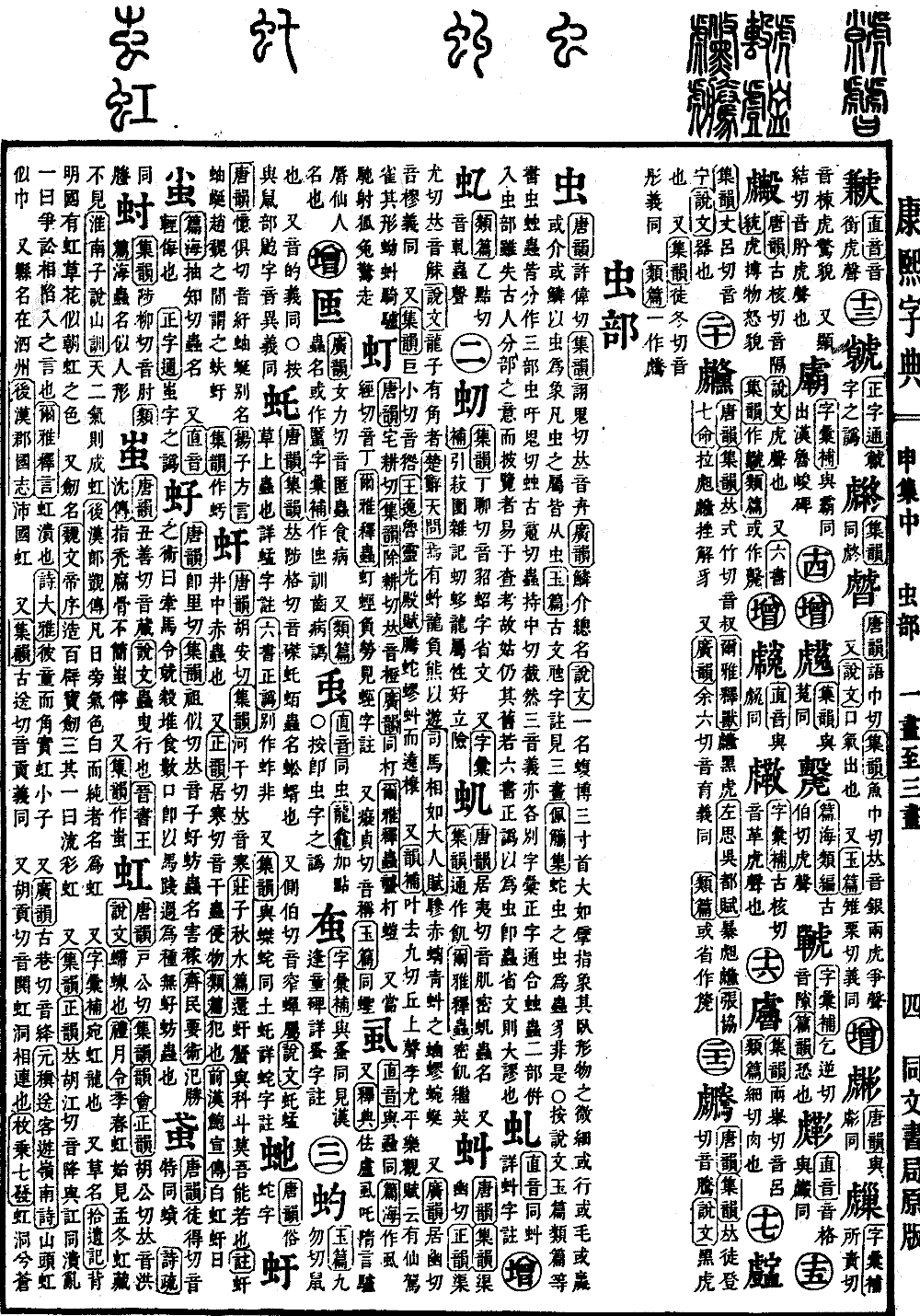
Shen Collection, Middle Volume. Radical: Insect (chóng). Kangxi stroke count: 18. Page 1076, Entry 19.
Pronounced hui.
A general term for scaly or armored creatures.
Defined as a viper with a body three inches wide and a head the size of a thumb; the character form mimics its crouching posture. It represents all small living creatures, including those that walk, grow hair, lack shells, possess shells, or have scales. All characters related to this concept are categorized under this radical.
This is an ancient form of the character hui (viper). For a detailed explanation, see the three-stroke section.
States that the character for snake-like insects is distinct from the character for insects and worms and should not be conflated.
Note: Works such as Explaining Graphs and Analyzing Characters (Shuowen Jiezi), the Jade Chapters (Yupian), and the Classification of Characters (Leipian) categorize these two characters under different radicals. The first is pronounced hui and is an ancient form of viper, while the second is pronounced chong. They differ in both pronunciation and meaning. While the Compendium of Characters (Zihui) and the Correcting Standard Characters (Zhengzitong) merge both under the same radical, this practice, while convenient, contradicts the original intent of ancient scholars. The assertion in the Rectification of the Six Writings (Liushu Zheng’e) that the first is merely a simplified version of the second is incorrect.
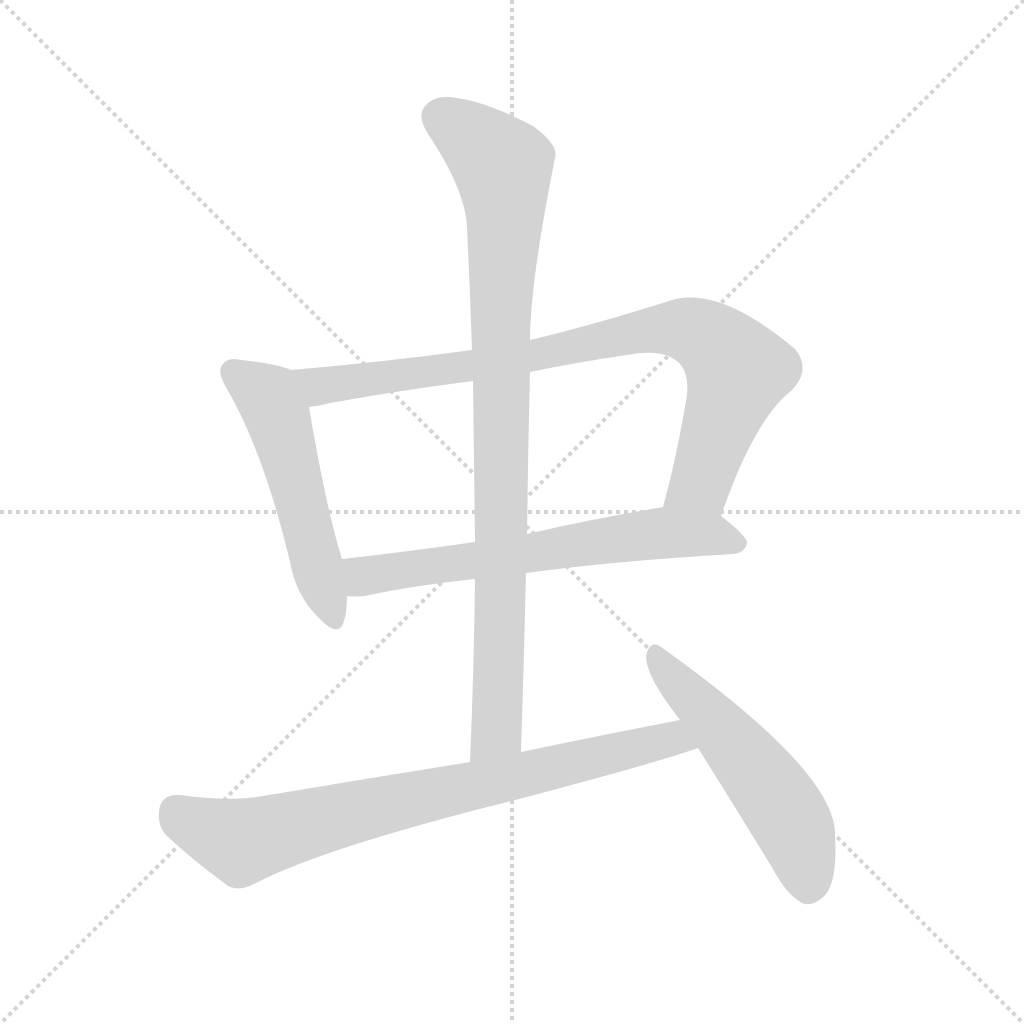
Chong
Pronounced chong.
The character is composed of three insect radicals and is a pictograph. All characters related to this are categorized under this radical.
Records: There are three hundred and sixty types of winged insects, led by the phoenix. There are three hundred and sixty types of hairy insects, led by the qilin. There are three hundred and sixty types of armored insects, led by the divine tortoise. There are three hundred and sixty types of scaly insects, led by the dragon. There are three hundred and sixty types of naked insects, led by the sage.
Insects with legs are called chong, while those without legs are called zhi (reptile).
Records: Creatures with external bones or internal bones, those that walk backward, sideways, in linked patterns, or in circuitous ways, those that emit sound with their necks, mouths, sides, wings, legs, or chests are all categorized as minor insects and serve as subjects for carving decorations.
States: Two multiplied by nine equals eighteen; eight corresponds to wind, and wind governs insects. Thus, insects undergo changes in the eighth month.
States: When meat rots, insects are born.
Also, in the Book of Odes (Shijing): There is a phrase describing heat.
The commentary explains: This describes the appearance of steaming heat.
Also, there is a bird called the peach insect.
In the Book of Odes (Shijing): It says, Truly that peach insect.
The commentary explains: The peach insect is the wren, a bird that grows from a small size to a larger one.
Also, in the Book of Documents (Shangshu): It says, The multicolored pheasant is used in painting.
The commentary explains: The multicolored pheasant is a type of wild fowl.
Also, it is a place name.
In the Zuo Commentary (Zuozhuan): It records that the Duke of Song attacked the state of Zhu and besieged the city of Chong for three months.
The commentary explains: Chong is a city in the state of Zhu.
Also, it is a book title.
In the Records of the Three Kingdoms (Weizhi): It is recorded that Handan Chun was skilled in writing the Cangjie Treatise, the Literary Expositor (Erya), and seal scripts.
Also, it is a surname.
In the History of the Former Han (Qian Hanshu): There is a Marquis of Qucheng named Chong Da.
Also pronounced zhong. It is identical to the character for insect-eaten decay.
Also pronounced tong.
In the Literary Expositor (Erya): Describes the steaming of hot air. Sometimes written as the variant chong.
In the Sound Distinctions of the Classics (Qunjing Yinbian): The character used in the context of steaming heat is also pronounced tong.
The Rhyme Compendium (Yunhui) states: Writing it as the simpler character is incorrect.
Chong textual verification:
In the Great Learning of the Elder Dai (Da Dai Liji): The text says eight governs insects, so insects change in the eighth month. This is corrected to eight governs wind, and wind governs insects.
In the Literary Expositor (Erya): The text says describing steaming heat. This is corrected to describing the scent of steaming heat.